





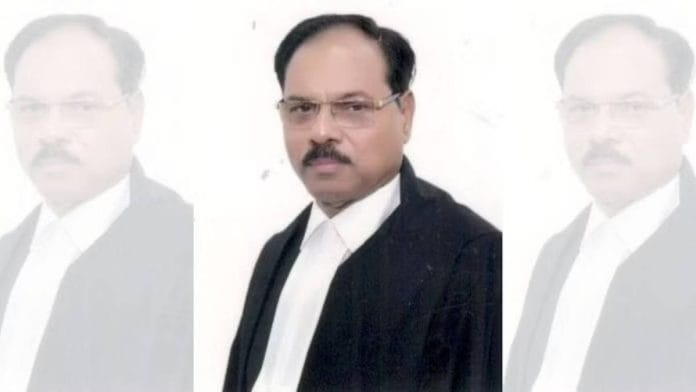



New Delhi: Justice Shekhar Kumar Yadav of the Allahabad High Court, who has a pending parliamentary impeachment motion against him for controversial remarks against the Muslim community, retires Wednesday with a full-court reference.
The row dates back to December 2024 when Justice Yadav used derogatory words like “kathmulla” in an apparent reference to Muslims at a Vishwa Hindu Parishad event.
The fact that the judge’s retirement has come before Parliament could even get to the matter of impeachment, legal experts say, lays bare a structural vacuum in the country’s judicial accountability framework.
There is an absence of timelines for Parliament to pass impeachment motions. India’s judicial removal process has no deadline—and often, no closure.
The delay
At the VHP event, speaking on the topic of “Uniform Civil Code: A Constitutional Imperative”, Justice Yadav had remarked that law works as per the majority community.
“We suffer when we see others suffering…but you [Muslims] don’t. We teach tolerance and kindness to our children since birth. When we have a child, we push them towards God since childhood, read Ved-mantras, teach them about non-violence, but your children are shown the slaughter of animals since childhood,” he had further said.
These remarks made by a sitting judge had drawn the ire of many, leading to an impeachment motion being moved in the Rajya Sabha. The motion was signed by the required 50 members in December that year, but was not admitted for consideration.
Justice Yadav was summoned by the Supreme Court Collegium, comprising the top five judges.
A month later, in a letter to the Chief Justice of the Allahabad High Court, he had written that he stood by his words at the event, and that his speech was “consistent with constitutional values”.
Uttar Pradesh Chief Minister Yogi Adityanath had also backed Justice Yadav, saying, “When a judge speaks the truth, some individuals try to threaten him.”
When the Supreme Court Collegium considered initiating an in-house inquiry into the judge’s conduct, the Rajya Sabha Secretariat had said that the matter fell within Parliament’s jurisdiction.
The process was also held up because of a delay in verifying the signatures of MPs who had signed the motion. In July 2025, then Upper House Chairman Jagdeep Dhankhar had noted that the inquiry was complicated by a potentially forged or disputed signature, which required further investigation.
In June 2025, Rajya Sabha MP and Supreme Court senior advocate Kapil Sibal had raised concerns over the signature verifications taking six months, and “whether this government is trying to protect Shekhar Yadav”.
In the meantime, organisations like the Campaign for Judicial Accountability and Reforms (CJAR) and the People’s Union for Civil Liberties (PUCL) formally requested the Chief Justice of India to withdraw all judicial work from him, citing a breach of constitutional morality.
However, no such step was taken, and Justice Yadav’s roster was changed to a civil one.
Also Read: ‘History will record unfairness’—what Justice Yashwant Varma wrote in letter to judges inquiry panel
What the law says
Under the law, judges found guilty of misconduct can be removed in two ways. One is an in-house procedure devised by the judiciary itself, and the other is the Judges (Inquiry) Act, 1968, which offers a legal framework for their removal.
If a motion is admitted, a three-member inquiry committee is formed to investigate the charges of “proven misbehaviour or incapacity”.
However, neither the in-house mechanism nor the statutory framework defines the term “misbehaviour” or “misconduct”, and it is left to the discretion of members of committees formed under them to judge whether a judge’s action would make them unfit for office.
Crucially, while the Judges (Inquiry) Act, 1968, lays down the structured procedure for removal, it does not mandate a time limit for the completion of the investigation or the parliamentary proceedings. As a result, the proceedings can outlast a judge’s tenure.
According to a 1977 resolution framed by all Supreme Court judges, “the behaviour and conduct of members of the higher judiciary must reaffirm the people’s faith in the impartiality of the judiciary”.
In Justice Yadav’s case, the process didn’t reach the preliminary stage of being admitted in the House, and with his retirement, the motion will have no legal effect after 15 April.
Political majority & constitutional design flaw
Legal experts point to deeper design flaws in India’s judicial impeachment process.
“Impeachment, at the end of the day, is a political process. It cannot go through without the support of the ruling party that controls Parliament,” senior Supreme Court advocate Sanjay Hegde told ThePrint.
He said that several cases in the past were resolved through resignations. “We have never impeached a judge in the history of our Republic.”
Even the impeachment of Supreme Court Justice V. Ramaswami failed in 1993, when the Congress under then Prime Minister P.V. Narasimha Rao had abstained from the vote, though present in the Lok Sabha, Hegde said. The necessary majority of those present and voting was not available to impeach Ramaswami.
Swapnil Tripathi, the lead for the Vidhi Centre for Legal Policy’s constitutional law centre, Charkha, explained the structural problems with the design of the impeachment structures.
“Both its procedure and substance are deliberately designed to operate at a high threshold, ensuring that impeachment is invoked only in the rarest of cases,” he told ThePrint.
Going back to the 1947 Constituent Assembly debates, Tripathi noted Sir Alladi Krishnaswamy Ayyar’s observations that while impeachment serves as a salutary check on judicial misbehaviour, it was never intended to be frequently invoked.
He added that Ayyar went so far as to remark that the “best testimony to such a power would be that it is never exercised”.
The provisions were inspired by comparable systems in common law jurisdictions such as England, Canada, Australia, and South Africa, where formal removal mechanisms exist but are seldom used.
Tripathi said this reflected a form of constitutional optimism, as the Constituent Assembly assumed that informal mechanisms, such as voluntary resignation, would operate alongside formal procedures, ensuring that only the most serious cases reached the stage of impeachment.
“A further concern lies in the substantive threshold of impeachment, which requires proof of ‘misbehaviour’ or ‘incapacity’. While this may capture grave instances such as financial impropriety or sexual misconduct, it is ill-suited to address conduct that falls short of removal but undermines public confidence, such as extra-judicial remarks affecting the perception of impartiality,” he explained.
“The in-house procedure developed by the Supreme Court was an attempt to address this gap. However, it suffers from significant limitations itself, most importantly, the non-binding nature of its outcomes.”
The result is a structural vacuum, he said, as judicial conduct that does not meet the threshold for impeachment may escape meaningful sanction altogether. “Impeachment is rarely achievable, and the in-house mechanism lacks enforceability.”