





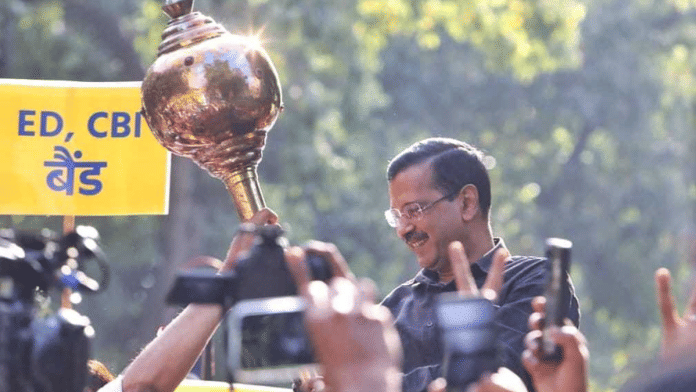



New Delhi: The Delhi High Court Tuesday issued notices to former chief minister Arvind Kejriwal and 22 others discharged in the excise policy case while hearing an Enforcement Directorate plea to expunge adverse remarks made by the trial court against the agency.
This comes a day after the HC stayed the trial court’s critical remarks against the CBI’s investigating officer in the 27 February order.
On Tuesday, a bench of Justice Swarana Kanta Sharma briefly heard the arguments presented by the ED which largely revolved around why it is being referred by the Rouse Avenue court in its order which had stated that “investigations by the state police, the CBI, or the Enforcement Directorate cannot be initiated or sustained solely on allegations of election-funding irregularities and excess expenditure”.
Additional Solicitor General S.V. Raju, who appeared for the ED, told the HC at the outset that certain adverse remarks made against the anti-money laundering agency should be expunged from the 27 February order, as those were not necessary for deciding the issue before the court.
The HC then asked, “Did he (the judge) say anything about the case or were these just general observations”?
In response ASG SV Raju said, “Even if they are general observations, how can they (trial court) make them. They will affect us.”
Relying on the 1963 Supreme Court ruling in State of UP v. Mohd. Naim, the ED argued that if judicial observations violate all settled considerations of justice, fair play and restraint by making remarks against an authority that was not before the court, they can be expunged.
“At the same time it is equally necessary that in expressing their opinions, judges and magistrates must be guided by considerations of justice, fair-play and restraint. It is not infrequent that sweeping generalisations defeat the very purpose for which they are made,” the ED’s counsel argued before the court.
Appearing for the respondents, senior advocate N. Hariharan said the ED’s plea “voluminous and bulky” and they needed more time to come up with their response.
To which the judge said, “File your reply and come before the court by next Thursday.” The matter will be heard next on 19 March.
Behind ED’s case
The ED filed the plea before the HC last night to get a direction for expunging or deleting certain “adverse, sweeping and unwarranted” observations made by the trial court in its 27 February order discharging all the accused persons in the excise policy case.
The ED argued in its plea that the trial court’s remarks were “wholly extraneous” as the agency was not even a party to the CBI proceedings in any capacity, and the judge should have confined himself to the CBI’s case.
The ED also said it was not given any opportunity to be heard before these “adverse observations” were recorded by the court, violating the fundamental principles of natural justice and judicial decorum.
What ED wants expunged
The ED’s plea asks the HC to order the deletion of 18 remarks made by the trial court.
In one of these remarks, the court has simply said that money-laundering allegations cannot exist without proceeds of crime and a demonstrable money trail, while in another the court went on to note that if investigative agencies like the CBI or the ED is allowed to enter the electoral arena merely on allegations of illegal funding or cash spending, the inevitable outcome would be the criminalisation of electoral competition.
Another remark that the ED wants deleted from the order was that the Prevention of Money Laundering Act cannot exist in a vacuum, and is predicated on the basis of prior scheduled offence and the generation of the proceeds of crime from it.
“It is only upon such constitutionally anchored scrutiny, where material discloses a clear, standalone criminal offence, independent of election-law violations, that involvement of agencies like the CBI or the Enforcement Directorate may be contemplated,” the trial court had also recorded in its order.
Predicate offence
The predicate offence, or a scheduled offence, is the underlying crime committed to obtain the “proceeds of crime”.
Section 30 of the PMLA lists various predicate offences across various statutes, including the Indian Penal Code, the Explosive Substances Act, the Unlawful Activities (Prevention) Act, the Arms Act, the Immoral Traffic (Prevention) Act, the Prevention of Corruption Act, and even the Copyright Act.
Crucially, to be accused of money laundering under the PMLA, the offence has to be linked to one of the scheduled offences.
(Edited by Ajeet Tiwari)