





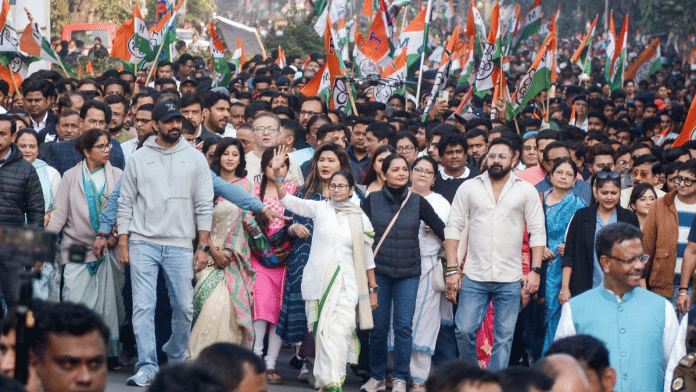


New Delhi: The Supreme Court Wednesday disagreed with West Bengal’s submission that the dispute between it and central agency Enforcement Directorate (ED) over Mamata Banerjee’s alleged interference during the raids on her political consultant was essentially a federal dispute, which can only be adjudicated through a suit before the top court.
A bench led by Justice Prashant Kumar Mishra verbally commented that a sitting chief minister had interfered with an ongoing central agency probe, which was an individual’s act. The same, it added, cannot be given the colour of a centre-state dispute.
“A chief minister of any state cannot walk into the midst of an investigation, put democracy in peril, and then say… don’t convert this into a dispute between the state and the Union,” said Justice Kumar.
The bench was hearing ED and its individual officers who have sought a CBI probe against West Bengal Chief Minister Mamata Banerjee and state police officials for allegedly obstructing the ED raid on I-PAC, the political consultant of the Trinamool Congress. These petitions have been filed under Article 32 of the Constitution, which allows citizens to move the top court for enforcement of their fundamental rights.
West Bengal has questioned the maintainability of such petitions, arguing the dispute should not be entertained under Article 32, but Article 31 which calls for a civil suit proceeding in case of a disagreement between the state and the Union.
Notably, the court’s observation on Mamata Banerjee’s action comes a day before the first phase of assembly elections in West Bengal.
According to the agency, Mamata Banerjee, accompanied by state officials, entered the I-PAC office as well as the home of its founder, Pratik Jain, while the searches were underway and walked out with a laptop, phone and several documents.
The bench, also comprising Justice N. V. Anjaria, remarked that a sitting chief minister cannot harm democracy by her actions.
“This is not a dispute between the state and the Union. A chief minister of any state cannot walk into the midst of an investigation, put democracy in peril, and then say… don’t convert this into a dispute between the state and the Union. This is per se an act committed by an individual who happens to be the chief minister keeping the whole democracy in jeopardy,” the Bench told senior advocate and TMC Rajya Sabha member Menaka Guruswamy, representing West Bengal.
Guruswamy was addressing the court in response to a petition filed by an ED officer. Her argument was that to invoke Article 32 for inter-departmental conflicts would weaken the fundamental rights provision for citizens.
She referred to Constituent Assembly debates on Article 32, as well as the Government of India Act, 1935.
“You have Article 32 so that citizens can enforce fundamental rights. That is the intended prescription of the drafters of the Indian Constitution. If your lordships find that ED officers can move Article 32 petitions, then your lordships are actually entertaining a situation which was not intended by the framers of the Constitution,” the senior counsel told the bench.
But the court differed in its view on the possible implication and application of Article 32 in such situations.
Justice Mishra said that even the country’s legal stalwarts would not have envisaged such a situation.
“You have taken us through Seervai, Ambedkar, but none of them would have conceived this situation in this country that one day a sitting chief minister will walk into the office (and obstruct a probe).”
At this Guruswamy told the court that she was not drawing its attention to the merits of the allegation, but on a technical ground of maintainability.
“When and if we come to the facts, then certainly we will convince your lordships. When we come to the facts, your lordships will see there is no situation as described by the other side. There was no criminal conduct, there was no intimidation, there was no infraction,” Guruswamy said.
When she asked the bench to refer the questions of law arising on Article 32 in the case to a larger bench, the court refused.
“In every question, there will be some question of law. That doesn’t mean every (Article) 32 petition is referred to a 5-judge bench,” the court said.
However, Guruswamy argued that in 75 years, the court had never seen a proposition like the one raised in the present plea. In response to this the court referred to recent instances where states had filed Article 32 petitions before the Supreme Court. Its hint was towards petitions filed by opposition-ruled states such as Tamil Nadu and Kerala, where they challenged respective state Governors’ inaction over state Bills forwarded for assent.
The Court asked Guruswamy if any substantial question was involved at all.
It also said that the court cannot shut its eyes to the realities on the ground in West Bengal. This is an extraordinary litigation, the Bench remarked. “We cannot shut our eyes to the reality of what’s happening. We cannot lose sight of the practical situation which is present in the state. Don’t compel us to make observations. This is not a litigation between Ram vs Shyam. This is an extraordinary situation where the contours are totally different. Court has to take decision keeping in view socio-political realities. It is an ever-evolving process,” it said.
During a hearing in January, the court had said there would be lawlessness in the country if it did not examine the issues raised by the ED. This followed a court notice to Banerjee and the then Director General of Police (DGP) Rajeev Kumar and others.
Guruswamy stuck to her stand and pointed that the schematic arrangement of the Constitution is that the rights under Part III of the Constitution, which enlists fundamental rights, are against the state.
Senior advocate Siddhartha Luthra, representing a police officer, argued that the ED did not have a separate identity and was a government agency.
The arguments in the case will continue Thursday.
(Edited by Viny Mishra)
Also read: Mamata is the architect of her own troubles. West Bengal won’t be fixed, even if she loses