





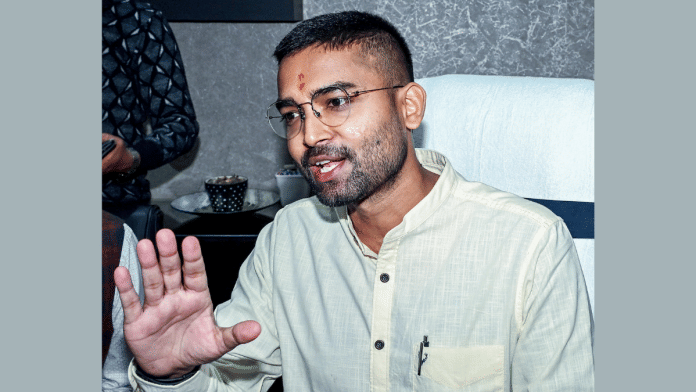


New Delhi: It’s a question that goes to the heart of India’s parliamentary system: how long can an unelected person exercise executive power?
The answer to this question is now before the Supreme Court, which is hearing a writ petition challenging the re-appointment of Bihar Panchayati Raj Minister Deepak Prakash based on an interpretation of a constitutional provision governing the appointment of state ministers: Article 164(4) of the Constitution.
The factual sequence is straightforward. Prakash served as Minister of Panchayati Raj for four months and 26 days before Chief Minister Nitish Kumar stepped down 15 April 2026, bringing his tenure to an end.
For the next 22 days, he held no ministerial office. On 7 May, after Samrat Choudhary formed a new government, Prakash was once again sworn in as minister despite remaining outside the legislature.
The writ petition, filed 30 May, now wants his appointment declared invalid, alleging it’s “a fraud upon the Constitution”.
On Monday, the Supreme Court issued notices to the Election Commission, the Bihar government and Deepak Prakash, the son of Rashtriya Lok Morcha (RLM) leader Upendra Kushwaha, on the petition challenging his eligibility to hold a cabinet post despite not being a member of either House of the state legislature.
A bench of Chief Justice Surya Kant and Justice V. Mohana sought the trio’s response on the petition filed by Bihar resident Rakesh Kumar Singh.
Also Read: Why do political leaders defect or stay? Look beyond obvious answers of ideology, money, power
What is Article 164(4)?
Prakash’s holding of office relied on an exception in Article 164(4), which grants ministers a grace period of six months.
It states: “A Minister who for any period of six consecutive months is not a member of the Legislature of the State shall at the expiration of that period cease to be a Minister.”
The wording raised an important question: did it cover ministers who then lost their seat, or did it mean that someone who had never even stood for election could be appointed minister, and later win a seat within six months?
The question first reached the Supreme Court in 1970. Tribhuvan Narain Singh was appointed the Uttar Pradesh chief minister even though he was not a member of the state legislature; a writ petition challenged his appointment.
In Har Sharan Verma v. Tribhuvan Narain Singh, the court took a broader interpretation of 164 (4), holding that “there is no reason why the plain words of cl. (4) of Art. 164 should be cut down”.
In the court’s view, all it meant was that a minister must become a member of the legislature within six months.
Since the judgment, 164(4) has been invoked extensively by ministers and even chief ministers who are appointed without holding a seat in the legislature. The standard political tactic is to then have an elected legislator in a “safe seat” resign so that the minister can run in a by-election.
Upper Houses of state legislatures also offer a route. In 2019, Uddhav Thackeray became Maharashtra’s chief minister without holding a seat; while COVID interfered with attempts to hold a by-poll, he eventually was elected to the state’s Legislative Council.
Tirath Singh Rawat was not as lucky. The Uttarakhand chief minister, who took office in 2021, resigned shortly before the six-month deadline after the COVID-19 pandemic made holding a by-election difficult.
Similar situations have arisen at the highest levels.
H.D. Deve Gowda was not, in fact, a member of the national legislature when he was made prime minister in 1996; he was protected by a similar six-month grace period under the Constitution’s Article 75(5), and secured appointment to the Rajya Sabha before the clock ran out. Article 75(5) applies to the Union level, while 164(4) governs the appointment of ministers at the state level.
The practice of having a minister join the legislature after taking their post is not by itself controversial. It becomes controversial if the provision is invoked twice.
What if the minister is re-appointed?
The question is whether there’s a loophole in Section 164(4): could a minister resign shortly before the six-month deadline, and then take office again to reset the clock?
In 1995, Tej Prakash Singh was appointed a minister in the Punjab government. He did not hold a seat, and failed to secure one in the months afterward. As a consequence, he submitted his resignation exactly six months to the day he took office.
Several months later, Singh was again made a minister; he still held no seat. A writ petition challenged his appointment, and the case made its way to the Supreme Court in 2001 as S.R. Chaudhuri v. State of Punjab.
The court, in its judgment, took a narrow reading of the exception in 164(4). It called the grace period “a one time slot for the individual concerned during the term of the concerned legislative assembly”. That is, the minister may not invoke 164(4) more than once during the same Assembly.
“Every Minister must draw his authority, directly or indirectly, from the political sovereign – the Electorate,” said the court and called attempts to bypass the provision “a subversion of parliamentary democracy”.
The Prakash controversy
The difference between the S.R. Chaudhuri case and the current one is subtle. In the previous case, the minister involved had run out the entire six-month clock. In this case, Prakash still had about a month left when his first term as minister came to a close.
Similarly, Tej Prakash Singh had exhausted the entire six-month grace period before being reappointed. Prakash did not.
When CM Nitish Kumar stepped down, the Bihar minister had served only four months and 26 days. On this view, Article 164(4) grants six months of ministerial tenure rather than a single constitutional opportunity, and Prakash merely resumed the running of the original clock when he returned to office.
The writ petition, however, argues that the time remaining should not matter; dividing the six months between appointments is “artificially fragmenting and reutilizing the limited constitutional grace period” under 164(4).
In any event, while the petition was filed when the balance of the six-month time had not elapsed, it has since ended. Prakash still holds no seat in the legislature.
The petition, however, goes much further. Its central claim is that the reappointment was unconstitutional from the moment it occurred.
According to the petition, Prakash’s first appointment on 20 November 2025 immediately triggered the constitutional exception contained in Article 164(4). That exception, it argues, is not a bank of days that can be withdrawn and redeposited at will. Rather, it is a single constitutional opportunity.
Once invoked, it cannot be “revived, renewed, fragmented, carried forward, or reutilized through resignation, dissolution of the Council of Ministers, cabinet restructuring, change in political leadership, intervening gap periods, or subsequent reappointment”.
Prakash’s appointment, argues the petition, was a “colourable exercise of constitutional power intended to indirectly achieve what is constitutionally impermissible directly”.
The petition’s strongest argument is its reliance on the language of the 2001 S.R. Chaudhuri judgment, which stated that a change of chief minister is “of no consequence”, and that even “resignation … before the expiry of the period of six consecutive months” would not permit a fresh appointment without first obtaining election to the legislature.
Ultimately, the Supreme Court may be required to answer a simple question: is Article 164(4) best understood as granting six months of ministerial tenure or a constitutional opportunity to obtain democratic legitimacy?
Sahaj Sankaran is a TPSJ alum, currently interning with ThePrint.
(Edited by Sugita Katyal)