





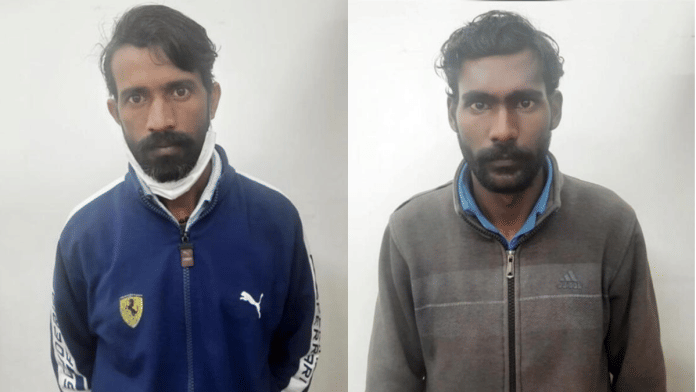


Gurugram: Eight years after a 12-year-old girl was abducted from her uncle’s house in Panipat’s Urlana Kalan village, raped and strangled, and four years after a trial court sentenced both her killers to death, the Punjab and Haryana High Court has pulled the case back from the brink and ordered a retrial after it found the investigation and trial was riddled with lapses too serious to ignore.
A bench of Justice Anoop Chitkara and Justice Ramesh Chander Dimri Tuesday set aside the death penalty awarded to Pardeep, 35, and Sagar alias Kallu, 25, holding that police negligence and a defective trial had denied the two men, and the victim’s family too, a fair shot at justice.
Like the same bench did last month in the case of a 7-year-old Palwal girl who was raped and strangled in 2021, the court, in its 32-page order, referred to the girl throughout only as ‘Laadli’.
Also, in a first, the Punjab and Haryana High Court in this case has embedded working hyperlinks to every precedent cited in its judgment, spanning over 35 Supreme Court decisions from 1951 to 2025, allowing any reader to instantly access and verify the full text of each authority, with most links opening directly to the PDF of the judgment on the Supreme Court website.
The move carries particular weight against the backdrop of rising judicial anxiety over artificial intelligence in legal research.
Only recently the Supreme Court issued a firm zero-tolerance directive to both the Bar and the Bench against producing, citing or relying on AI-generated precedents without rigorous verification, warning that the use of fake or “hallucinated” judgments constitutes professional misconduct for advocates and a serious judicial lapse if a court itself rests its reasoning on fabricated authority.
By embedding live links that take the reader straight to the authentic source, the high court has offered a practical answer to that very concern.
She went out to throw the garbage
On the evening of 13 January 2018, ‘Laadli’ left her uncle’s house in Urlana Kalan to dispose of household garbage. She never returned. Her family searched through the night. The next morning, they found her body, stripped, lying at the edge of a stagnant pond behind the village’s Balmiki Chaupal.
The FIR named no one. But within a day, the case cracked open. A home guard, Surender, who lived near the accused and was distantly related to ‘Laadli’, told police that Pardeep and Sagar had come to him, confessed to the crime, and asked to be handed over to the police.
Their disclosure statements led investigators to a stained mattress at Pardeep’s house, an empty condom wrapper, semi-burnt clothes identified as the victim’s, and eventually the girl’s slippers and the tasla (iron pan) in which she had carried out the garbage.
The trial concluded in four years. In February 2022, a sessions court convicted both men and handed down the death penalty on three counts for each—murder, causing death during sexual assault, and aggravated penetrative sexual assault under the POCSO Act—besides jail terms for kidnapping and gang rape. The case reached the high court as a mandatory murder reference, with the convicts also filing separate appeals seeking acquittal.
The FSL report nobody showed the doctors
The bench’s sharpest criticism was reserved for what happened, or rather, didn’t happen, after the postmortem.
The doctors who examined the girl’s body had been careful. Cause of death, they said plainly, was asphyxia due to strangulation. But on the question of sexual assault, they held back: Their final opinion, they noted in writing, would follow only after they saw the Forensic Science Laboratory’s (FSL) report.
That FSL report came in. It found semen on the vaginal swabs, vaginal slides, the mattress, and two pieces of underwear. It should have gone straight back to the doctors for their conclusive word. But it never did.
“It was grossly negligent on the part of the Investigating Officer and the supervisory officers not to seek the opinion of the doctor(s) by forwarding the FSL Report to the doctor(s),” the bench observed, adding that neither the public prosecutor nor the trial judge noticed the gap either, and the trial was “concluded hurriedly”.
The court was unsparing about where the blame lay, and where it didn’t. “We cannot blame the doctors for this negligence,” the judges said, holding instead that it lay “squarely at the hands of the investigator, SHO, and supervisory ffficers, including the then head of the district police, all of whom were irresponsible.”
Questions that were never asked
The court found a second, equally fundamental problem: The way the two men were questioned about the evidence against them under Section 313 of the CrPC (now Section 351 BNSS), the stage where an accused gets to personally respond to the case built against him.
The judges found that one questioner wrongly told Pardeep his extra-judicial confession was made before one ‘Suresh Kumar’, when the record showed it was made before a different man, PW-1 Surender Kumar. Small detail, but of the kind that courts have repeatedly held cannot be brushed aside.
More significantly, two crucial recoveries, the tasla and the girl’s slippers, both identified in court by her uncle, were never properly put to the accused in a way that let them respond to what those objects meant for the case against them.
Citing a long line of Supreme Court rulings going back to 1951, from Tara Singh to last year’s Chandan Pasi, the bench underlined a settled principle: An accused cannot be convicted on evidence he was never asked to explain.
Neither acquittal nor confirmation
Faced with a genuine dilemma—free two men accused in the rape and murder of a child on a procedural technicality, or let a flawed conviction stand—the court chose a third path.
“If we give benefit of a curable irregularity to the accused by acquitting them, then it would cause more serious prejudice to the victim, without her being at any fault at all,” the bench wrote, adding that four to five years’ delay in reopening the questioning would not, by itself, prejudice the accused either.
The court set aside both the conviction and the death sentences and sent the case back to the trial court, with instructions to first summon the doctors to record their opinion on the sexual assault question, then re-examine both accused properly on all the evidence, and give them a fresh chance to lead defence evidence, before passing a new judgment “without being influenced by the previous judgment as well as this one.”
The murder reference itself, having become infructuous, stands closed. The high court asked the trial court to wrap up the retrial “expeditiously” noting that the FIR is already eight years old.
(Edited by Viny Mishra)
Also read: Why Punjab & Haryana High Court overturned woman’s conviction in 2004 rape conspiracy case