





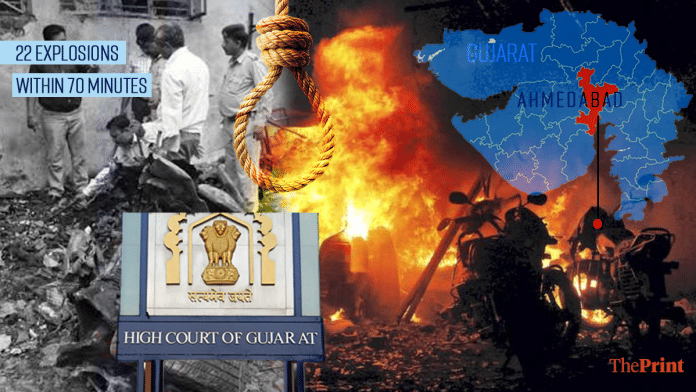


New Delhi: Eighteen years after Ahmedabad was rocked by 22 explosions within 70 minutes, leaving 56 people dead and 240 seriously injured, the Gujarat High Court upheld a special court verdict awarding the capital punishment to 38 convicts and life imprisonment to 11 others.
Behind the devastating attacks, the court said, was a meticulously planned “thick conspiracy”, driven by religious radicalisation, revenge for the Godhra riots and the Babri Masjid demolition, and an intent to “spread anarchy” through mass civilian killings.
A bench of justices A.Y. Kogje and S Dave noted the blasts were executed through meticulous training, and with a strategy designed to maximise human casualties by targeting those seeking emergency medical aid.
The 49 individuals were convicted in 2022 by a special court in Ahmedabad under the Indian Penal Code, Unlawful Activities (Prevention) Act and Explosive Substances Act. The court had acquitted 28 accused and one approver who had been granted pardon.
This, it did, while consolidating 547 separate but related criminal cases stemming from 35 different FIRs in Ahmedabad and Surat into one unified trial.
The convicts challenged the order in the high court, which delivered an exhaustive judgement last week. The 2,223-page order was made public late Monday.
Beyond the technicalities of forensic evidence and witness testimonies, the court’s observations provide a profound exploration of the human angle regarding the death penalty, balancing the mental agony of the condemned against the calculated cruelty inflicted upon the 56 victims.
The order of execution of sentences in death penalties is postponed for three months as the convicts wish to appeal in the Supreme Court.
The High Court dealt with a consolidation of 547 Sessions cases, involving 78 accused persons. The prosecution proved the murder of 56 citizens and grievous injuries to 240 others.
In its order, the court rejected the defense’s plea to view the incidents in isolation, instead identifying the serial blasts part of an interconnected web of terror that struck Jaipur, Bengaluru, and Mumbai during the same proximate period.
“Therefore, the incident of serial Blasts in Ahmedabad and planting of explosives is a result of conspiracy which in turn is a part of larger conspiracy,” it said.
Also Read: Why Madras HC set aside death sentence of man convicted of raping minor daughter
The sequence of terror
The path to the carnage of 26 July 2008, was paved through a series of training camps and logistical meetings across several states. The conspiracy was conceptualised at a “terror camp” in the forests of Vagamon, Kerala in December 2007, according to the HC order.
The court said that under the guise of organised gatherings by the banned Students Islamic Movement of India (SIMI), participants were imparted physical and weapons training. It also noted that the meetings included lectures and debates aimed at “inciting sentiments (Takrir) to get revenge for the losses suffered by Muslims” and to “establish Islamic rule”.
At the camp, they decided to “spread Anarchy by attacking (the) public at large of Hindu community to achieve the objective of Jihad”, the HC said, noting this was all planned as a revenge for the 2002 Godhra riots and the demolition of the Babri Masjid in 1992.
A second camp was held in the forests of Pavagadh in Halol, Gujarat in January 2008. Witnesses, including the Munjavar (caretaker) of the Hazrat Khundpir Dargah, testified to the presence of 20 to 22 individuals who stayed there under the guise of “trekking”. At this camp, the group received specialised training in bomb-making, shooting air guns, and “crawling on elbows”, the HC has observed.
Between May and July 2008, the conspirators moved to Ahmedabad and Surat, securing “safe houses” or hideouts in areas like Vatva and Danilimda, the HC noted.
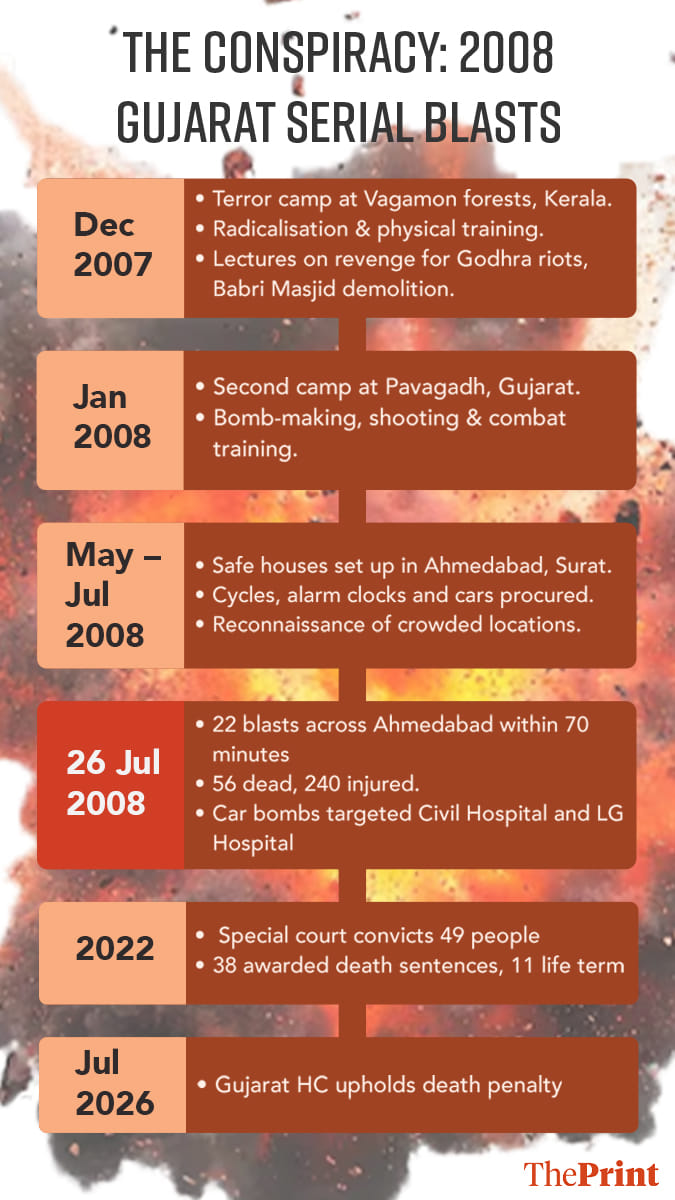
Procurement tasks were assigned with clinical precision: cycles were bought from local shops, and 50 ‘Prince’ brand alarm clocks were purchased from Mumbai to serve as timers. Recce missions were conducted to identify crowded, predominantly Hindu areas for maximum impact, according to the court order.
The explosions in Ahmedabad were timed to create a domino effect of chaos. On 26 July 2008, 22 explosions rocked busy markets in Maninagar, Khadia, Raipur, and Naroda between 6:30 pm and 7:00 pm.
The bombs were hidden in tiffin carriers or cloth bags on the handles of old bicycles. Then, between 7:30 pm and 7:45 pm, car bombs started going off at the Civil Hospital and L.G. Hospital, in what the court described as the most “sinister” part of the plot.
Stolen WagonR cars, packed with LPG cylinders and ammonium nitrate, were parked near the Trauma Centers. The court observed that these were intentionally timed to coincide with the arrival of ambulances carrying the injured from the earlier market blasts. This was a calculated move to kill more people and cripple the medical infrastructure at its most critical moment, the judges believe.
Between 27 July and 9 August 2008, 15 unexploded bombs were discovered across Surat, hanging from trees and tucked behind hoardings. The High Court noted that Surat escaped mass casualties only due to a “faulty mechanism”—the battery source failed to provide sufficient current to ignite the detonators. It noted that had they exploded, the damage would have mirrored the devastation in Ahmedabad.
The court firmly rejected viewing the Ahmedabad serial blasts and the bomb plantings in Surat as solitary events, concluding instead that they were part of a “thick conspiracy” interconnected with similar terror attacks in Jaipur, Bengaluru, and Delhi.
This connectivity was established through an identical modus operandi, specifically the use of “boat-shaped” wooden explosive containers and timer devices that were identical to those found in Delhi and Jaipur, while those used in Bengaluru and Surat shared a common design.
The court highlighted that the “Indian Mujahideen” claimed responsibility for these coordinated attacks across Rajasthan and Gujarat through “Message of Death” emails sent via hacked, unsecured Wi-Fi networks in Mumbai and Pune.
Thus, the court determined these events constituted a singular “larger conspiracy”, and a coordinated attack on the sovereignty of the nation intended to destabilise the government through mass killings.
The ‘rarest of rare’ case
The bench acknowledged that a death sentence often results in “mental agony to the convicted person” and this recognition is reflected in the procedural mandates of Section 407 of the BNSS, which requires sentences to be submitted “forthwith” to the High Court to prevent inordinate delay.
Before the special court, the accused argued for leniency, citing that they are young Indian Nationals with families, and were “misled by the communal atmosphere” following the 2002 riots.
‘There is no doubt in mind of Court that such concerted attack is an attack on sovereignty of India…which ultimately resulted in death of 56 persons indiscriminately and injuries to 240 persons without their fault… (it) will take this case in category of ‘rarest of the rare’,’ says HC.
The HC counterbalanced this by highlighting the extreme inhumanity of the crime. It described scenes where “dead bodies of the humans were lying in burnt and half-burnt conditions with body parts lying in scattered condition detached from the body”. The court noted that the 2 40 survivors are left “carrying the fear and scar for the rest of their life”.
The deliberate targeting of trauma centers was viewed as a direct attack on human compassion, stripping away any mitigating factors for those who planned it.
In applying the ‘rarest of the rare’ doctrine established in the Bachan Singh v. State of Punjab in 1980, the High Court emphasized that the blasts constituted an “attack on the sovereignty of the nation”.
The court referred to the 262nd Law Commission Report, which recommended keeping the death penalty only for terrorism-related offenses, and abolishing it for general offenses.
The court identified several “special reasons” for confirming the death penalty: the coordinated nature of the conspiracy, suggesting a shared common design to topple the democratically-elected government, the targeted selection of non-Muslim areas and medical facilities and the sophistication of the plot, which involved hacking unsecured Wi-Fi networks in Mumbai to send “Message of Death” emails to media outlets.
“There is no doubt in the mind of the Court that such concerted attack is an attack on the sovereignty of India with ultimate objective as is even reflected from evidence of witnesses, to topple democratically elected Government, which has ultimately resulted in death of 56 persons indiscriminately and injuries to 240 persons without their fault, will take this case in the category of ‘rarest of the rare’,” it said.
The Section 27 debate
The prosecution’s case rested on the testimony of 1,163 witnesses and a vast array of forensic reports; but a major legal battleground was the use of Section 27 of the Evidence Act which serves as a critical proviso and allows partial exception to the general legal prohibitions against confessions made to police officers or while in custody, as mandated by Sections 25 and 26 of the Act.
This section allows for the admission of information provided by an accused person in police custody provided it relates distinctly to a “fact thereby discovered”.
The High Court clarified that a “fact” is not limited to material objects like weapons or explosives but includes “any mental condition of which any person is conscious”, such as an accused’s exclusive knowledge of a specific location used in the conspiracy.
This interpretation was pivotal in validating “pointing out panchnamas” – where convicts voluntarily led investigators to terror training camps in Halol and Vagamon, secret hideouts in Ahmedabad and Bharuch, and the exact spots where they planted bomb-laden bicycles.
The defense argued that since the blast sites were already known to the police, “pointing out” these locations did not constitute a new discovery. However, the High Court ruled that “discovery of fact” is not limited to physical objects but includes the “mental awareness” of the accused.
The fact that an accused could lead the police to a specific spot where he received a cycle or attended a meeting demonstrated exclusive knowledge of the conspiracy.
Furthemore, the evidence of Aiyaz Razakmiyan Saiyed, an original accused who was granted pardon and later transitioned to being an approver as a prosecution witness, was pivotal.
Despite the defense’s assertions that his application for pardon was a “desperate measure” delayed by 11 years and that he was “lured” into cooperation to avoid the death penalty, the court found his testimony to be wholly reliable, consistent, and credible.
The court observed that the law does not prescribe a specific timeline for an accused to turn approver and accepted his explanation that his disclosure was born out of genuine remorse and a desire to serve the nation by revealing the truth.
Aiyaz provided what the court termed a “probable catalogue of events” that meticulously detailed the evolution of the conspiracy, starting from his radicalisation at the SIMI office in Shahpur to his involvement in high-level planning. Most notably, he described the pivotal meetings held at Dariyapur in early 2008, according to the HC.
These gatherings were attended by top SIMI and Indian Mujahideen operatives, including Safdar Nagori and Abdul Subhan (Taukir), where they delivered instigating speeches regarding “Jihad” as revenge for the 2002 riots and showed instructional videos on bomb-making and suicide bombings, the HC observed.
Aiyaz’s testimony, the court said, was critical in establishing the “meeting of minds” among the 78 accused, as he recounted how tasks were assigned and locations for reconnaissance were selected.
On the day of the carnage, i.e. 26 July 2008, Aiyaz’s role was central to the execution of the plan in the Naroda area. He testified that he received four heavy bags containing bombs from Abdul Rajik (a key local coordinator and logistical operative for the Indian Mujahideen) at the Ajit Mill crossroads and was provided with a bicycle.
(Edited by Ajeet Tiwari)
Also Read: Trial courts handed 128 death sentences in 2025, highest female convictions since 2016, says report