





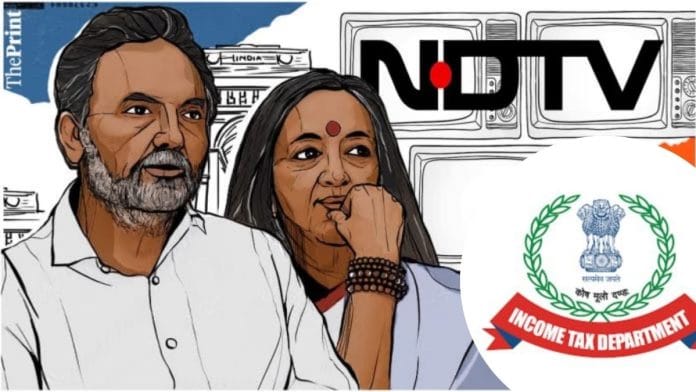



New Delhi: Putting to rest a decade-old matter, the Delhi High Court has quashed the income tax (I-T) reassessment notices issued to NDTV co-founders Prannoy and Radhika Roy in 2016, observing that the move was “arbitrary and contrary to statutory provisions”, and imposed costs on the tax department for the same.
The notices were issued over their transactions in connection with RRPR Holding, the promoter of NDTV. The promoter company had given an interest-free loan to the news channel, which the tax department claimed was never assessed as part of the income of the Roys, former executive co-chairpersons of NDTV.
“Hurling the reassessment proceedings in such a situation hits at the very root of fair adjudicatory process. Initiation of reassessment proceedings… leads to unnecessary harassment of an assessee on the one hand and gives rise to unpredictability/uncertainty, if not anarchy, on the other,” the court stated in its order delivered Monday.
The bench of Justices Dinesh Mehta and Vinod Kumar imposed a Rs 2 lakh cost on the income tax department for its conduct in the case, while remarking that although no amount of costs would have been enough in this case, some amount had to be imposed.
“No amount of cost can be treated enough for these cases, however, we cannot but leave these cases without imposing any. Hence, we impose a token cost of Rs 1,00,000 per case upon the respondents to be paid to each of the petitioners,” the division bench ruled.
Essentially, the court noted that despite the Roys’ complying with the tax authorities and furnishing their account books, which clearly showed that RRPR Holding had given interest-free loans of Rs 20,92,00,000 and Rs 71,00,00,100 to Prannoy and Radhika, respectively, since they were the directors of NDTV then, the tax authorities had acted against them and issued notices. The court observed that it could not be said that the petitioners had failed to disclose true and material facts before the assessing officer (AO).
Although the tax notices were issued separately to Radhika and Prannoy, the court clubbed their cases together while taking note of the similarity of facts in both cases, and delivered one judgement.
Quashing the notices and imposing costs on the department, the court ruled: “The facts of the present case themselves speak volumes, as to how proceedings are arbitrary and contrary to the statutory provisions, besides being against the fundamental principles of adjudicatory process. In the facts of the case though, no judicial precedents or pronouncements are required to quash the impugned proceedings.”
Also Read: You can call NDTV elitist, anglicised. But it defended democracy, gave us Ravish Kumar
Breaking down the case
In its ruling, the high court said the Roys had a “strong case” given that the proceedings against them were without jurisdiction, even if they were not vindictive and arbitrary, as their lawyer had argued.
Tax reassessment proceedings for income for the assessment year 2009-10 were initiated in 2011 and then in 2013. In March 2016, a reassessment notice was issued yet again.
The court noted that in the first instance, the tax department had asked the Roys to explain and produce their balance-sheets and shareholding patterns along with the account books. All of these were furnished by the Roys, as requested, to the satisfaction of the authorities.
However, the tax authorities tried to treat the interest which would have accrued on the interest-free loan as “deemed income” under Section 2(24)(iv) of the Income Tax Act, 1961, which expands the definition of income beyond just cash earnings, and includes non-monetary benefits like free accommodation, and interest-free loans.
The court noted that this was done at the time when the issue of receiving loan from the promoter company was under scrutiny before the AO, and the Roys had been asked to explain it by a notice.
Reassessment proceedings are only permitted in the event of a new fact coming to the notice of the tax authorities, which should have been disclosed by the assessee but was not, the court said. The court said that the AO had knowledge of all the facts before the second reassessment was initiated against the Roys.
For the second time, the books were summoned and explanations were sought from the Roys. To all of this, they obliged, the court noted, adding that “the respondents cannot justifiably trigger proceedings” under the IT Act, all over again, after this.
After reassessment notices were issued by the tax department again in March 2016 under Section 148 of the Income Tax Act, which empowers the AO to send a notice to a taxpayer for escaping assessment, the Roys moved the Delhi High Court in 2017. Section 148 empowers tax authorities to reopen assessments when they believe some income escaped taxation due to underreporting or errors, in order to ensure fair tax collection.
The matter of Radhika
Radhika, the petitioner, had 50% shareholding in RRPR Holding. For the assessment year 2009-2010, she submitted a return of income on 31 July, 2009. The return was filed and processed, and accepted. However, in July 2011, she received a notice under the IT Act, and reassessment proceedings were initiated, alleging that her income had escaped assessment.
The tax department alleged that the purchase of NDTV shares took place at a substantially lower price than its market value, and that’s how Radhika escaped assessment.
Two years after the first notice, the IT department issued another notice to her in March 2013, asking her to show cause as to why the loan received by her from NDTV’s promoter company should not be treated as part of her income.
In response, Radhika furnished her account books and claimed that the funds received from RRPR Holding were without any stipulation of interest.
In March 2013, an order was passed by the tax department where the AO was allowed to reassess income that has “escaped assessment”. The order stated that Radhika’s income was over Rs 3.17 crore, more than twice what she had quoted.
Three years after this, Roy received another notice that the reassessment of income will be done again, but this time to the satisfaction of the Principal Commissioner of Income Tax.
Surprised, Radhika asked the authorities the reasons for this reinitiation of reassessment proceedings in a letter dated 12 April, 2016. In July of that year, the IT department responded with reasons for the reassessment, such as receiving fresh information from sources.
Arguments in court
Before the court, Roy’s lawyer, senior advocate Sachit Jolly, argued that the re-initiation of assessment proceedings was “arbitrary and vindictive”, and that the AO had used his power illegally and without any authority of law, as all of Radhika’s account books were placed before the tax authorities before they passed the March 2013 order seeking reassessment.
Jolly also pointed out that during the earlier reassessment proceedings, the tax department had raised contentions about the interest-free loan received from RRPR Holding, while in the second round of reassessment proceedings, they again invoked the same reason.
Although Radhika owned 50% stake in the company, the amount given to her as interest-free loan was because she had given a personal guarantee, her lawyer said, adding the notice should be quashed for lack of jurisdiction.
On the other hand, the tax department’s lawyer, N.P. Sahni, argued that although “at first blush” the separate notices to the Roys appeared to be identical, they were not. The tax authorities argued that the Roys had invoked the court’s writ jurisdiction against a notice without even filing a response to it.
Putting these contentions to rest, the court said the power under Sections 147-148, which deal with tax reassessment proceedings, is an “exception to the normal assessment proceedings”.
Once such powers have been exercised and an assessment order has been passed, the tax department cannot be allowed to reopen the assessment all over again simply because someone complained about or suggested a new facet of the same transaction, the court said.
(Edited by Nida Fatima Siddiqui)
Also Read: Prannoy and Radhika Roy and the world of news this week on