





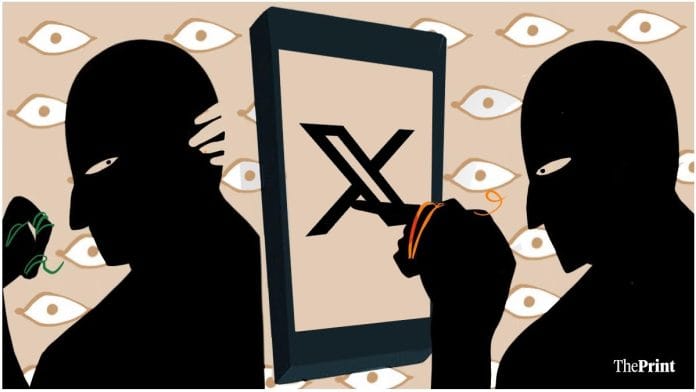



New Delhi: The Indian Youth Congress has launched ‘Digital Azadi’, a nationwide campaign offering pro bono legal support, platform-level intervention, and national amplification to social media users whose accounts or content have been withheld or removed by government orders.
The campaign has a dedicated portal where those affected can file case reports. According to the IYC, it will pursue high court petitions and engage directly with platforms on behalf of the complainants.
The ‘Digital Azadi’ launch comes amid a documented and accelerating wave of content takedowns across X, Instagram, and Facebook, days after the Centre proposed amendments to the IT Rules that would further expand its power over individual users online, not just platforms.
The takedowns especially target accounts that are critical of the Union government and have now spread beyond political satire, extending into civic accountability journalism and food safety activism.
Got an email from X saying that they received a blocking order from the Indian Ministry of Electronics and Information Technology citing Section 69A of the Information Technology Act, 2000, regarding my X account.
So, Exposing the fake propaganda and false narrative set by the… https://t.co/6hUisBg5kT pic.twitter.com/pIGqWyRnr8
— Mohammed Zubair (@zoo_bear) March 29, 2026
The ‘Digital Azadi’ portal asks affected users for their name, WhatsApp number, platform, handle, approximate follower count, a description of what happened, and supporting screenshots or documents.
According to the IYC, submitted cases will receive four kinds of support: pro bono legal representation and court action; direct engagement with platforms to seek account restoration; national-level amplification of the case; and organisational pressure on authorities.
IYC Legal Cell National Chairman Roopesh Singh Bhadauria said the ‘Digital Azadi’ campaign was specifically designed for those outside the reach of existing support networks.
“Getting relief or fighting for these big creators—if not the Indian Youth Congress, they will get help from somewhere or the other,” he said. “But this initiative is aimed towards the small-time YouTubers who are working in media towns and small cities, districts, and towns, where they are doing some sort of journalism, exposing rampant corruption, shooting it and uploading it. They are also being targeted, and nobody is giving them any sort of legal service.”
In February, Indian Youth Congress workers had staged a ‘shirtless protest’ at the AI Impact Summit, which had become a major flashpoint between the outfit and the government.
‘Overwhelming’ response
Bhadauria described the operational model of ‘Digital Azadi’. The IYC’s social media department will map and receive complaints, and route them to the legal cell.
“Whoever is facing such harassment—they will send their complaints, and thereafter, they will mark these matters to us, and we will take it forward from there,” he said.
The ‘Digital Azadi’ campaign is rolling out across 24 states, with state legal cell chairpersons and district-level coordinators handling follow-ups.
“There is a proper follow-up channel, and there is a turnaround time. We will make sure they get relief and are taken care of,” he said.
The legal cell is also supported by people beyond party lines.
“It is an initiative by the Indian Youth Congress legal department, but it is in collaboration with the social media department and free-thinking organisations working in this field,” Bhadauria said. “They can come from any forum. They might be having their own trusts or NGOs. We are getting a good response from their side—they are willing to give time, they are willing to run around.”
Bhadauria called the response since the campaign’s launch “immediate”. “The response is overwhelming, and it requires a lot of lawyers and legal activists to help them out,” he said, adding that the team is now mapping cases state-by-state to build a structured follow-up chain.
IYC Delhi President Akshay Lakra, himself an advocate, said the organisation was responding to a vacuum.
“There is no platform to address such issues. So this is the first time we are giving such an opportunity,” he said. “Anyone who needs assistance for such matters, we will help them out.”
He described the chilling effect on younger users as “deliberate”.
“Imagine a 19-year-old. Will he have the courage now to write against the government?”
Lakra also cited a personal example. During the AI summit protests in February, he posted a quote by Bhagat Singh. The post was withheld following action by the Haryana police.
“Imagine sharing Bhagat Singh’s photo is now not being allowed,” he said.
The ‘Digital Azadi’ campaign is open to both verified and anonymous account holders and users across all platforms, not only those with a large following.
‘Just the tip’
Bhadauria cited specific cases to illustrate the scope of what the ‘Digital Azadi’ campaign was responding to.
One involved Vinod Tiwari, an IYC office-bearer from Chhattisgarh. “He wrote something regarding the Indo-US trade deal—nothing objectionable, no curses, no swear words, no obscenity at all—and he was picked up. He was literally picked up from his place, produced in Delhi, and sent to Tihar,” he said. “Only for writing a post.”
Another involves Anurag Ojha, a YouTuber from Delhi. “He was picked up from Patel Chest, and his parents—nobody—were informed for three days. They were looking for him, filing a missing persons complaint,” Bhadauria said. “That is when we got to know that it was UP Police who picked him up, related to some sort of video he made during the Bihar elections.”
He said such cases were not outliers. “There are hundreds of such cases, numerous cases, across every state. This is just the tip.”
He described what he characterised as an organised targeting system. “They have this entire ecosystem—paid people who keep an eye on handles voicing the dissent of the people. They create a kind of PDF list and target them in bunches. Ten accounts suspended, then twenty accounts suspended. We get to know of the big accounts. But nobody knows what is going on in the smaller towns.”
The IYC added that it previously secured relief for withheld accounts—including those of Congress spokesperson Supriya Shrinate and parody handles—via petitions and direct outreach to platforms.
‘Account withheld’
From 18 March, several X handles critical of the Union government have been withheld in India. These include popular parody accounts—@Nher_who, @DrNimoYadav, @indian_armada, and @DuckKiBaat—as well as journalist-activist Sandeep Singh’s account.
The suspensions came with the message: ‘Account withheld in IN in response to a legal demand.’
Facebook pages of news platforms ‘Molitics’ and ‘National Dastak’, and the account of satirist Rajeev Nigam, also faced orders to be withheld.
Further, a recent notice dated 1 April and issued by the Delhi Police to X sought identifying details—including mobile numbers used for account registration, IP logs, ports accessed, and recovery email IDs—for several X accounts, including @khurpenchh, @gemsofbabus_, @YTKDIndia, @NalinisKitchen, and @IamTheStory_.
The police action stemmed from an FIR filed on 24 March by FSSAI Director Sweety Behera, who alleged that posts published by those handles were made with “malicious intent to defame her and damage her reputation in society”. Highly confidential details relating to her had been taken from places where they were supposed to remain confidential, she said. In response, accounts or specific posts were withheld.
The 9 and 10 March posts came primarily from @khurpenchh—an account known for exposing alleged irregularities in government recruitments and bureaucratic appointments, along with an associate handle, @YTKDIndia.
The posts raised questions about discrepancies in Behera’s appointment as FSSAI Director. One allegation was that her application claimed services from 2006 to 2020 at Nestlé India. Her service certificate, however, reportedly showed that she joined the company in 2007. Moreover, her experience and CTC criteria were found deficient during the selection process, purportedly.
One of the accounts, @YTKDIndia, said—after the FIR was filed—that its content was derived entirely from a “verified internal inquiry report of the FSSAI” on the director. It claimed that it neither conducted the inquiry itself nor introduced additions or alterations and that its reporting was fair, accurate, and not intended to malign any individual.
The account of Nalini Unagar, a food blogger and YouTuber with lakhs of followers across platforms, running the handle @NalinisKitchen on X, apologised in the same case. On 2 April, Unagar posted on X: “Delhi Police have filed an FIR against me. I had written about an FSSAI issue. I have already taken down those posts and am also removing many others.” With Unagar’s posts deleted by the time reports were published, their exact content remains unclear.
Other instances of takedowns include the Kerala Police order for the removal of posts carrying an Election Commission (EC) directive that incorrectly bore the BJP’s Kerala unit seal—it was attributed to a “clerical error”. The police work under the EC during the Model Code of Conduct.
Tens of thousands of takedowns
The takedowns follow the Centre’s amendments to India’s IT Rules that significantly shortened the compliance window for platforms.
The IT (Intermediary Guidelines and Digital Media Ethics Code) Amendment Rules, 2026—notified on 10 February and effective since 20 February—reduced the content removal compliance window from 36 hours to three hours.
The impact has been staggering. Meta alone restricted more than 28,000 pieces of content in India in the first six months of 2025, following government requests, according to the company’s transparency reports.
A further proposed amendment released for public consultation on 30 March would extend these powers to individual users. The draft rules—IT (Intermediary Guidelines and Digital Media Ethics Code) Second Amendment Rules, 2026—expand government control not only over platforms but also to users who post or share news and current affairs content online.
Under the proposal, the Ministry of Information and Broadcasting would be empowered to issue blocking orders directly to individual users on platforms such as YouTube, Instagram, Facebook, and X. Feedback is open until 14 April.
(Edited by Madhurita Goswami)
Also Read: Meta and YouTube ordered to pay $6 million in social media addiction trial. What’s the case?