





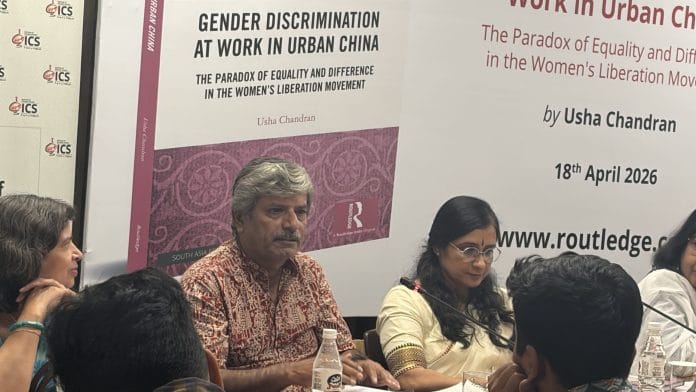


New Delhi: Does a cultural revolution or a ‘socialist’ transformation ensure gender equality? A new book on discrimination in urban workforces in China says, no.
The book discusses how the trajectory of women’s liberation in China, from the early 20th century to the present, has been anything but linear. It notes how the promise of equality has often coexisted with deeply embedded structures of difference and discrimination.
The discussion, hosted by the Institute of Chinese Studies in collaboration with the India International Centre in Delhi on 18 April, was centred on Usha Chandran’s Gender Discrimination at Work in Urban China: The Paradox of Equality and Difference in the Women’s Liberation Movement, which examines workplace discrimination and the broader trajectory of women’s liberation in China.
The book connects the past and present, as well as the political and the personal, by exploring women’s labour both inside and outside the home, beyond familiar divides, like equality versus difference, state versus society, and ideology versus everyday experience.
The discussion largely focused on a wide-ranging debate over a central question: Why does gender inequality persist despite decades of reform and official commitments to equality in China?
More than just a discussion of the text, it evolved into a deeper critique of the tensions between ideology, policy, and lived reality. For most participants, the argument was that contemporary China lacks an independent feminist movement.
Senior academics, like Professor Patricia Uberoi, Dr Govind Kelkar, Professor Sabaree Mitra, Dr Hemant Adlakha, and Dr Ritu Agarwal, were co-panellists in the discussion.
Chandran argued that while the defining feature of modern Chinese women in the 20th century was their economic liberation—largely achieved through participation in social labour—gender discrimination in the workplace existed from the Mao era and the Cultural Revolution through the reform and globalisation periods. This included policies like the one-child policy, SOE layoffs, contract labour, and feminised informal employment.
Drawing on statistical data, policy reports and scholarly research, the book shows that while women gained economic independence and awareness, true gender equality remained elusive, especially under market reforms.
“Market economy and reforms actually proved the iron ball. So it was also realised that even though women attained economic liberation, they did not attain gender equality,” she noted.
While individual voices continue to resist discrimination, Professor Adlakha argued that “the CCP does not allow Me Too also,” limiting the scope of organised activism.
Speakers repeatedly stressed the need to situate China’s gender dynamics within a longer historical arc and cautioned against viewing the country’s trajectory as beginning in 1949 or with economic reforms decades later. Instead, they pointed to earlier upheavals and intellectual movements as essential to understanding present conditions.
This shift, some argued, represents a reversal of earlier ambitions. Referring to recent official rhetoric, where Chinese Premier Xi Jinping said: “Women’s work is linked to family harmony and social harmony… [they] must encourage marriage and childbearing.” The remark, they added, stands “exactly opposite to what Engels was saying” about the family as a site of inequality.
The discussion also highlighted structural disparities in education and employment. Panelists cited examples of gendered expectations in university admissions and persistent wage gaps, suggesting that formal legal equality has not translated into substantive equality.
Questions from the audience pushed the conversation further, particularly around the notion of choice. Are women’s decisions—in careers, marriage, or lifestyle—truly autonomous, or are they shaped by economic and social pressures? Chandran, in response, emphasised structural constraints: “To be precise, there are no choices, because the choices are shaped by larger structures.”
Also Read: China’s Hainan boom could hurt Indian exports, widen trade gap. It’s a new global model