



Hyderabad: Telangana witnessed widespread protests by students and faculty members of polytechnic colleges in various districts Wednesday.
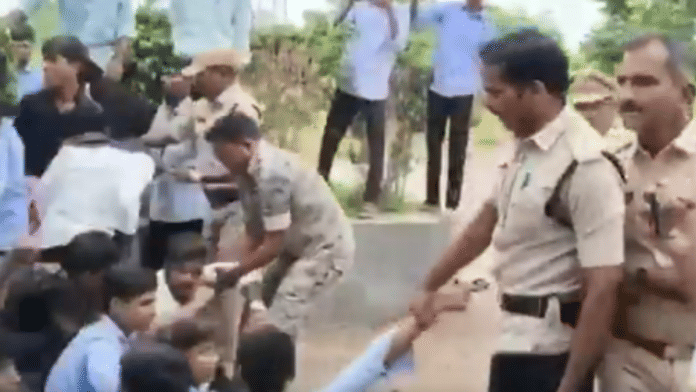
Police have detained many students in many districts as they attempted to block highways, and some others have been taken into preventive custody to ensure the issue does not escalate.
The protest is against the proposed amalgamation of polytechnic education courses with the state’s newly structured Department of Skill, Human Capital and Knowledge Training Initiatives (Shakti). The Congress-led state passed a government order (GO) in July under Shakti, not only renaming the Labour, Employment, Training, and Factories Department, but also integrating several institutions.
The order brought Industrial Training Institutes (ITIs), Advanced Technology Centres (ATCs), and Polytechnic colleges under the unified ecosystem of the Young India Skills University (YISU) and the SHAKTI department to align technical training with industry demands.
The government’s objective, made known at the time of passing the GO in the first week of July, was to overhaul technical education by aligning all training institutions under one umbrella, the YISU, of which the chief minister is the Chancellor.
The YISU, established in August 2024, aims to standardise technical training under a Public-Private Partnership (PPP) model to address industry skill gaps, making students “industry-ready” and directly employable upon completing their education.
However, students from these polytechnic and technology centres have demanded that the government repeal the GO to protect the distinct identity and autonomy of these institutions.
Several student organisations such as the All India Democratic Students’ Organisation (AIDSO), the Students Federation of India (SFI), and the Telangana Polytechnic Joint Action Committee (TPJAC) spearheaded these protests.
Students staged dharnas at Ramanthapur in Hyderabad, demanding the immediate cancellation of the Shakti Scheme, which caused heavy traffic jams.
Similar agitations in Warangal and Hanamkonda districts took place Tuesday, with teachers and students wearing black bands and badges to signal their displeasure. Teachers and students from various polytechnic colleges also converged at Nizamabad and Bhupalapally, demanding the rollback of the GO.
On its part, the Telangana government has defended the implementation of the GO, and no official from the Higher Education Department has responded to the protests yet.
Students’ concerns
Student bodies that ThePrint spoke to said they fear the merger would undermine the authority and autonomy of the State Board of Technical Education and Training (SBTET) and turn diploma education into general labour training.
Many students from low-income communities who cannot pursue a two-year intermediate programme after completing their 10th Grade opt for diplomas from polytechnic colleges and use them as a stepping stone to apply for admission to engineering colleges. The students who currently enrol in polytechnic or technology courses undergo a three-year rigorous academic and practical training programme.
“Our biggest worry is that we will not be able to apply for undergraduate programmes through the lateral entry scheme. With the government norms not providing any clarity on this, we fear we will have to take the intermediate course all over again,” said Suravarapu Rajitha, one of the Telangana Polytechnic JAC members.
Besides fears of being denied lateral entry, with the YISU being a PPP model, students are concerned about the high fee structure and fewer scholarships. Staff and faculty are concerned about resource rationalisation or arbitrary transfers.
The Bharat Rashtra Samithi (BRS) has come forward to officially support the ongoing protests, demanding a rollback of the GO, saying that the new administrative move would only render students ‘ready-to-manpower’, rather than equipping them with sufficient subject knowledge.
Dr Ramesh, former president of the BRS Vidyarthi (BRSV), told ThePrint that the party wing would support the ongoing protest until the GO was repealed.
(Edited by Viny Mishra)