






India’s largest conglomerate could be facing prolonged uncertainty as a regulatory hurdle stalls the process to appoint a new chairman.
Tata Sons Pvt., the holding company of Tata Group, is looking for a replacement for Natarajan Chandrasekaran, who unexpectedly announced in mid-August that he wouldn’t be seeking reappointment. That decision followed a months-long board impasse over an extension of his tenure.
Tata Sons has until late February, when Chandrasekaran is due to step down, to find a successor. The leadership crisis comes at a pivotal moment for the sprawling business empire, whose brands range from Taj hotels to Tetley tea, as Tata Sons undertakes a multibillion-push into semiconductor manufacturing.
What is the Tata Group?
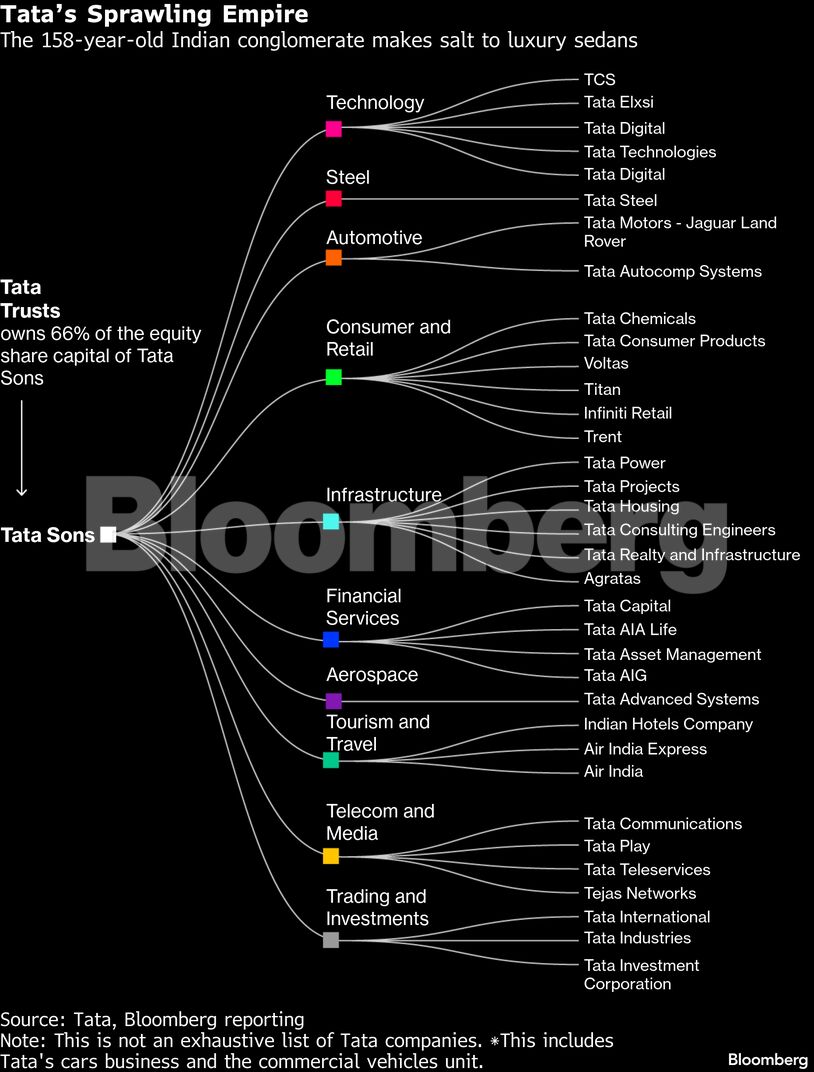
Tata Group is India’s oldest conglomerate, founded nearly 160 years ago by Jamsetji Tata. Its businesses are among the country’s most influential, spanning cars, steel, software, airlines and hotels.
The 32 companies under the Tata Group umbrella — of which 26 are publicly listed — generated combined revenue of about $170 billion during the 12 months through March 2026.
Tata Group is at the helm of India’s push into high-tech businesses. It has plans to expand production of Apple Inc. iPhones, in addition to semiconductors.
What role does Tata Sons play?
Tata Sons is the holding company for all of Tata Group’s businesses, including Tata Motors Passenger Vehicles, which owns Jaguar Land Rover. It also serves as an incubator for newer businesses, such as Air India, battery maker Agratas, Tata Electronics and Tata Digital, the operator of online grocery service Big Basket.
Around 66% of Tata Sons is controlled by Tata Trusts, a collective of 13 charities, while Tata Group companies hold about 13% of Tata Sons. Tata Trusts is headed by Noel Tata, who took over in October 2024 after the death of his half-brother, Ratan Tata, the enterprise’s patriarch and one of India’s most prominent business executives.
Tata Sons reported revenue of 423.67 billion rupees ($4.46 billion) for the 12 months ended March 2026.
Who is Natarajan Chandrasekaran?
Chandrasekaran, or Chandra as he is commonly known, was the first non-Tata family member to lead Tata Sons. Handpicked by Ratan Tata, he spent 30 years at Tata Consultancy Services, eight of them as chief executive officer. He transformed the IT giant into India’s most valuable enterprise, gaining a reputation as a technocrat and a reliable pair of hands.
Over the past decade, Chandra’s biggest success was steering Tata Group into advanced technologies, including the manufacture of iPhones and electric vehicles. During his tenure, Tata Group’s 15 largest listed companies more than doubled their revenue to 12.3 trillion rupees in the year through March 2026, from 6 trillion rupees in the year through March 2017. Profit for this Tata cohort grew by more than 360% between those periods, to 1.66 trillion rupees.
Chandra had been under pressure over the past year to lift the fortunes of the business, which has contended with a deadly Air India crash, a cyberattack on Jaguar Land Rover severe enough to dent the UK’s gross domestic product, and the growing threat that AI poses to Tata Consultancy Services’ business. He was also under pressure to deliver on one of his most ambitious bets: India’s first homegrown semiconductor chips.
Why is Chandra stepping down?
Chandra announced on Aug. 12 that he would step down as chairman of Tata Sons when his tenure ends in February. His decision followed a months-long stalemate over his reappointment, after a director withheld support for a term extension, amid broader disagreements over Tata Sons’ debt levels and whether the company should pursue a public listing.
How might Chandra’s resignation change the Tata Group?
Chandra’s departure is expected to have far-reaching implications across the Tata Group, escalating leadership questions at a highly sensitive juncture. Noel Tata has pressed Chandra to avoid a public listing of Tata Sons despite regulatory pressure. The Tata Trusts chairman has also expressed concern about Tata Sons’ debt levels.
With Chandra stepping down, the burden shifts to Noel Tata to reassure shareholders, market regulators and policymakers that the conglomerate can deliver on initiatives central to Prime Minister Narendra Modi’s ambitions to turn India into a global technology and manufacturing powerhouse.
Why is there a delay in choosing Chandra’s successor?
On Aug. 13, one of the 13 charities that make up Tata Trusts approved forming a selection panel to find a new chairman — a precedent set in early 2017 when a five-member committee chose Chandra following the unexpected ouster of Cyrus Mistry. But the panel can’t be formed without a mandatory nominee from the Sir Ratan Tata Trust (SRTT), another key philanthropic arm.
The Maharashtra Charity Commissioner ordered SRTT to freeze all board meetings pending an official inquiry into a complaint over a 1989 share transfer transaction. The complaint alleges that 833 Tata Sons equity shares were improperly transferred from the Navajbai Ratan Tata Trust to Naval H. Tata without fair consideration, valid documentation, or proper approvals. These shares were subsequently inherited by Naval’s sons — Ratan, Noel, and Jimmy Tata.
Tata Trusts has dismissed the allegations as “baseless.” Still, in the absence of relief from the Charity Commissioner, SRTT — which together with the Sir Dorabji Tata Trust controls 51.54% of Tata Sons — can’t hold meetings and so is unable to put forward a nominee to the search panel.
What are the broader implications of this stalemate?
Due to the restrictions on SRTT, Tata Sons was forced to defer its planned annual general meeting in August for a lack of quorum. Under Indian law, the AGM was supposed to take place by the end of September, within six months from the end of financial year, but Tata Sons was granted a three-month extension by the Registrar of Companies.
While there’s still a few months to find Chandra’s successor, an extended limbo risks unsettling investors in the group’s listed entities and stoking concerns about the strategic direction of Tata Sons’ businesses and their ability to execute key growth initiatives.
Disclaimer: This report is auto generated from the Bloomberg news service. ThePrint holds no responsibility for its content.