



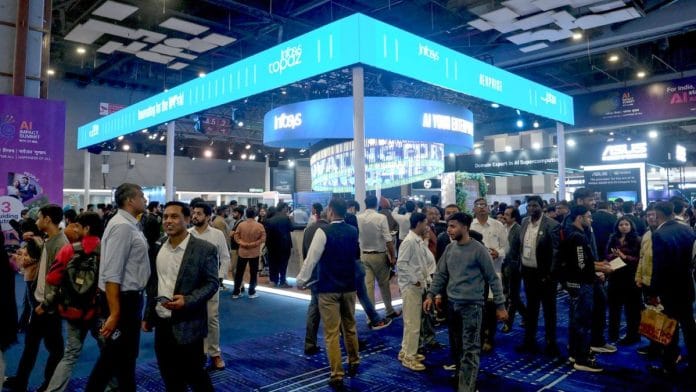
New Delhi: Union Minister for Electronics and IT Ashwini Vaishnaw Tuesday apologised for disruptions that marked the opening day of the India AI Impact Summit, saying organisers were “open-minded” and working to address complaints after large crowds overwhelmed arrangements at the venue, Bharat Mandapam on the first day.
“If anybody has faced any problems yesterday, my apologies for that… Whatever feedback you have, please share with us. We are open-minded,” Vaishnaw said at the venue, adding that a dedicated coordination war room had been set up to monitor issues in real time.
But even as the minister apologised for Day 1, Day 2 at Bharat Mandapam again long queues and confusion over entry passes. Several attendees told ThePrint, that despite registering in advance, their QR codes did not scan or their names were not reflected on the access lists at the main gate.
“We had confirmation emails, but at the counter they couldn’t find our badges,” one startup founder said. “We were moved between two lines for nearly an hour.” Another delegate said she missed the opening remarks of a scheduled panel while waiting to complete security checks.
To access a session venue, attendees were required to pass through at least two to three layers of security screening. Participants said that if they stepped out of a speaker session into the expo hall and attempted to return, the security process had to be repeated from the beginning, adding to delays and congestion between halls.
Inside the venue of the AI summit, frequent loudspeaker announcements were used to regulate movement between sessions. Attendees and speakers said halls were cleared abruptly to make way for subsequent events or high-level visits. In several instances, speakers were asked to wrap up discussions earlier than scheduled.
ThePrint attended a session titled ‘Building Trust in the Age of Synthetic Media’, which saw long queues outside the hall, including international delegates and speakers. Organisers instructed several attendees to “leave and attend another session” due to capacity constraints. Security personnel also used sharp, rooster-like alarm sounds over the public address system to prompt people to exit and clear the area.
“We were mid-Q&A when an announcement came asking everyone to clear the room immediately,” a policy researcher who was part of another panel told ThePrint, requesting anonymity. “It felt rushed. People still had questions.”
Security personnel were seen guiding participants out once seating capacity was reached. According to multiple attendees, announcements were repeated at short intervals, instructing people to vacate aisles or shift to alternative halls. Organisers cited safety and time management as reasons for the strict enforcement.
Congestion was particularly visible around sessions featuring international guests. Several foreign delegates were surrounded by groups seeking photographs as they moved between halls. Attendees told ThePrint that the situation at times became difficult to manage, prompting some overseas speakers to rely on Indian aides or volunteers to help navigate through crowds and decline repeated photo requests.
“One of the visiting delegates couldn’t walk five steps without being stopped for selfies,” an organiser said on condition of anonymity. “We had to assign someone to stay with them so they could reach their next session.”
Exhibition areas remained active but tightly monitored. Access to certain sections was temporarily restricted during high-profile visits, with volunteers forming human chains to create passageways through crowded corridors.
Lunch hours again saw heavy footfall at food counters. Following complaints on Day 1 regarding delays and payment issues, volunteers distributed food coupons to some participants as a gesture to offset inconvenience. Several attendees confirmed receiving meal vouchers after being unable to enter full sessions or after being asked to vacate halls mid-way.
“They gave us food coupons after our session was cut short,” a delegate said. “It was appreciated, but it doesn’t change the disruption.”
Connectivity issues continued intermittently, affecting digital payment systems at certain stalls. Additional volunteers were deployed to manage crowd flow and redirect attendees when halls reached capacity.
Despite the operational strain, panels and keynotes proceeded across tracks, with organisers attempting tighter adherence to schedules at the AI summit. Officials said corrective steps taken after the first day—including expanded coordination teams and closer monitoring of entry points—were aimed at stabilising arrangements for the remainder of the summit.
For many participants, however, Day 2 of the AI summit remained defined as much by queues, repeated security checks and abrupt announcements as by the discussions on artificial intelligence that brought them to the Capital.
(Edited by Viny Mishra)