



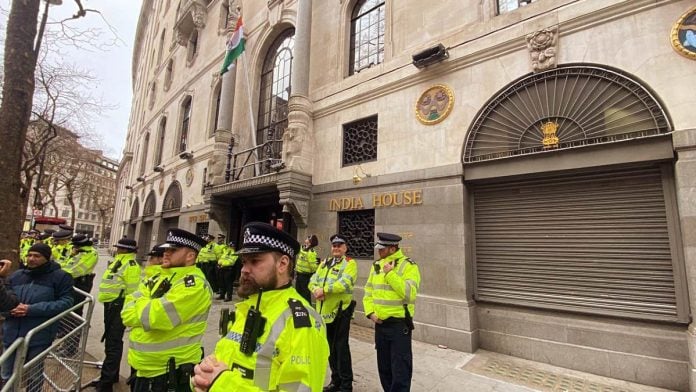
New Delhi: A special court in Delhi has discharged United Kingdom national Inderpal Singh Gaba from the offence of disrespecting the national flag despite observing that it was an offence under the Prevention of Insults to National Honours Act, 1971. The National Investigation Agency (NIA) special court considered factors such as Gaba’s nationality and the fact that the offence occurred outside the its jurisdictional limits. Additionally, the court flagged the absence of a prosecution sanction from the Union government, which is necessary to try a foreign national for an offence committed on foreign soil.
The special court, however, did frame charges against Gaba under the Unlawful Activities (Prevention) Act (UAPA) for taking part in a violent protest outside the Indian High Commission at London in March 2023, observing that the NIA could prima facie establish he was shouting pro-Khalistan slogans.
Gaba was detained by immigration authorities at the Attari border on 9 December 2023, while he was returning from London via Pakistan, and was later arrested by the agency as part of the probe into violence against the Indian High Commission and staffers in London. Gaba was granted bail in February last year.
Gaba’s counsel Arun Khatri said he would challenge the court’s order framing charges against Gaba under the UAPA. “We will challenge this in the high court, and it will be interesting to see how it is going to evaluate the material collected by the NIA against my client, who is a foreign national, for an event happening on foreign soil, especially the sanction part,” Khatri told ThePrint.
Offences made out but not charged
In September 2024, the NIA submitted its chargesheet on the March 2023 protest to court. Gaba is one of multiple accused named in the chargesheet.
According to the chargesheet, around 60 people, including Gaba, at the protest were carrying the yellow flags used by Sikh separatists. It says two others accused, Avtar Singh alias Khanda and Gurcharan Singh—both of Indian origin and wearing saffron turbans—instigated the mob by shouting anti-India and pro-‘Khalistan’ slogans. During the same, one of the agitators wearing a saffron turban climbed up the balcony, where the Indian flag was hoisted, with the help of others.
The said rioter, the NIA alleged in the chargesheet, dishonourably pulled down the National Flag and was trying to pass it down towards the rioters, who were trying to tear it. The agitators downstairs were pulling down the rope of the flag with force. Meanwhile, the rioter atop the balcony was handed over a yellow separatist flag by his fellow agitators from below, and he started waving it and also tried putting it on the flag post.
Additionally, the rioter who had climbed up the balcony intruded into the high commission building and assaulted the officers with a metallic flag pole, causing injuries to the officers, the NIA alleged. Simultaneously, other rioters started attacking the glass walls and window panes of the high commission building.
According to the NIA, Gaba was part of the overall design behind the violent incidents on 19 and 22 March 2023. It claimed the campaigns were in response to the crackdown against Waris Punjab De and its leader Amritpal Singh.
Special Judge Vikas Dhull observed that he was convinced that Gaba had committed an offence under Section 2 of the Prevention of Insults to National Honours Act, 1971, by standing on the National Flag as it lay on the ground. However, he said that his court couldn’t try him for the offence, citing his nationality.
Secondly, he observed that the jurisdiction of the Prevention of Insults to National Honours Act, 1971, is limited to Indian soil; hence, Gaba could not be charged for the offence.
“Said Act does not have any provision similar to Section 4 of the Indian Penal Code, 1860. Section 4 of IPC [Section 1(5) of Bharatiya Nyaya Sanhita] extends to extra-territorial offences, i.e. any offence committed under the IPC by any citizen in any place beyond India and any person committing any offence on any ship or aircraft registered in India,” Special Judge Dhull observed in the order passed Thursday.
ThePrint has seen a copy of the order.
“In the absence of any analogous provision in the Prevention of Insults to National Honours Act, 1971, whereby the Act has been extended to extra-territorial offences, the offence committed by a British national, i.e. accused in a foreign country i.e. Britain, cannot be tried in India,” the judge observed.
Also Read: NIA invokes UAPA, Anti-Hijacking Act in FlyDubai pilot attack case; to probe larger conspiracy
‘Union govt’s sanction needed’
The judge further said that the offence could not be tried before his court, even assuming that the place of the offence, outside the Indian High Commission, was territory of India, because the agency had not secured any sanction from the Union government.
“Further, assuming that the place outside Indian High Commission, London, forms territory of India, then also the offence under Section 2 of the Prevention of Insults to National Honours Act, 1971, cannot be tried before this court in absence of any sanction from the Central government of India,” he observed.
“Section 188 of the Code of Criminal Procedure, 1973, provides that when any offence is committed outside India, by a citizen of India or by any foreigner, then such offence can be tried in India, at any place where he is found, subject to the condition that the previous sanction of the Central Government is taken. In the present case, no such sanction under Section 188 CrPC has been obtained,” he observed.
Additionally, the court also cleared Gaba of conspiracy charges, flagging that the NIA failed to produce any evidence to establish that he was a member of the Waris Punjab De WhatsApp group in the UK and that he shared any messages or chats showing his involvement in the planning of the violent protest on 19 or 22 March 2023.
The court also rejected the NIA’s charge that Gaba was linked to the violent protests on both occasions, and said that the agency had failed to establish his presence at the first protest on 19 March or his involvement in planning them.
“Apart from the aforesaid, there is also no other material on record to show that the accused was in any way connected with the planning and organisation of the violent demonstration of 19.03.2023,” Special Judge Dhull said in the order.
The court, however, said that the videos extracted from Gaba’s own mobile phone corroborated that he took part in the protest on 22 March and raised slogans such as “Khalistan Zindabad” and “leke rahenge Khalistan”, and that he stood on the Indian flag when it was spread on the ground. The court also raised a “strong suspicion” that Gaba’s participation in the 22 March protest was a “voluntary and planned act”, since he may have been aware of the violent protest on 19 March.
“This court can take judicial notice of the fact that the Khalistan movement is a movement launched by Sikhs of Punjab whereby they seek secession of Punjab territory from India and forming it a separate state by the name of Khalistan. Therefore, accused by shouting slogans like ‘Khalistan Zindabad‘ and being part of the group where Khalistan flag was being raised and slogan like ‘Khalistan leke rahengein‘ was being raised, show that conduct of accused was supporting the claim to form Khalistan by ceding a part of territory of India i.e. Punjab,” Special Judge Dhull ruled.
“Further, the act of accused showing disrespect to the Indian National Flag by standing on it was an act intended to be done to cause disaffection against India. Therefore, the aforesaid acts of accused fall within the definition of “unlawful activity” as provided in Section 2(0) of UA(P) Act,” he further said in the order.
Notably, through an amendment to the National Investigation Agency Act in 2019, the Ministry of Home Affairs empowered the agency to probe an offence on foreign soil if it targets Indian sovereignty or interests.
(Edited by Nardeep Singh Dahiya)