





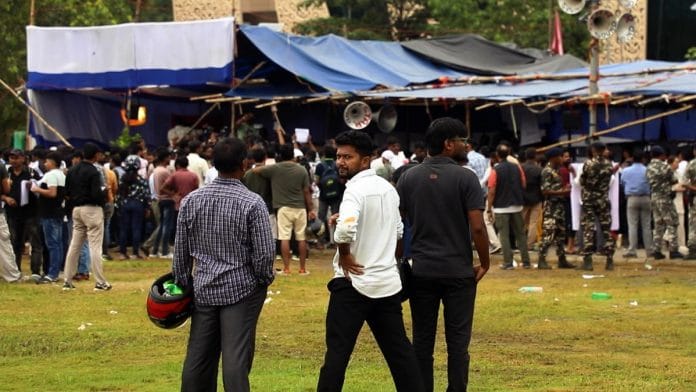


Ranchi: A Blinkit order arrived at Ranchi’s Jaipal Singh Munda stadium Tuesday night, with two cartons of essentials for hundreds of protesters who have been camping at the venue since 29 July. “Someone from outside India has sent this. From Thailand,” the delivery boy told the protesters.
One carton contained packets of peanuts, almonds and other snacks, along with Odomos and energy drink sachets. The other was filled with sanitary napkins for female protesters.
The pooling of resources at the protest ground is reminiscent of last month’s protests against the NEET exam paper leak at Delhi’s Jantar Mantar where food and other essentials poured in from across the country.
Inspired by the Cockroach Janta Party (CJP) protest at Jantar Mantar in New Delhi, hundreds of students from across Jharkhand have been protesting at the stadium against alleged paper leaks and irregularities in the Jharkhand Public Service Commission (JPSC) and Jharkhand Staff Service Commission (JSSC) recruitment exams. The protest began after the 14th Jharkhand Public Service Commission Combined Civil Services Examination (JPSC CSE) held in April was mired in controversy due to allegations of irregularities.
The protests have now brought together aspirants who have appeared for multiple recruitment exams conducted by the JPSC and the JSSC over the years.
Ever since students in Jharkhand decided to protest against the recruitment exams, parallels have been drawn between the protests at Ranchi’s Jaipal Singh Munda stadium and those protests at Jantar Mantar. However, while the Delhi protest may have inspired the protesters in Jharkhand, the two agitations differ in five prominent ways.
Fragmented protest
First, activist Sonam Wangchuk and the CJP served as a cohesive unit, binding protesters together in their common demands, which included then Union Education Minister Dharmendra Pradhan’s resignation, among others.
However, the agitation in Ranchi is highly fragmented, with two separate stages at the protest site and multiple interest groups with differing demands.
One set of students is demanding the cancellation of the 14th JPSC CSE, a Central Bureau of Investigation (CBI) probe and larger systemic reforms.
Others are seeking fast-track courts, the state education minister’s resignation, stricter punishments for those found guilty in recruitment exam scams, and stricter bail conditions for the accused. A two-page demand letter has also been issued, listing additional demands for cancellation and CBI/ED probe of several past exams, among other things.
Older protesters
The second big difference is that the Jantar Mantar protest was predominantly a Gen-Z-dominated and led protest. The average age of those personally affected sat firmly in the 14-to 29-year age bracket. However, in Ranchi, protesters from their early 20s to late 30s and even early 40s shared personal grievances with the examination process.
The maximum age limit for the JPSC and JSSC exams varies but ranges between 35 and 40 years.
For instance, Kishore Mandal, a protester from Giridih district, is 35-years-old.
He told ThePrint he had appeared for four exams so far: 7th to 10th JPSC Combined Civil Services Examination (CSE), the 11th to 13th Jharkhand Combined Civil Services Examination, the 14th JPSC CSE, then backlog exams and Forest Ranger exams. He got an age relaxation to appear in the last exam, through a court order.
“I have been fighting since the starting days of this protest,” he said.
Adding, “I am not fighting for just my future personally. I am also fighting for my small daughter, a five-year-old girl, because she will ask me this question, ‘Papa, where were you when such crimes were plaguing the system?’”
Different demands
The third difference lies in the cause they are fighting for.
While the Delhi protest was largely centred around the NEET paper leak, the Jharkhand protest isn’t limited to just one examination or even one alleged irregularity.
Students have alleged paper leaks, backdoor recruitment, non-disclosure of cut-off marks, and fudging of OMR sheets, among other things.
They say the recruitment exams often don’t stick to the calendar issued by the JPSC and JSSC. Moreover, when they are held, they are either often cancelled because of alleged irregularities and paper leaks, or end up in court.
Conventional posters
The fourth difference lies in the banners used in the protests.
Since Gen Z has grown up on memes, posters and placards at Jantar Mantar were all in quintessential meme language.
Protesters made reels on the site, even while anticipating beatings, making “rate my outfit” videos and even recording lip-syncing and dance reels.
In Ranchi’s protest, the placards and posters are more conventional.
Near the main stage, protesters have hung handwritten posters with slogans like: ‘Nyay nahi to andolan jari rahega’ (the struggle will continue if we don’t get justice), and ‘Paper leak dhandhli bardasht nahi! Yuva jaga hai, ab aar paar hoga’ (we won’t tolerate paper leak fraud; the youth has awakened, and now it is all or nothing).
One poster called the main accused in the case, Jharkhand government employee Abhay Tiwari, ‘Veer Soorma Bhopali’, and the biggest “khiladi”.
Naming Tiwari as one of the masterminds in the case, the CID has said that he has a track record of clearing several competitive examinations.
They include the 2018 Police Sub-Inspector written examination; the 2013 written examination for a post in the Navy; the 2014 written examination for an assistant post at the Bhabha Atomic Research Centre; the 2018 CRPF Head Constable examination (written and typing); the 2014 Northern Coalfields Limited (NCL) written examination; JSSC examinations for PGT (Post Graduate Teacher) and CGL; JPSC examinations for various posts, and the Jharkhand Combined Civil Services preliminary examinations.
The poster, made by ChatGPT, hangs in full view, with Tiwari’s picture.
Protest language
The final difference is the language of the protest.
The protesters, as well as political leaders in Jharkhand, emphasise that their protest has not used any expletives or abusive language against anybody. They are ensuring that abusive language is not used at the site.
Before the tiranga march Wednesday, members of the core team behind the protest urged members to use decent language during the march.
On the other hand, the language used by protesters at Jantar Mantar has remained a talking point during and even after the protest.
The protesters in Jharkhand say the language of their agitation distinguishes them from the Delhi protests. “Students have been raising Jharkhand’s image in the entire country. We aren’t taking any names, nor are we raising the slogans of ‘Bharat tere tukde honge’,” one of the core committee members, Pawan Kumar Goswami, told ThePrint.
“We haven’t been using abusive language. We’re not asking for anybody’s resignation either. We’re only making genuine demands, and we want reform,” Goswami added.
(Edited by Sugita Katyal)
Also Read: Anatomy of Jharkhand protests: 2 stages, 8 on hunger strike, a quest to be ‘non-political’
Why has this media buried this protest in the inside pages? Nothing much to feed off of it to suit your political agenda? Not that profitable? Not that sensational enough?