



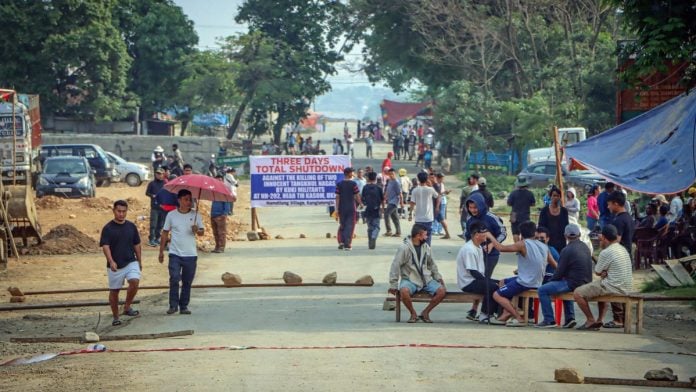
New Delhi: Amid continued unrest in Manipur, Meitei groups have moved the Supreme Court against “highway blockade and extortion”, stating that the state and central governments “are yet to come up with an alternative route and emergency supply chain plan to effectively offset the adverse effect of highway extortion and blockade of national highways in Manipur”.
The Team Meitei Personalities Manipur (TMP Manipur) and Meitei Alliance Trust Monday filed a Public Interest Litigation (PIL) before the apex court under Article 32 of the Constitution, seeking judicial intervention to ensure safe, free and non-discriminatory movement of people, passengers, goods and essential supplies along national highways in Manipur.
The petition wants the governments to “prepare a route-resilience plan identifying alternative road, rail and other logistics options for essential supplies, including storage points, trans-shipment arrangements, security requirements and the authority empowered to activate contingency routes”.
Manipur has four main National Highways, primarily connecting it to the rest of India and the neighbouring country of Myanmar.
These include National Highway 2 connecting Manipur to Dimapur, Nagaland and Guwahati, Assam through Kangpokpi and Senapati districts; National Highway 37 connecting Manipur to Silchar and Guwahati, Assam through Jiribam district; National Highway 102 connecting Manipur to Myanmar through Moreh and Tenoupal districts; and National Highway 202 connecting capital city Imphal to Mokokchung in Nagaland, passing directly through Ukhrul district.
The petition names the State of Manipur, the Union of India through the Ministry of Home Affairs, and the National Highways Authority of India (NHAI) as respondents. It seeks comprehensive directions to prevent unlawful highway blockades, address extortion and unauthorised collections from highway users and an effective mechanism to protect vital transport routes.
‘Gross & incessant violation’
The PIL raises “serious issues of gross and incessant violation of constitutionally guaranteed fundamental rights of the people of Manipur for the last more than three decades, apparently because of Manipur’s remote location beyond the mainstream national glare and apparent governmental apathy”.
“The petitioners are left with no option but to file the instant Public Interest Litigation under Article 32 of the Indian Constitution in general public interest of the people of Manipur and Manipur’s fragile economy in particular against the rampant extortion rackets on the national highways of Manipur (reportedly a fundraising module for insurgent groups) and frequent blocks/blockades of such highways, causing serious economic woes for the last more than three decades,” it says.
It says that the constitutionally guaranteed fundamental rights to equality under Article 14, life and personal liberties under Article 21 and free movement under Article 19(1)(d) of the people of Manipur have “long been seriously infracted by mass extortion rackets and frequent blockades of national highways in Manipur. Manipur cannot continue to be the victim of the much cliched ‘out of sight, out of mind’ syndrome”.
The petitioners have urged the court to ensure that access to national highways is not restricted on the basis of ethnicity, community, residence, origin or destination. They have also sought directions against the unlawful obstruction or control of highway passage in the name of bandhs, economic blockades, protests or agitations, while preserving the lawful exercise of the right to peaceful protest, a TMP member said.
Coordinated highway protection plan
The petition states, “The issues raised in the present petition concern public access to and the uninterrupted functioning of the national highways and other vital transportation routes in Manipur, which directly affect movement of people, food, medicines, fuel, essential commodities, commercial goods, etc.”
The TMP member said a key prayer in the petition is for the “Union and State governments, in consultation with highway administrations and security agencies, to prepare and implement a coordinated highway protection and free-movement plan within a timeframe fixed by the court”.
The petitioners have sought a comprehensive long-term plan that should “identify vulnerable points on all national/state highways in Manipur by dividing them into mapped stretches, with critical junctions, bridges, bottlenecks, recurring obstruction points and truck-holding areas”.
“On designated highway corridors, unauthorised barricades, gates, private checkpoints, forced diversion, collection points, vehicle inspections or occupation of the carriageway should be prohibited. Legitimate statutory checkpoints should be clearly identifiable by agency, unit and responsible officer,” it adds.
“Apart from their scarcity, prices of essential commodities shoot up during national highway blockades, causing serious social and economic trauma to the people of Manipur. To this extent, during heightened risks, the respondents should be directed to prioritise: (a) medicines, oxygen, medical supplies, fuel, Liquified Petroleum Gas (LPG), water and life-critical commodities; (b) food and other essential commodities; and (b) ordinary commercial cargo. This categorisation is only for prioritising protection and does not legitimise blockade of other lawful traffic movement.”
Action against extortion, unauthorised collections
The petition calls for action against the unauthorised collection of money, purported taxes, tolls, fees and compulsory contributions from highway users. “Various groups have been collecting and extorting money along national highways in Manipur for the last some decades. A highway can be nominally open while being practically unusable if vehicles are repeatedly stopped, threatened or compelled to make unauthorised payments,” the petition says.
“Extortion should therefore be treated as a distinct highway security problem. Such large-scale extortion on the highways of Manipur has been making the prices of commodities comparatively high since businessmen tend to pass on the burden of extorted amount to the consumers ultimately.”
It seeks the Government of Manipur and Union of India “ought to be directed to share information with this Hon’ble Court about the number of First Information Reports (FIRS) relating to extortions on national highways in Manipur, pending court cases and steps taken to prevent such daylight robbery on the highways of Manipur.”
The petition also says: “Mention may be made here that even the then chief minister of Manipur in 2010 had gone on record before the Assembly to confirm that between 1995 and 2010, 628 bandhs and blockades were witnessed in Manipur, causing a loss of about Rs 3000 crore to the state exchequer”.
“It is also reported that during 3 May 2023 to 8 September 2026 i.e. three years and four months (1225 days), Manipur witnessed 523 days of economic blockades and shutdowns of national highways. Even 2011 witnessed 123 days of blockade, and 20 days of bandh in the state of Manipur,” the petition states.
“Because the respondent state of Manipur and Government of India have not taken adequate steps to ensure that inmates of camps housing ex-militants under the suspension of operations arrangement with the Government of India are not allowed to come out and extort money on the highways of Manipur.”
It says, “Where credible material indicates that a person associated with an organisation covered by a suspension of operations or ceasefire arrangement has participated in extortion, intimidation or unlawful interference with highway movement, the incident should be investigated in accordance with law and the applicable terms of that arrangement. The existence of such an arrangement should not, by itself, prevent investigation or accountability for an alleged offence.”
The TMP official said the petition seeks appropriate legal action against offences involving intimidation, coercion, violence and extortion associated with such collections. The petitioners have also requested a publicly designated, 24-hour reporting channel and nodal officers to receive complaints concerning blockades, threats, extortion and unlawful collections. The proposed mechanism would facilitate prompt complaint registration, response and referral for investigation, alongside safeguards for the identity and safety of complainants and witnesses.
The petition further seeks prompt registration, investigation and prosecution of offences involving unlawful obstruction, extortion, wrongful restraint, intimidation, assault and damage to property, wherever warranted by the evidence and applicable law. It also calls for investigations into individuals alleged to have organised, financed, directed or enforced such conduct, subject to due process.
Another significant prayer concerns alleged unauthorised occupations, hoardings, gates, barriers, checkpoints, collection booths and similar structures on national highway land in Manipur.
(Edited by Nardeep Singh Dahiya)