


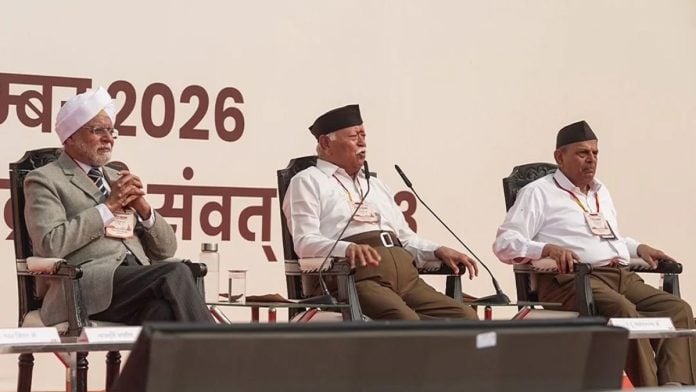
New Delhi: Heaping praise on the Rashtriya Swayamsevak Sangh for its contributions in nation-building, former Chief Justice of India J.S. Khehar Sunday lauded the Sangh for protecting Sikhs during the 1984 riots in Delhi.
“Official RSS publications maintain that swayamsevaks actively helped protect Sikh families and even guarded threatened neighbourhoods. This position was confirmed by writer and historian Khushwant Singh, who, despite his close association with the leadership of the then ruling party, credited RSS with helping and safeguarding Sikh lives and maintaining communal harmony. And that is the truth of my belief,” he said.
Justice Khehar was speaking at an RSS mega event, ‘Rashtra Vandanam’, held at Samrasta Sthal in Delhi’s Rohini Sunday as part of its centenary celebrations.
During his tenure as the CJI, Justice Khehar was a part of the bench that had declared instant triple talaq unconstitutional. However, he had authored the dissenting judgement, along with Justice S. Abdul Nazeer. Their minority opinion had proposed that Triple Talaq be made inoperative for 6 months from the ruling, and in this time, the Parliament must frame a law governing triple talaq. The minority had opined that the solution against the gender discriminatory practice lay in legislative change, not a constitutional challenge.
Also present at the event were Home Minister Amit Shah, Finance Minister Nirmala Sitharaman, Health and Family Welfare Minister J.P. Nadda, and Delhi Chief Minister Rekha Gupta, among others.
RSS Sarsanghchalak Mohan Bhagwat also spoke about his global outreach during the centenary year celebrations.
“We saw this environment in countries around the world…this attempt was made in all five continents. The reason for this attempt was that there were many people who were spreading negative propaganda about India, Hindutva, and the Sangh, and it was going on unchecked…The other side isn’t confronting the people. So they confronted them, which is why we made the effort,” he said, adding that people outside India are curious about the country’s “mindboggling diversity”.
Khehar also mentioned Bhagwat’s visit to New York, and the comments made by New York mayor Zohran Mamdani before the event. Mamdani had publicly claimed that he did not support the rally, adding that he grew up with an understanding of India as “a pluralistic society of a secular Republic that believed in the belonging of each and every person who was from India”.
Referring to Mamdani’s statements, Khehar asserted that when the mayor referred to India as a “pluralistic society”, the former intended to “convey that India lacked oneness, which was the theme of the celebrations”.
“He (Mamdani) was obviously ahead of himself. At the event, Dr Mohan Bhagwat described the Indian position as unity in diversity. Dr Bhagwat acknowledged the plurality expressed by the Mayor as diversity. At the same time, he clarified the Indian position as oneness in diversity,” the former judge said.
‘At the forefront in moments of crisis’
In his address, Bhagwat pointed out how if a foreign power attacks India, all differences of opinion in India disappear. “The only requirement is that this unified wisdom which awakens in times of crisis should always remain steadfast in the hearts of all of us and our conduct full of mutual goodwill should stand firm in this country,” he said.
In his address, Justice Khehar congratulated RSS for its “extraordinary achievements”, and said, “Recorded history evidences that swayamsevaks have been at the forefront in moments of crisis. During the partition of the country in 1947, swayamsevaks played an active role in organising self-defence, relief and in the evacuation of Hindus and Sikhs in Punjab. Thereafter, after the Chinese invasion of 1952, swayamsevaks, at great personal risk, supported the Indian Army as well as the civil administration in carrying men, material, fuel and other essential supplies, behind the frontlines.”
He added that in recognition of the contribution of swayamsevaks, then Prime Minister Pandit Jawaharlal Nehru had invited RSS to India’s Republic Day Parade in 1963, and claimed that more than 3,000 swayamsevaks had participated in the parade.
“Following the earthquake in Assam in 1950 and the earthquake in Latur in Maharashtra in 1993 as well as the earthquake that hit Bhuj in Gujarat in 2001, thousands of swayamsevaks cleared debris, set up temporary medical camps, distributed food and participated in longtime village rehabilitation,” he further said, adding that the same enterprise was displayed by swayamsevaks during Covid-19 pandemic.