


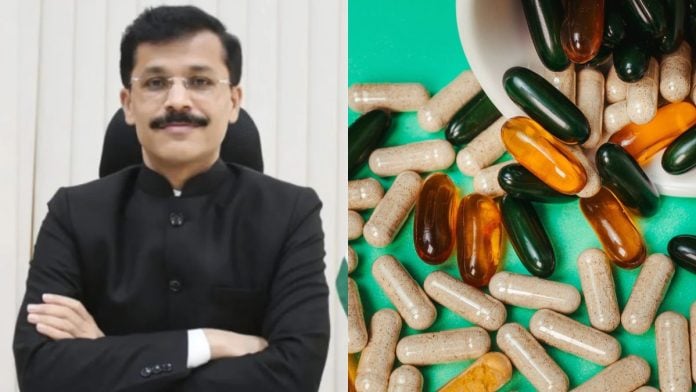
New Delhi: Maharashtra Food and Drug Administration (FDA) Commissioner Tukaram Mundhe is back with a warning for supplement sellers and promoters: health supplements cannot claim to cure diseases.
In a post on social media platform X on Tuesday, Mundhe said claims made on product labels, websites, e-commerce platforms and through influencers must comply with the law. He added that gyms, pharmacies and fitness centres selling supplements must obtain a licence or registration from the Food Safety and Standards Authority of India (FSSAI).
“No supplement can claim to cure a disease. If a product label, website or influencer makes such a promise, it is not just misleading; it is against the law,” he said.
Those publishing or promoting misleading advertisements, including social media influencers, would be held accountable, he said.

The warning follows a statewide compliance order issued by the Maharashtra FDA on 20 November, directing stricter enforcement of existing regulations for three categories of products — health supplements, nutraceuticals and foods for special dietary use.
Health supplements, which include products such as vitamin tablets, protein powders and mineral supplements, are meant to add nutrients to a person’s regular diet. Nutraceuticals contain ingredients derived from food, such as plant extracts or other concentrated compounds, which are marketed for their nutritional or physiological benefits. Foods for special dietary use are formulated for people with particular dietary requirements, such as those with diabetes or other health conditions, or for groups such as pregnant women and sportspersons.
These products are regulated as food, and not medicines, under the Food Safety and Standards Act, 2006. This means they cannot be marketed as products that treat or cure diseases, and must comply with FSSAI rules on ingredients, composition, labelling and health claims.
Crackdown after violations
The FDA said inspections, consumer complaints and surveillance repeatedly revealed violations, including the sale of products without valid licences, use of unapproved ingredients, excessive levels of vitamins and minerals, misleading health claims and inadequate labelling.
In a statewide inspection drive on 13 November, officials searched 17 establishments across six divisions and seized stocks worth Rs 1.38 crore. The products included supplements containing Magnesium Acetyl Taurate and Nicotinamide Mononucleotide — ingredients whose approval applications had been rejected by FSSAI.
The compliance order covers manufacturers, brand owners, importers, distributors, retailers, pharmacies, gyms and e-commerce platforms, irrespective of their size or turnover.
Businesses must hold the appropriate FSSAI licence or registration, with the relevant product category endorsed on it. A licence under another law does not exempt gyms, pharmacies or medical stores from this requirement.
Responsibility extends to online platforms and influencers
The order reiterated the prohibition on claims that products can treat, cure, mitigate or prevent diseases, as well as misleading medical representations and doctor endorsements. The requirements extend to e-commerce listings, social media promotions and influencer advertisements.
Mundhe said manufacturers, wholesalers, retailers and sellers would each be responsible for verifying the legitimacy of products rather than shifting the blame along the supply chain.
The FDA said the state’s 1,100 existing food business licence holders in the health supplement and nutraceutical categories would be subject to risk-based inspections. Sports nutrition, weight-loss, sexual wellness, herbal and imported products, along with sales through gyms and online platforms, will be subjected to particular scrutiny.
(Edited by Anupama Yadav)
Also Read: What makes a good leader? Tukaram Mundhe’s lessons at Shiv Khera Academy launch