


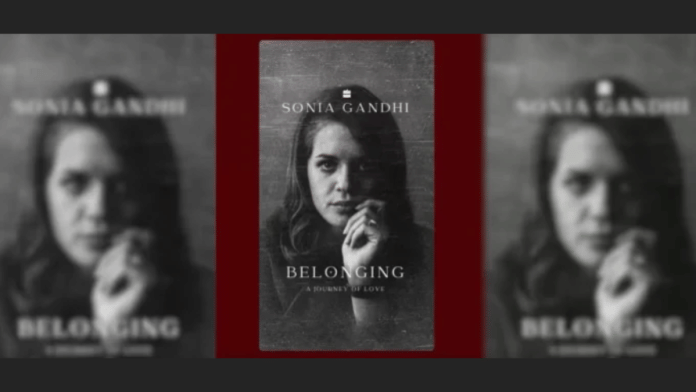
New Delhi: Sonia Gandhi had agreed to become Prime Minister after the Congress-led UPA won the 2004 Lok Sabha elections but changed her mind before Manmohan Singh was chosen for the post, according to her forthcoming memoir, Belonging: A Journey of Love.
In an interview with The Hindu ahead of the book’s release on 10 November, Gandhi, who was Congress president at the time, recalled that months before the election, she had told one of her children, “Absolutely not”, when asked whether she would accept the post if the party won. However, after the results, and amid pressure from party leaders, she eventually relented, saying “Theek hai” (okay), before changing her mind.
Asked whether she had ever wondered how the UPA government might have been different had she become Prime Minister, Gandhi said the thought had never crossed her mind. “No, not at all. That has never crossed my mind. Our experience was by and large a very positive one. We worked as a team, and our roles were distinct with him (Singh) leading the government and I leading the party,” she said.
Also Read: In new video, Sonia recalls being against Rajiv becoming PM, says memoir may cause some ‘tamasha’
Sharad Pawar’s 1999 revolt
Gandhi also revisited the 1999 revolt by Sharad Pawar, P.A. Sangma and Tariq Anwar, who questioned her foreign origin at a Congress Working Committee (CWC) meeting and argued that she could not hold high office in India.
The confrontation prompted Gandhi to offer her resignation as Congress president. She was, however, persuaded to continue after the party expelled the three leaders who went on to form the Nationalist Congress Party (NCP).
In her memoir, Gandhi recalls walking out of the meeting in tears. “I hadn’t entered politics to grab position and power. It was some of these colleagues who had urged me to join politics, and now they were turning on me… It wasn’t the issue of holding office that hurt me; it was that my loyalty to India was being questioned,” she writes.
She eventually decided that she could not allow the episode to distract her from her political responsibilities. “I could not let my personal feelings divert me from my larger purpose. I had to continue.”
Gandhi said her decision to enter politics, after years of staying away from public life, came when she felt the Congress was weakening and the purpose behind her family’s sacrifices was under threat. “I felt I had to do something,” she said.
On Indira Gandhi and Emergency
The memoir also reflects on the influence of Rajiv and Indira Gandhi on her political life. Describing the Emergency as “indisputably, a dark chapter in the history of independent India”, Sonia Gandhi said the pressures on Indira Gandhi at the time came from beyond Sanjay Gandhi.
“It was not only Sanjay, though in the public mind he is often seen as synonymous with the Emergency. There was a lot of pressure from some of her senior colleagues, and I think there were very few people around her like Rajiv who had a different point of view,” she said.
Gandhi said she understood the full gravity of the period only after the Emergency ended. “It was only after the Emergency that I came to know the true gravity of what had been happening,” she said.
She acknowledged that democratic rights had been curtailed and habeas corpus suspended. She also referred to the violent protests, arson and calls for the bureaucracy and armed forces to disobey orders that preceded the Emergency.
Gandhi also pointed out that Indira Gandhi had called the March 1977 elections and later publicly expressed regret and apologised for the excesses committed during the Emergency.
Congress’s stand on secularism and political compromises
On the Congress’s internal affairs, Gandhi said some party members had argued against taking an uncompromising stand on secularism, but maintained that this was not the party’s position. “In our policies and actions, I believe we have been steadfast in standing with the constitutional right of our people to worship and practise their religion and belief without fear,” she said.
She also reflected on the political compromises made during her years as Congress president, questioning in her memoir whether some of those decisions had achieved their intended purpose. She said they continued to weigh on her conscience.
In the interview, Gandhi acknowledged that political compulsions had sometimes required the Congress to join hands with parties that did not share its ideology.
“It never sat easy in my mind,” she said, adding that the Congress had never compromised with the BJP or the RSS. “We never made any compromises with the BJP and the RSS and we never will.”
On the BJP, RSS and Narendra Modi
On the current political situation, Gandhi said the past 12 years had caused serious damage to India’s democratic institutions and that restoring them would require considerable effort. “Over the last twelve years great damage has been done to the fabric of our country, our democracy and our institutions. Even after this government goes it will take time to restore our systems back to health, and great effort from political parties,” she said.
Asked what the Congress could learn from Prime Minister Narendra Modi’s rise, Gandhi cited former Prime Minister Manmohan Singh and party president Mallikarjun Kharge as examples of leaders who had reached the top through different routes within the Congress.
“I don’t think we have much to learn from the RSS,” she said.
She accused the government of exercising control over institutions, particularly the Election Commission, and mainstream media, while using money, power and religion to its political advantage. She also alleged that Opposition parties had not been given a level playing field.
Defending the Congress’s record, she said, “It is the only party that has had the resilience to withstand this onslaught,” adding that it was working with like-minded groups.
On Rajiv Gandhi and her journey to belonging
Gandhi also spoke about the values she had carried from her childhood, including “loyalty to family and friends, sincerity and feeling for others, the idea of being dutiful and responsible”. Describing the memoir as more than a love story about Rajiv Gandhi, she said it also traced her growing attachment to his family and India.
“It is also the story of how I grew to love Rajiv’s family and the country to which they belonged, and then I too came to belong in it,” she said.
She added that she remained the person Rajiv Gandhi had met 60 years ago, “But I used to smile and laugh a lot more then!”
The publisher for Gandhi’s memoir had changed from Penguin Random House India to HarperCollins India allegedly over editorial disputes. However, when asked about the change, Gandhi declined to comment, saying, “I would rather not involve myself in these controversies.”
(Edited by Chingkheinganbi Mayengbam)