


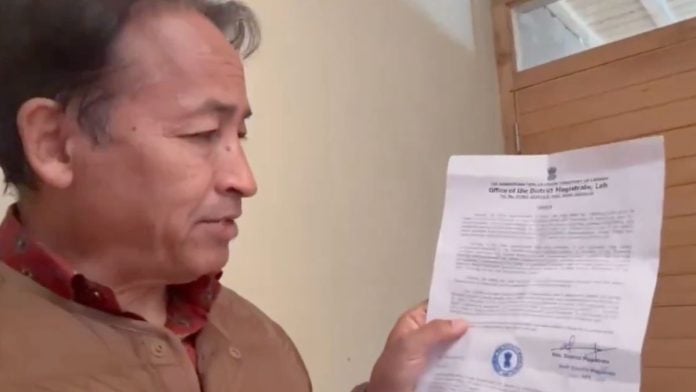
New Delhi: Ahead of the Ladakh Autonomous Hill Development Council (LAHDC) elections scheduled for 4 December, the Ladakh administration issued an order restricting climate activist Sonam Wangchuk’s movement, a day before he was due to participate in a protest against the advancement of the polls.
The order, issued on 11 November and signed by the Additional District Magistrate, invokes Section 163 of the Bharatiya Nagarik Suraksha Sanhita (BNSS) to impose preventive restrictions on Wangchuk for 60 days. The activist has alleged that he was forcibly taken from the protest site to his residence and placed under house arrest, with 20-30 police and paramilitary personnel deployed outside his home.
Meanwhile, Ladakh DGP said that “Sonam Wangchuk has been advised to stay at his residence in view of the prohibitory orders issued by the Chief Electoral Officer, UT Ladakh, and the District Magistrate, Leh.”
Wangchuk has filed a representation seeking clarification from government officials on the restrictions imposed on him.
How Wangchuk was taken home
Speaking to ThePrint, Wangchuk said he visited the proposed protest venue, NDS Memorial Park in Leh, around 7 pm on 11 November to oversee preparations being made by volunteers.
He alleged that around 8 pm, a group of men in plain clothes, accompanied by a uniformed police officer, entered the tent where he was having refreshments with volunteers.
“At about 8.00 pm, while I was having refreshments with them in the tent, a group of policemen, dressed in plain clothes without name tags, wearing hoodies and black masks, arrived at the venue, accompanied by a police officer in uniform,” he told ThePrint. “They informed me that an order of the Magistrate had been passed against me, and handed me a copy of it.”
Wangchuk said he felt compelled to accompany the personnel. “I was forcefully pushed into a vehicle by four men in masks, without being informed of where I was being taken. They would not allow me to take out my phone, and an attempt was made to take it from me, which I resisted. I was in this way prevented from informing my family or from speaking to a lawyer.”
He said he was driven towards his village and eventually taken to HIAL, reaching there at approximately 8.40 pm.
“I was told to remain at home under the supervision of police guards. Since that evening, dozens of armed police personnel have been stationed at and around my residence and continue to remain deployed there as I write this representation,” he said.
“Nothing has changed since 11 November, the internet is very slow, they are not allowing me to leave. There are around 20 to 30 people keeping an eye on me, and even have CCTV mounted on the police vehicles to record my movements,” Wangchuk told ThePrint.
He added that the police had set up three tents, with at least five to ten personnel in each.
Wangchuk also took to X, where he said, “I am under house arrest.”
DAY 3 OF HOUSE ARREST
Is this really house arrest !?
My Experiment with law & disorder…! Our lawyers from Supreme Court asked us if it's is really a house arrest of 60 days as I had claimed or just 'an advice to stay at his residence' as the DGP Ladakh tweeted. Since the… pic.twitter.com/6RYUg4maUP
— Sonam Wangchuk (@Wangchuk66) November 13, 2026
“Dozens of armed guards surround my house while the government version says ‘I have been advised to stay at home’. All for asking uncomfortable questions like… why is the Judicial Enquiry Commission Report (of last year’s killings in Leh) delayed & a phoney Council election is foisted on people with rocket speed in mid winter,” he wrote, adding, “The whole of Ladakh is in protest.”
He also alleged that his reach on X, Instagram and YouTube had been “drastically suppressed.”
Also Read: Sonam Wangchuk accuses Centre of backtracking, reiterates demand for Ladakh legislature
Protest goes ahead in Leh
Despite the restrictions imposed on Wangchuk, the dharna at NDS Memorial Park went ahead on 12 November, with approximately 600 people gathering at the venue.
Wangchuk said the gathering passed off peacefully and that the police present did not object to or stop it.
“It passed off entirely peacefully, and the police present raised no objection and did not stop it. Therefore, if that gathering were an unauthorised one within the meaning of the order, it would have been prevented; it was not. On the Administration’s own conduct, therefore, it is not an unauthorised gathering, and nothing in the order bars my participation in it,” he said.
What does the administration’s order say?
The order issued by the Administration of the Union Territory of Ladakh followed a request from the Senior Superintendent of Police, Leh, for preventive orders and restrictions on Wangchuk.
It cited his “activities, previous antecedents and alleged attempts to mobilise and instigate the general public” as having affected public order in the district previously. It also said there was an apprehension that his future programmes, demonstrations, hunger strikes and public gatherings could again lead to a disturbance of public peace and tranquillity in Leh.
The order further stated that such activities, if not regulated, could create circumstances prejudicial to the ongoing electoral processes for the Municipal Committee, Panchayats and LAHDC, Leh, and adversely affect their peaceful and orderly conduct.
It also noted that the Model Code of Conduct was in force in the district following directions issued by the State Election Commission for the Union Territories and the Chief Electoral Officer, Ladakh.
The magistrate invoked Section 163 of the BNSS to impose restrictions on Wangchuk’s movement. “This order shall come into force with immediate effect and shall remain in force for a period of 60 days,” the order stated.
Wangchuk seeks clarity on restrictions
In his representation, Wangchuk sought clarification from the Administrative Secretary to the Government, the Lieutenant Governor of Ladakh, the Chief Secretary, the DGP, the District Magistrate and the Senior Superintendent of Police, Leh, among other officials. He also addressed the Home Minister and Home Secretary of the Government of India.
Wangchuk pointed out that the written order did not explicitly mention house arrest, detention or confinement, nor did it direct him to remain at his residence. He said the instruction to stay home had instead been communicated orally by the personnel who took him from the protest venue.
He also questioned the scope of the restrictions, saying the order did not specify where he could not go, the boundaries within which his movement was restricted or the hours during which the restrictions would apply. It also did not clarify whether he could leave his home for work, medical treatment, worship or family obligations, or travel outside Leh district, he said.
“Am I at liberty to leave my residence? If I am not, I respectfully seek clarity as to under which provision I am being prevented, and whether any order of detention, by whatever name it may be called, has been passed against me,” he asked.
“In light of the above, the order dated 11.11.2026 is clearly bad in law, arbitrary, vague and disproportionate,” he said.
He also objected to the use of the expression “any activity” in the order, arguing that it was vague and could prevent him from carrying out his ordinary occupation and day-to-day activities.
He further questioned the provision prohibiting “unauthorised rally or gathering”, saying the order did not specify the authority from which permission could be sought, the procedure for obtaining it or the time within which an application would be decided.
3 reasons why the protest was called?
The first was the advancement of the LAHDC elections to 4 December, 2026. Protesters argued that the polls would coincide with the onset of extreme winter in Ladakh, when a substantial section of the electorate migrates out of the region and may be unable to vote.
The second was the decision to hold the elections while dialogue between representatives of Ladakh and the Union Government on the restoration of democracy in the region remained stalled.
The third was the delay in making public the judicial inquiry commission’s report into the incidents of 24 September, 2025.
(Edited by Anupama Yadav)
Also Read: Colonel Sonam Wangchuk, MVC—a quiet warrior, a gentle soul, the Lion of Ladakh