





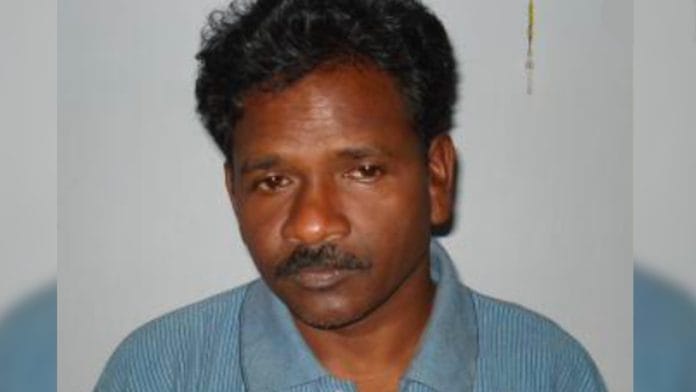

New Delhi: On a September night in 2007, a police team in Jharkhand landed a prize catch—without firing a single bullet. Acting on a tip-off about the movement of a Maoist leader in the Khunti area near Ranchi, the police team intercepted a vehicle loaded with detonators and arrested Misir Besra, the seniormost leader of CPI (Maoist) in Jharkhand.
Besra, also known as Bhaskar or Sunirmal, was then a member of the banned outfit’s think tank, the politburo, and the mastermind behind some of the deadliest attacks in the region.
But, the breakthrough was brief. Besra escaped from the grasp of the Bihar Police following an audacious attack by Maoist cadres at the court premises in the state’s Lakhisarai district in 2009, when he was taken on a production remand.
Nearly two decades later, 66-year-old Besra remains an elusive figure for security forces. All other remaining members of the CPI (Maoist) politburo either surrendered or were killed in encounters across Chhattisgarh, Telangana, Maharashtra and Andhra Pradesh.
“The deployment of forces has been reinforced in the forest, and although direct contacts have not been established yet, we are hopeful that the day of direct contact and exchange of fire is not very far,” a source in the Jharkhand Police told ThePrint.
The Maoist insurgency was once considered the country’s most serious internal security threat. Left-Wing guerrillas operated across vast swathes of jungles from West Bengal to Chhattisgarh, Jharkhand and Maharashtra—an area known as the ‘Red Corridor’.
But, after decades of armed conflict born from a peasant uprising in West Bengal’s Naxalbari in 1967, the movement’s footprint has shrunk in recent years. Many Maoists surrendered ahead of MHA’s 31 March deadline to eradicate Left-Wing extremism in India.
Except Besra.
Now, police have now turned to his family for help.
Also Read: Messengers for security forces, a listening ear to Maoists—Bastar journalists acted as ‘bridge’
Emotional appeals & Saranda searches
ThePrint reviewed three videos released by Besra’s younger brother, his son and son-in-law with a common appeal: please surrender and return to live with the family.
His younger brother, Devi Lal Besra, is a para-teacher in Giridih district, while his son, Jay Besra, works as a canteen helper in southern India. Besra also has a daughter. Her husband, too, has called on Besra to surrender.
Their appeals, however, have not yielded any results so far.
Meanwhile, security forces have maintained their momentum in the Saranda forest, where Besra is believed to be hiding. Sources in the forces and intelligence agencies said Saranda remained the last uncharted territory for them. There is no consensus among security and intelligence officials on the path Besra may adopt—surrender or continue to fight.
Some officials in Jharkhand Police said they did not see him laying down his arms and surrendering before the forces. “Historically, the tribals of Jharkhand are known to be staunch fighters. They do not give up their weapons and are not driven by any deadlines or threats of a crackdown,” one police officer said, adding that no senior Maoist leaders surrendered in Jharkhand, irrespective of the killings of the cadres working with them.
Besra first entered police records when he allegedly looted four rifles from a police search party in the Hembram area of Ranchi in 2000. During interrogation after his 2007 arrest, Besra allegedly confessed to having carried out the loot.
He allegedly carried out two big attacks on security camps of the CRPF in Hazaribagh and Jharkhand Armed Police (JAP) in Dhanbad in 2001, killing 12 and 13 personnel, respectively. The twin attacks were followed by the looting of at least 26 SLR rifles and two Light Machine Guns (LMGs), along with ammunition.
He allegedly orchestrated the looting of nearly 100 weapons over a decade till his arrest in 2007. But the most brazen was the Jehanabad jail break in which 389 prisoners walked out of a Bihar prison following a Maoist attack in November 2005. During interrogation by Jharkhand Police, Besra allegedly confessed to having played a key role in the jailbreak.
Overall, Besra faces 154 cases across several police stations in Jharkhand, Bihar, Odisha, and West Bengal. He has also been charged in three cases being probed by the National Investigation Agency (NIA).
‘Professional revolutionary’
Besra’s initiation into a life of violence wasn’t sudden. Born into a tribal family engaged in agriculture in Jharkhand’s Giridih, Besra was the eldest of three children.
According to police records, he developed a tilt for the Left-leaning movement early in life, inspired by the struggles of Shibu Soren—Jharkhand’s former chief minister and founder of the ruling JMM—against landlords and moneylenders in the state’s rural pockets.
Besra received an education up to Class 7 at a government school in his native village before passing the matriculation exam from a high school in a nearby village with second division in 1980. There was no gap in his education, as he graduated in Hindi from Dhanbad’s Katras College in 1986.
The planned post-graduation did not work out, and he left the Master of Arts programme midway through admission at Dhanbad’s P.K. Roy Memorial College.
According to police records, Besra’s college years coincided with the movement against landlords in the villages in Giridih and neighbouring districts.
As the Soren-led movement faded, police records suggested that the Maoist Communist Centre of India (MCCI), formed in West Bengal, began expanding its base in the region.
The MCCI was the precursor to the Communist Party of India (Maoist), which came into existence in September 2004 following its merger with the People’s War Group, active in Andhra Pradesh.
A duo of Kanai Chaterjee and Prashant Bose was carrying out expansion work in the region, travelling from village to village to propagate the MCC’s ideology and sow the seeds of the organisation.
Chatterjee’s death in 1982 did little to deter Bose, police records suggest, and in Besra, he got a more than able lieutenant for the rapid expansion of the outfit in the tribal-dominated regions of the state.
Police records trace Besra’s association with the MCCI to 1984-85, when he began attending several programmes held by Bose and the outfit’s other frontal organisation, including the Krantikari Mission Committee (KMC), which functioned at the village level.
According to police records, his formal induction into the outfit occurred in 1986.
By 1987, he had become a “professional revolutionary,” according to police records accessed by ThePrint. He went underground in 1989.
Bose and his wife were arrested by Jharkhand police in November 2021, leaving Besra as the seniormost Maoist in the Eastern Regional Bureau, overseeing the outfit’s organisation in Jharkhand, Bihar and West Bengal.
ThePrint has also accessed a letter Bose left for Besra from his deathbed. Bose died at Ranchi’s Rajendra Institute of Medical Sciences on 3 April after a prolonged illness.
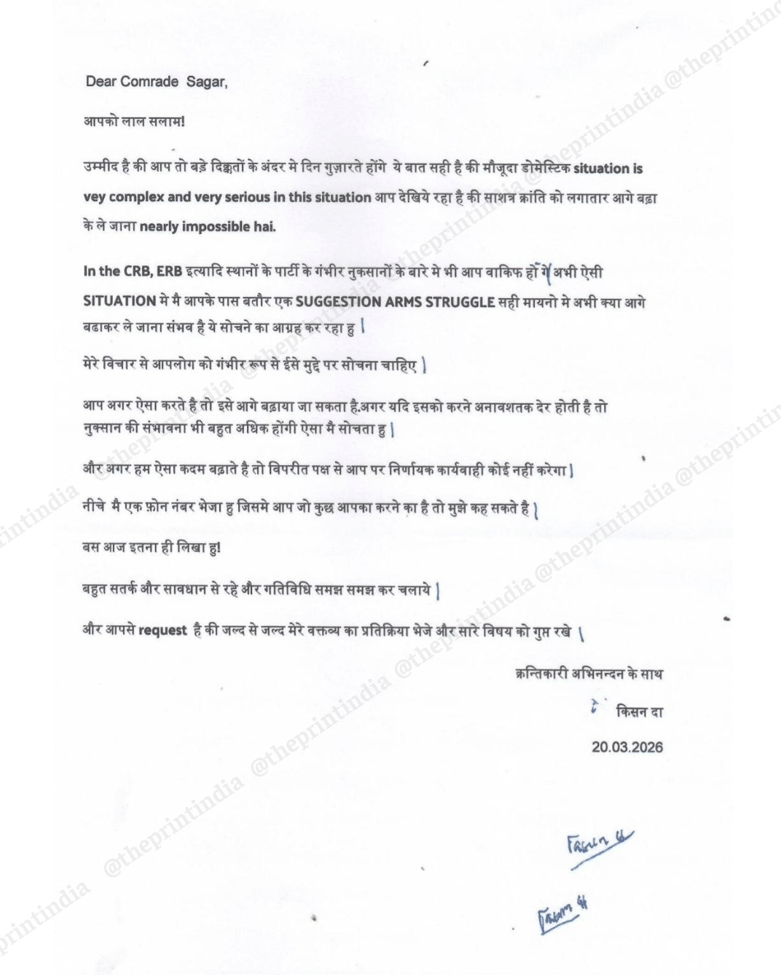
An organisation man
Besra’s uninterrupted education until his post-graduation was not lost on Bose, who had firmed up his revolutionary orientation after coming out of jail in the late 1970s. He was one of the founding members of the MCCI.
Due to his educational background, Bose sent Besra to Kolkata, where he worked in the MCCI’s press department and extensively worked behind the scenes on the publication of propaganda magazines such as Lal Chingari and Lal Pataka in the early 1990s.
However, Bose summoned him back on 31 December 1992 to oversee the expansion of the organisation in the other districts of Jharkhand, where the tribal population was in the majority.
He was first sent to the Silli region in Ranchi, and after three years of aggressive expansion in the tribal heartland, Besra and Bose formed the Jharkhand Regional Committee (JRC) in 2000.
Slain Maoist leader Prayag Manjhi, commonly known as Vivek da, was appointed the first secretary of the JRC, and the outfit grew by leaps and bounds and controlled territory from almost the entire range of the Parasnath hills to Seraikela-Kharsawan in the state. Vivek was killed in an encounter with the security forces in April last year, in the Lugu hills in Bokaro district’s Lalpania area.
Besra was instrumental in forming the outfit’s first armed unit, which took shape in Ranchi’s Bundu region in 2000. Within two years, he was inducted into the Bihar-Jharkhand Special Area Committee of the MCCI. He was further elevated as a member of the MCCI’s central committee in 2003.
After the merger of the MCCI and the PWG in September 2004, he was further inducted into the Central Military Commission, the topmost body of the merged outfit on military affairs, and appointed secretary of the Eastern Regional Bureau.
Today, Besra is in the forests. And the question many are asking is: will he surrender soon or will police succeed in arresting them?
(Edited by Sugita Katyal)
Also Read: From ‘jal, jungle, jameen’ to jobs: Surrendered Maoists seek new lives with state rehabilitation