





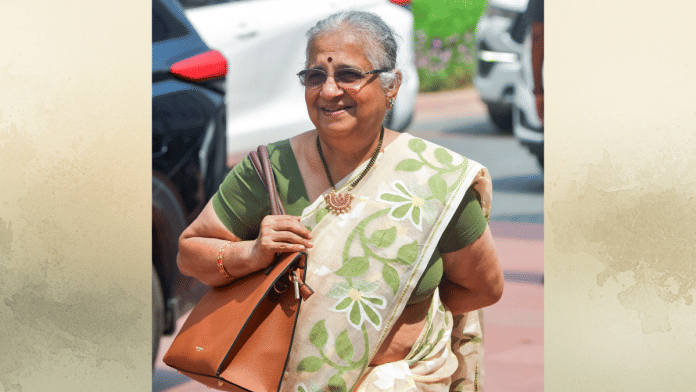


New Delhi: Underlining the need for a national policy and screening framework for maternal mental healthcare, Rajya Sabha MP Sudha Murty Tuesday flagged the issue as an “essential” one that requires the Central government’s attention.
Raising the issue through a special mention in the Rajya Sabha, Murty, a philanthropist and chairperson of the Murty Trust, said, “I would like to bring to the attention of the government an essential yet frequently overlooked dimension of healthcare, that is maternal mental healthcare.”
Studies show that every one in five new mothers in India experience postpartum depression (PPD), a serious medical condition characterised by feelings of intense sadness, anxiety, and fatigue after childbirth, Murty said.
Despite being very common, mental health issues of women after childbirth are rarely discussed, she said.
“Most women suffer in silence which can lead to severe emotional distress, difficulty in bonding with the newborn baby, chronic physical exhaustion, and long term delay in the child’s cognitive growth,” the MP pointed out in the Upper House.
Acknowledging that the existing healthcare system has done “wonderful work” when it comes to reducing the maternal mortality rate, Murty flagged the need for equal attention to be given to postpartum depression.
According to UNICEF, the maternal mortality ratio (MMR) is defined as the number of maternal deaths during a given time period per 1,00,000 live births. It depicts the risk of maternal death relative to the number of live births and essentially captures the risk of death in a single pregnancy or a single live birth.
Murty cited the example of Karnataka, saying that a “simple yet successful” model already exists there.
“Mental health checks are part of the Thayi Card Scheme. Frontline Accredited Social Health Activist or ASHA workers are trained to use a short questionnaire designed by the National Institute of Mental Health and Neuro Science (NIMHANS) to screen for early signs of depression during home visits,” she said.
Upon identifying a mother who needs help, she is immediately referred to the medical officers at the local primary health centre, or connected to telecounselling or support, Murty pointed out while referring to the Karnataka model.
“I humbly request the government to create a national policy on maternal mental health which should expand Karnataka’s questionnaire,” Murty said while adding that the Karnataka model should be applied across the country, through the Mother & Child Protection Card, which refers to a health-tracking and counseling document issued by the government.
ASHA workers can also be trained to recognise early warning signs, Murty said. “This will ensure that every new mother receives timely care, support and empathy,” she said.
(Edited by Viny Mishra)
Also read: Indian mothers’ care, sacrifices are glorified. TUS data reveals their invisible labour