






International Mother’s Day, celebrated every year on the second Sunday of May, is an occasion to express gratitude to mothers for their love, care, and countless sacrifices. The word “mother” here extends beyond biological mothers to include grandmothers, stepmothers, aunts, and every woman who holds a family together with strength and compassion.
While a mother’s emotional investment is difficult to measure, the time spent providing care certainly isn’t. And the numbers tell a story worth reflecting upon.
The Time Use Survey (TUS) 2024, conducted by the Ministry of Statistics and Programme Implementation, captures how people across India spend their time each day. Covering both rural and urban households, the survey offers a rare empirical window into the everyday lives of Indians.
Using the unit-level data from the TUS 2024, we identified individuals who devote time to childcare activities—both men and women. A detailed analysis of this cohort offers important insights into how domestic services, caregiving responsibilities, and paid employment are distributed within Indian households. The findings are striking, revealing not only the unequal burden of work but also women’s often-invisible labour that sustains families and society every single day.
Measuring the minutes
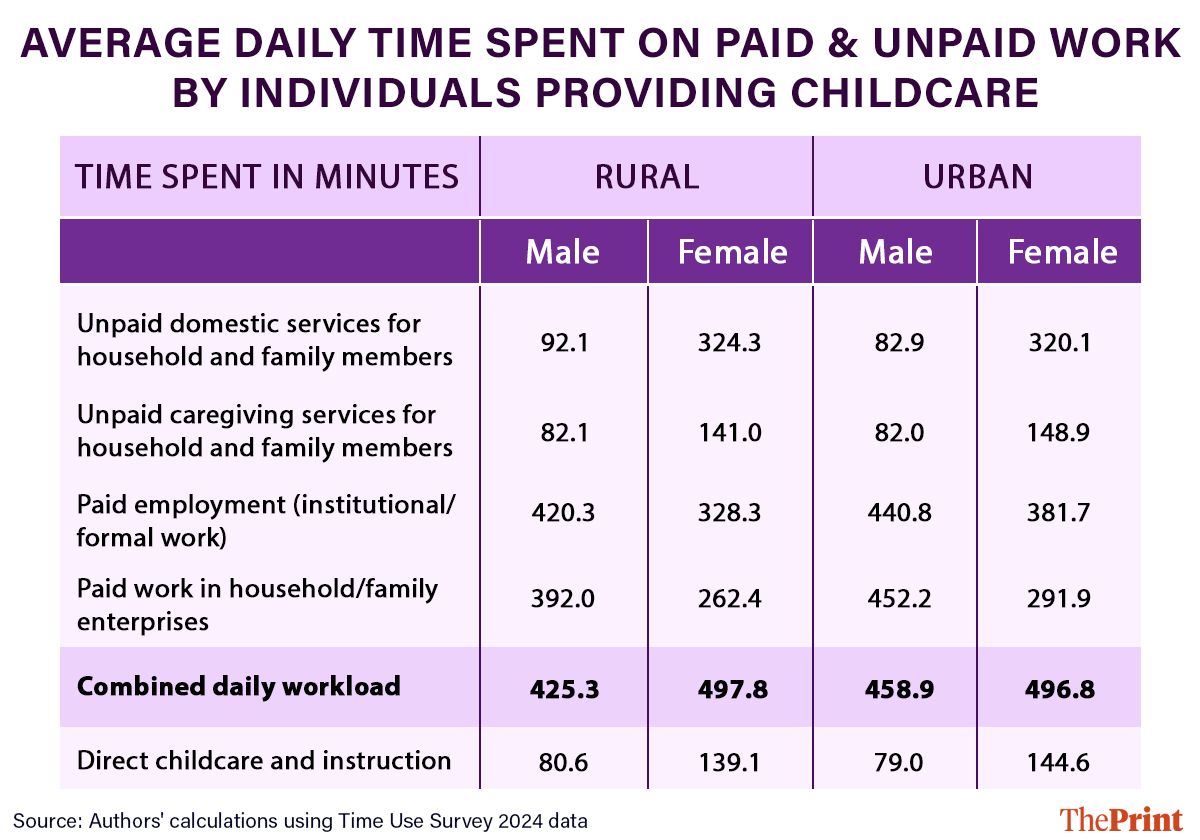
Across India, women who devote time to childcare activities consistently spend far more time on unpaid work within households than men who devote time to the same activities. In rural areas, women spend an average of 324 minutes per day—over 5 hours—on unpaid domestic services such as cooking, cleaning, fetching water, and managing the household. Their male counterparts spend approximately 92 minutes on the same activities. The pattern holds in urban areas too: women average 320 minutes daily compared to men’s 83 minutes.
The story is similar, though somewhat less stark, when it comes to unpaid caregiving: looking after children, the elderly, and household members with disabilities. Rural women spend around 141 minutes a day on caregiving, while rural men spend about 82 minutes. Urban women spend nearly 149 minutes, compared to urban men’s 82 minutes.
What makes these figures even more concerning is what happens when one combines paid employment with unpaid domestic and caregiving work. Women in both rural and urban India put in more time overall than men when all four categories of work are considered together. On average, a rural woman works nearly 498 minutes in combined paid and unpaid activities; a rural man spends around 425 minutes. The urban figures are along similar lines—497 minutes for women and 459 minutes for men.
Childcare and nurturing
When it comes to childcare and instruction—a category that captures time spent directly nurturing and educating children—rural women spend an average of 139 minutes a day, compared to 81 minutes spent by rural men. Urban women spend 145 minutes on childcare and instruction, while their male counterparts spend 79 minutes. Mothers, it seems, are not only primary caregivers but also the principal educators of the next generation, often without formal recognition or remuneration.
It is worth noting that women who are employed also bear the full weight of domestic responsibility. The TUS 2024 data shows that even working women—those engaged in paid institutional/formal or household-enterprise employment—continue to shoulder a substantially larger portion of the unpaid workload. This convergence of paid and unpaid labour is what researchers and economists have long described as the “double burden” of women’s work.
Also read: India’s new wage code could raise pay without hurting jobs. Here’s how
Visibilising women’s labour
This is not a critique of any individual or household arrangement. Families across India function in diverse economic, social, and cultural contexts, and men also work long hours in fields, factories, and offices. What the data simply invites us to do—on a day dedicated to celebrating mothers—is to make the invisible labour visible.
For generations, the work that women do within the home has gone largely uncounted in national productivity measures, uncompensated in formal economic terms, and under-recognised even in everyday conversation. The TUS is an important step toward correcting that oversight. It puts numbers to sacrifices that were previously only spoken of in grateful, affectionate, but ultimately superficial terms.
The woman who rises before dawn to cook a meal, the grandmother who minds the children so her daughter-in-law can go to work, the aunt who steps in during a family crisis—their contributions have always mattered. Now, India has a way to measure how much.
Poonam Munjal is a professor at the National Council of Applied Economic Research (NCAER), New Delhi. She tweets @poonam_munjal.
Palash Baruah is a fellow at NCAER. He tweets @DrPalashBaruah.
Views are personal.
(Edited by Prasanna Bachchhav)