


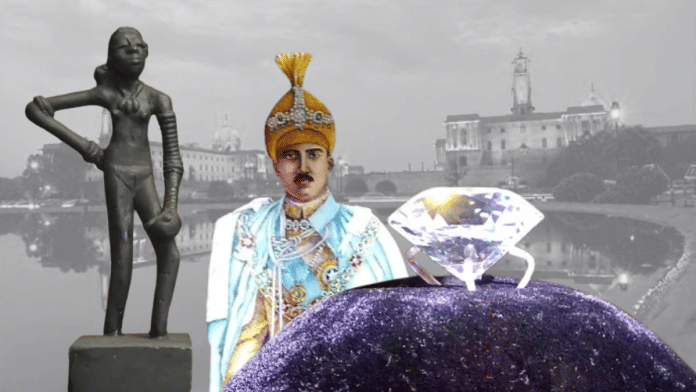
New Delhi: Jewels of the Nizams of Hyderabad, held in the Reserve Bank of India vaults, will be among more than a thousand adornments on display in the first gallery of the Yuge Yugeen Bharat museum, Culture Secretary Vivek Aggarwal said Monday.
The central government bought the 173-piece collection from the Nizams’ jewellery trusts in 1995 for around Rs 217 crore. It includes the 184.75-carat Jacob diamond, which the last Nizam, Mir Osman Ali Khan, is said to have used as a paperweight. The jewels have been in RBI custody since then and have been shown only occasionally, at the National Museum in Delhi and the Salar Jung Museum in Hyderabad.
The Nizam’s descendants and groups in Hyderabad had asked for a permanent display in the city. However, earlier this year, the government told the Rajya Sabha that no decision had been taken to move the collection to Hyderabad.
The gallery will also have the Harappan Dancing Girl, Taxila jewellery from the National Museum, miniature paintings and Gandhara sculptures. “The Dancing Girl is the first image we have of various adornments women wore during the civilisational journey,” Aggarwal told reporters at Kartavya Bhawan.
The first gallery of the Yuge Yugeen Bharat museum is expected to be opened to the public next year. The Cabinet approved the museum on 11 November at an estimated cost of Rs 3,230 crore. It will be built by repurposing the North and South Blocks and unveiled carried out in phases until 2030-31.
The adornments gallery is expected to open in North Block in the second half of 2027. Later galleries will cover architecture and cityscapes, mathematics and astronomy, languages and scripts, faith and spirituality, and trade.
Prime Minister Narendra Modi had announced the Yuge Yugeen Bharat museum in May 2023 at the International Museum Expo. In December 2024, the National Museum signed a technical cooperation agreement with France Muséums Développement, the agency linked to the Louvre’s expansion, for planning and design. The government expects the museum to handle up to one crore visitors a year.
“We want to showcase the sophistication of the Indian cultural narrative through how Indians presented themselves… right from day one,” Aggarwal said. An advisory committee will review the descriptions and selection of objects before approval.
Last month, former Lok Sabha MP R Senthil had written to Union Culture Minister Gajendra Shekhawat, the culture secretary, and the Director General of the National Museum, when the Dancing Girl was withdrawn from display at the Harappan gallery, ThePrint had reported.
On 11 November, the 4,500-year-old bronze figurine returned to the gallery in a new bulletproof independent showcase instead of its original place. The statue was also at the centre of a dispute in June, when its bare torso was covered in an NCERT arts textbook for class 9 students.
Aggarwal said the Dancing Girl had been moved to a mock gallery so scenographers could plan the display. “If somebody wants to plan a new gallery, he or she has to see the objects that are going. How do you plan it otherwise?” he said.
More artefacts will come to Yuge Yugeen Bharat from museums across the country, including the Indian Museum in Kolkata and the Prayagraj museum, but “the main source” will be the National Museum. About 1.8 million objects have been identified so far, including from 52 Archaeological Survey of India (ASI) site museums, state museums and private collections.
Aggarwal said about 90 percent of the National Museum’s collection is in storage. The museum holds over two lakh objects. The Janpath museum will stay and be re-curated as a “museum of history” after the move, with objects drawn from that storage. “Yuge Yugeen is a museum of civilisation,” he said.
On the Central Secretariat Library, which must leave Shastri Bhawan before demolition, Aggarwal said it has been allotted “sufficient space” in the GPO complex. This is the first time the ministry has named a site.
The 135-year-old library has more than 8.5 lakh books and has been housed across four floors of Shastri Bhawan, about 5,500 square metres, since 1969. The Directorate of Estates had earlier offered two rooms of about 300 square metres in Kartavya Bhawan-2. In February, the Culture Ministry told the housing ministry the space was inadequate. The Supreme Court has since taken suo motu cognisance of the relocation, and sought a detailed plan from the Centre. Aggarwal said the ministry was working on preserving the artwork on Shastri Bhawan’s facade, and that no decision on it had been taken yet.
On the Harappan script, Aggarwal said there was no “credible lead” on a decipherment. “Some scholars say that it is Sanskrit. Some scholars say it is Tamil. Some scholars say it is sign language,” he said.
Two smaller meetings have been held since the conference, and the Indira Gandhi National Centre for the Arts (IGNCA) has created a repository of resources. The IGNCA and ASI are the nodal bodies. The ASI hosted an international conference on the script in Greater Noida in August 2025. The ministry invited research on the script at the Gyan Bharatam conference in September that year. In January 2025, Tamil Nadu Chief Minister M.K. Stalin announced a $1 million prize for deciphering it. “We really need to work harder,” he had said.
(Edited by Gitanjali Das)
Also Read: The past controversies of Mohenjo-Daro Dancing Girl. Her nudity has always been an issue