





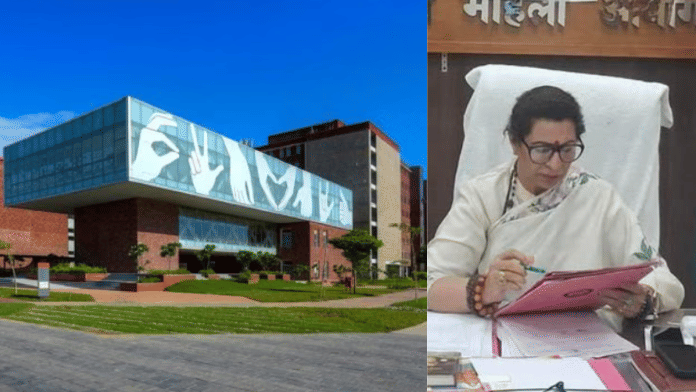



Gurugram: Is this a case of a missing person or a young woman choosing to walk away? The story of a former Ashoka University student has two conflicting narratives: one of indoctrination and exploitation by a sex-change racket, the other of escape and self-determination.
Her parents, both academics themselves, have not seen her in over two-and-a-half years. They say she went missing. They want the anti-terror probe agency NIA to investigate the university and some of its staff.
A spokesperson for Ashoka University said the woman ceased to be its student in May 2023, and its faculty and staff have no involvement in the matter.
The parents, meanwhile, appeared before the Haryana State Commission for Women with their plea. They have named a professor, a researcher, a student activist, and, in their words, a “chain” of people involved in what they describe as a “sex-change racket”.
But there is another set of documents in the case that tells a sharply different story, in the daughter’s own words.
Also Read: Daughter ‘missing since 2023’, parents blame Ashoka University prof. Women’s panel wants CBI probe
The night she left
On 24 October 2023, she left her home in Haryana’s Rohtak. She was 22 years old. A graduate of Ashoka University. By her own account, she had been planning this for some time.
In a written statement submitted to the SHO at Kundli police station, Sonipat, one of several letters she wrote to police on the very day she left and in the days that followed, she explained why.
“I left my natal home on 24th October 2023 because of years of physical and emotional abuse at the hands of my mother and father,” she wrote. “My father has been physically abusive towards me since I was 10 years old.”
She described an incident from just days before she left: her father entered her room forcibly at 3 am while she was asleep, began shouting at her, blamed her for his health problems, and threatened to beat her. She also wrote that he had threatened to break her phone, laptop, door, and windows.
“I left to escape this violence,” she stated.
On the day she left Rohtak, she sent an email to the Rohtak Police. She wrote a letter to the Kundli thana, got it stamped by them, and also sent a handwritten letter to the Rohtak Police, all informing authorities she was leaving out of her own free will, exercising her constitutional right as a major to reside at a place of her choice.
She requested that her address be kept confidential from her parents.
Four days later, on 28 October 2023, she recorded a statement under Section 164 of the CrPC before a magistrate in Rohtak.
Under the Code of Criminal Procedure (CrPC), now replaced by Bhartiya Nagrik Suraksha Sanhita (BNSS), a statement under Section 164 is a formal statement or confession recorded by a Magistrate rather than a police officer.
Despite all this, she wrote in her complaints to the police that the Rohtak Police continued calling her friends repeatedly. Her father, she said, was still trying to harass her and her friends. She feared for her life and liberty and sought police protection.
The complaint was filed with the Station House Officer of the Kundli Police Station on 28 October 2023. Another complaint was filed on 6 November that year with a police station whose name was not shared with ThePrint, ostensibly to hide the place of her residence.
What the parents say
The parents, who have chosen to go public, tell a very different story, though.
In response to queries, they told ThePrint that their daughter was a bright student, scoring 96 per cent in Class XII from a premier school. She was admitted to Ashoka University in 2019 for a three-year BA programme in Liberal Arts.
On 24 October 2023, they say, they found her missing and lodged a missing persons report the same day.
Based on call records, they claimed, police traced her location to the residence of a university staff member. But by the time police arrived, they alleged, the university administration had tipped off the staff member, and she had already left.
Four days later, when the daughter appeared before a court, she was accompanied, the parents say, by two women “associated” with Ashoka University who work in the laboratory of Dr Bittu Kaveri Rajaraman, an associate professor of biology and psychology at the university.
The parents said they learnt of this court appearance only later.
They said that subsequently they found, in their home, a certificate issued by Ashoka University in a name other than the one they had given their daughter, a name, they said, was not a Hindu name.
They also said they found from bank records that money had been transferred from their daughter’s account to that of another student, whom they allege collects funds for gender transition procedures.
“We feared that at Ashoka University, our daughter was exploited by the faculty led by Dr Bittu Kaveri,” the press note states.
The parents have called for a probe by the NIA into Ashoka University, Dr Bittu Kaveri Rajaraman, and several others, including students, researchers, activists, and lawyers, who they claim form a network involved in what they describe as “physical and mental exploitation of young people”.
Who is Dr Bittu Kaveri Rajaraman
At the centre of the parents’ allegations is Dr Bittu Kaveri Rajaraman, an associate professor of biology and psychology at Ashoka University. Dr Rajaraman is a transgender academic and activist, widely known in academic and LGBTQ+ circles.
Information available online about Prof Bittu Kaveri shows that he is a genderqueer trans man who believes that the annihilation of caste, class, ableism, and gender is necessary for queer and trans liberation.
The parents allege that the two individuals who allegedly accompanied their daughter to the court worked in Dr Rajaraman’s laboratory, and that Dr Rajaraman, at a university event, publicly addressed their daughter by the name on the certificate found at their home, a recording of which, they say, is available on YouTube.
They have also alleged that Dr Rajaraman had once claimed that when she joined Ashoka University, she was the only transgender person there, and that now there are over 80 such students, a statement the parents characterise as evidence of “indoctrination of young people”.
Neither Dr Rajaraman nor the individuals named by the parents have, as of this report, issued any public response to these specific allegations.
The Print reached Dr Rajaraman through email and WhatsApp messages. But, she didn’t respond.
What Delhi HC found
Even as the parents were filing complaints with the Haryana women’s panel, their daughter had already approached the Delhi High Court.
In an order dated 27 May 2024, Justice Swarana Kanta Sharma of the Delhi High Court recorded that the petitioner, the daughter, appeared in person and interacted with the court in the presence of her counsel.
She told the court she was a major, aged about 22 years, and wanted to choose her own way of life. She stated clearly that she did not wish to interact with her family, including her parents and grandfather.
Significantly, the court also separately interacted with the parents and the grandfather, who stated before the court that they had no intention of communicating with her against her wishes or interfering in her life.
A subsequent order, dated 11 July 2024, passed by Justice Neena Bansal Krishna, records that police protection had already been granted to the daughter since November 2023, and that she had since shifted to rented premises.
The petition was disposed of, with a liberty granted to her to approach the court afresh if she shifted address and again faced a threat.
The court, in other words, had heard her, verified her presence, and provided her legal protection, not once, but across multiple hearings spanning several months.
The women’s commission hearing
Meanwhile, the case reached the Haryana State Commission for Women, where it took a dramatic turn earlier this week.
Ashoka University’s registrar, summoned for a hearing, reportedly did not answer a single question before the panel. Women’s Commission chairperson Renu Bhatia told journalists that the commission would recommend to the state government that the case be handed over to the CBI.
“It is a sensitive issue. It is about the future of our daughters,” she said.
A spokesperson for Ashoka University said, “As per official records, the student pursued undergraduate studies at Ashoka University from August 2019 till May 2023. She left her home in October 2023 to stay independently. She approached the Delhi High Court and the court granted her permission to stay independently at a place of her choice.
“She ceased to be an Ashoka University student in May 2023 and we have no knowledge of her current whereabouts. The university and its faculty and staff have no involvement in this matter,” the spokesperson said.
But what surprised the commission chairperson most was the appearance of a lawyer who claimed to represent the daughter, even though the commission had not issued any summons to her.
“We don’t even have her address. A lawyer appeared on her behalf without us having summoned her. Where did this lawyer come from for someone who has been untraceable for two and a half years?” Bhatia said.
The lawyer reportedly told the commission her client was willing to appear via video call. She was asked to appear in person on Tuesday. She did not.
The commission has said it will also look into how many students may have left the university and how many may have undergone gender transition.
(Edited by Ajeet Tiwari)
Also Read: Ashoka University’s housekeeping staff go on strike against unfair wages, dismissals