





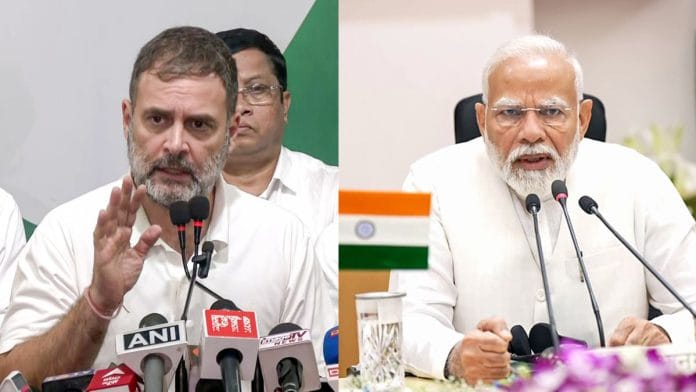


New Delhi: Leader of Opposition Rahul Gandhi on Monday accused Prime Minister Narendra Modi of being “the most anti-youth Prime Minister in India’s history”, after security forces used tear gas and lathicharge on thousands of protesters marching towards Parliament.
The Centre had responded to students demanding accountability for exam irregularities with police action instead of justice, he further said.
In a post on X, Rahul said that Modi was so “anti-youth” that he could not even seek the resignation of Union Education Minister Dharmendra Pradhan, which is one of the primary demands of the Cockroach Janta Party and activist Sonam Wangchuk. The Congress leader further claimed that 152 paper leaks had affected 7.5 crore students.
“Who has been punished? Hardworking young people,” he said, accusing the government of responding to students’ legitimate questions with “batons and detention” while those responsible for the alleged leaks remained free. “This government is not just failing the youth—it has turned against them,” he wrote on X.
Congress general secretary Priyanka Gandhi Vadra echoed the criticism, saying the Opposition had been demanding a discussion on the education policy because it had “flaws”, but the government was unwilling to debate the issue. “Instead, tear gas shells are being fired at the children themselves and they are being beaten,” she said, also accusing the Centre of choosing force over dialogue.
Congress president Mallikarjun Kharge also attacked the government over the police action against the protesters. “The government is lathi-charging youth and students. If you do not know how to conduct examinations, vacate the throne; the people will take over,” he said, adding that the government was not fit to remain in power.
Kharge also targeted the Centre over the Ram Temple donation theft case, saying that PM Modi should take responsibility because the Shri Ram Janmabhoomi Teerth Kshetra Trust had been constituted under his government.
The Congress leaders’ remarks came as thousands of protesters under the banner of the CJP attempted to march from Jantar Mantar to Parliament on the opening day of the Monsoon Session, demanding Pradhan’s resignation and wider reforms in the examination system. The Delhi Police had denied permission for the march and deployed heavy security in the heart of the national capital.
As protesters attempted to move towards Parliament, police fired tear gas shells and carried out baton charges to disperse the crowd as it tried to breach multiple barricades. Several protesters were detained, while security was tightened around the Parliament complex. Despite the crackdown, many demonstrators continued marching in smaller groups towards Parliament.
The protest has drawn support from several opposition leaders, including those from the Aam Aadmi Party, Trinamool Congress and Left parties, who have backed the students’ demands.
Later in the day, the Centre initiated its first formal engagement with the movement, with CJP representatives meeting Union Minister J.P. Nadda for talks.
(Edited by Gitanjali Das)
Also Read: Protesters narrate horror stories of broken bones, bruises & being ‘trapped’ in tear gas chambers
Hilarious. His own party is ruling in Telangana and Katnataka. In Telangana, CM him self is a education minister. He dedicates most of the time in other things. So, he works like a part time education minister. So far, no significant reform introduced for the students and youth.
This CJP protest is just a political movement by left wing groups like in Nepal and Bangladesh. They have no genuine intention to reform the education.