





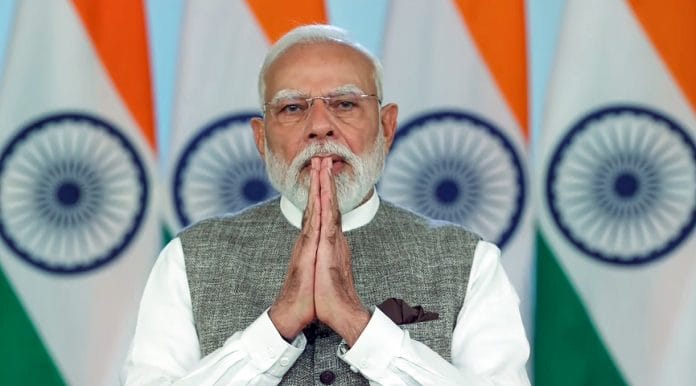


New Delhi: Prime Minister Narendra Modi on Monday lauded the country’s scientific community on National Technology Day, calling the 1998 Pokhran nuclear tests a “landmark moment” that showcased India’s scientific excellence and unwavering commitment.
In a post on X, the Prime Minister said, “Greetings on National Technology Day. We recall with pride the hard work and dedication of our scientists, which led to the successful tests in Pokhran in 1998. That landmark moment reflected India’s scientific excellence and unwavering commitment.”
Calling technology a key pillar of a self-reliant India, the Prime Minister said innovation continues to drive growth, widen opportunities and strengthen multiple sectors of the economy. He added that the government remains focused on supporting talent, encouraging research and developing solutions that contribute to the country’s progress and fulfil people’s aspirations.
“Technology has become a key pillar in building a self-reliant India. It is accelerating innovation, expanding opportunities and contributing to the nation’s growth across sectors. Our continued focus remains on empowering talent, encouraging research and creating solutions that serve both national progress and the aspirations of our people,” he added.
The celebration of National Technology Day was started by former Prime Minister Atal Bihari Vajpayee in 1999 to honour Indian scientists, engineers and technologists, who worked for India’s scientific and technological advancement and ensured the successful conduct of Pokhran tests in May 1998.
Since then, National Technology Day is observed every year on May 11.
India conducted Pokhran-II tests, a series of five nuclear explosions, in May 1998 at the Indian Army’s Pokhran Test Range in Rajasthan. It was overseen by the then Prime Minister Atal Bihari Vajpayee. The test was also led by scientific figures, including R Chidambaram and APJ Abdul Kalam.
In a press statement, the Department of Atomic Energy said the first three detonations were carried out simultaneously at 3:45 pm IST on May 11. These included a 45-kiloton thermonuclear device, a 15-kiloton fission device and a 0.2-kiloton sub-kiloton device. Two more nuclear devices, detonated simultaneously on May 13, were also in the sub-kiloton range, with yields of 0.5 kilotons and 0.3 kilotons.
The department said the tests marked the culmination of decades of sustained efforts towards self-reliance in India’s nuclear weapons development programme. It noted that the programme drew on expertise across several disciplines, including explosive ballistics, shock wave physics, condensed matter physics, materials science, nuclear and neutron physics, radiation hydrodynamics and advanced electronics engineering. The statement added that the development of complex computer simulation software and specialised production and fabrication technologies had also played a critical role in accurately predicting weapon yields.
According to the department, India has developed world-class expertise in several of these fields, including shock wave physics and high-pressure equation-of-state research. (ANI)
This report is auto-generated from ANI news service. ThePrint holds no responsibility for its content.