



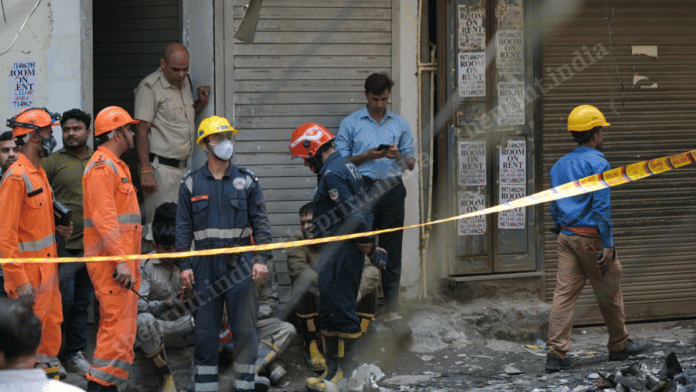

New Delhi: A four-storey Bed and Breakfast (B&B) establishment goes up in flames. With only one common entry and exit point, trapped guests can be heard screaming and crying for help. Some jump on to mattresses laid out on the ground by helpful neighbours. Subsumed by the blaze, a nearby electric pole starts emitting deadly sparks.
Smoke, dust, confusion, sirens. Charred bodies pulled out; badly burnt survivors rushed to hospital.
As this horror unfolded in South Delhi on Wednesday morning, the irony couldn’t have been starker. Coming just a week after the tourism department of the Delhi government rolled out a draft Bed and Breakfast (B&B) policy, the 21 deaths in this blaze that broke out at just such an establishment in South Delhi have only underlined at terrible cost the necessity of strict regulations for running these lodgings.
B&Bs are small, homegrown establishments that provide night stay and breakfast, usually at relatively lower cost. They have become increasingly popular worldwide because they replace the sterile luxury of hotels with authentic local experience.
Now available on the official website of the Department of Tourism, Government of the National Capital Territory of Delhi (GNCTD) for feedback and comments from stakeholders and the general public, the draft policy aims at enhancing homestays, supporting small entrepreneurs, boosting tourism capacity and ensuring guest safety. That last bit of the draft policy—Delhi Bed & Breakfast Policy, 2026, extending to the National Capital Territory (NCT) of Delhi—is in the spotlight now as questions arise about safety at the now-charred Flourish Stays in Malviya Nagar’s Hauz Rani area.
First off, the four-storey B&B where the fire broke out—for reasons unknown yet—was apparently running no fewer than 24 rooms at the time of the fire, including in the basement. Situated practically across the road from Max Hospital, Saket, the B&B primarily catered to patients, their kin and attendants. Business must have been good, given the hospital remains busy round the year and caters to overseas patients, mostly from Africa and Central Asia.
Profit maximisation seems to have overruled the regulations, which clearly limit the number of double-bedded rooms that a B&B establishment can let out to five as per the Bed and Breakfast Establishments (Registration and Regulation) Act, 2007, that applied to the National Capital Territory of Delhi. A subsequent amendment of the Act in 2021 kept the five-room limit but debate had commenced on relaxing this to eight, a suggestion the draft policy of 2026 incorporates.
In any case, the room limit seems to have been breached blatantly and willfully. That extended, inevitably, to the restaurant area where the fire is suspected to have broken out, since it was catering to far more guests than allowed by the law.
Harshit Khatri, who runs a B&B called The Greetings at Derawal Nagar in Norh Delhi, said he was shocked by news of the fire. “Following government policy is like the least threshold,” he said. “The scale and magnitude of your business doesn’t matter–what matters is the business going according to the government’s norms and protocols.” Khatri also emphasised proper training of staff.
The draft policy seems to exist in another dimension, not cyberspace. On safety, it seeks to ensure “safe, hygienic, and standardized lodging… periodic inspections, guest safety measures, police verification, and Foreigners Registration Office (FRO) compliance”. To qualify and register as a B&B, compliance with Delhi Fire Service (DFS) norms is a must in the draft policy, apart from municipal and building bye-laws and police verification.
Sticking to fire safety, the B&B would have needed a No-Objection Certificate from the DFS, and annual renewal of the same. The rules also mandate basic firefighting equipment like extinguishers and smoke or heat alarms. They also mandate a smoke-free kitchen, and that fire evacuation paths be kept clear at all times. The B&B also appears to have flouted safety norms by keeping one common exit and entry, apart from running two rooms in the basement.
The Delhi Police has filed a case of culpable homicide against unknown persons, and the probe can be expected to proceed apace. Given that the Flourish Stay was a duly licenced establishment, how many of these regulations it followed will be revealed in totality soon enough, but it’s looking bad already.
Urvashi Puri runs a B&B in Central Delhi. “Fire regulations have been there all along on paper, but I think somewhere some people have not been following and getting through, so it’s a combination of things,” she told ThePrint. Dialogue and education, she said, adding that profit makes people greedy, and that it’s usually newcomers who let themselves be guided by it.
Blaming the authorities won’t do, she said. “We cannot always blame the system or the government body for lapses like this; we need to take some onus on ourselves and keep a check on each other (sic).”
Also Read: Foreign nationals in Delhi for treatment died in B&B blaze. Some jumped, others were too weak to run
Draft for the Capital
B&B owners around town seemed satisfied with last week’s draft policy but suggested a few norms on questioning which could be accommodated by the government, making the policy even better.
The Delhi Bed & Breakfast Policy, 2026 is meant to be extended to the entire National Capital Territory of Delhi and shall not be applied to other types of “transient accommodations such as hotels, motels, guest houses, boarding, lodging houses, etc”. According to the proposed norms, only residential nature and lawfully constructed premises will be eligible for homestay registration and the applicant must possess valid legal proof of property ownership authorising its use as a bed and breakfast.
The policy highlights a minimum of one and maximum eight lettable rooms making for a maximum 16 beds in total with an on-site owner or manager or caretaker readily available at all times. Under the proposed system, operators can register online through the tourism department’s portal using a self-certification and self–renewal model that bypasses mandatory prior inspections. However, officials reserve the right to inspect properties whenever necessary.
One of the key highlights of the published draft is categorisation of B&Bs into ‘Gold’ and ‘Silver’ categories based on room size and furnishings, sanitations and hygiene standards, safety arrangements and guest amenities and service quality.
For the ‘Gold’ category with enhanced standards, guest rooms must be at least 120 square feet in area with CCTVs at the entrance and commons areas only. In the ‘Silver’ category, rooms have to be at least 100 square feet in area. Amendments in the operational guidelines ensure maintenance of smoke or heat detectors, upholding of courteous services, hygienic preparation and service of food with proper furnished bed-rooms, 24 x 7 water supply and other important norms.
Khatri told ThePrint that the draft policy would be a “cakewalk” for hosts and government agencies provided the rules, regulations and norms issued by the tourism ministry are followed properly.
Another important stipulation in the draft policy is ensuring proper emergency management with first-aid kit readily available, identifying the nearest hospital or clinic details, and reporting incidents to local authorities when required.
The draft policy says that registrations can be cancelled for misrepresentation, severe safety violations, prohibited actions, or the owner’s involvement in criminal activity and if cancelled, the applicant has 30 days to appeal the decision before the Secretary, GNCTD.
Khatri said the guests would be the most benefited by the policy as they would get an option to explore the local culture of the place and have a safer place in comparison to hotels. “We would like to request the authorities to take us seriously, and to not consider us secondary in terms of hospitality and tourism. Just give us equal platform to perform in terms of hotels,” he said.
The first version of the Capital’s B&B policies was derived during the 2007 Commonwealth games, with a minimum of one and maximum of 5 bedrooms, manual licensing, and owners or managers mandated to resided in the same premises.
Puri said the new norms were quite similar to the earlier ones, but remarked that detailed requirements have been provided regarding hygiene, size and other necessities making the new Delhi Bed and Breakfast Draft Policy, 2026 more clear and precise.
Unfortunately, many B&B owners remain unaware of any policy about their businesses. Speaking to B&B owners across western, eastern, northern and central Delhi, ThePrint found many who didn’t know about the policy, or didn’t get a chance to read it.
“I am unaware about the updates of the policy as I get my work done through the one who applies for my licence, so I didn’t read it nor did I ever feel the need to do so,” one B&B owner from East Delhi told ThePrint.
Nishtha Modgil is a TPSJ alum, currently interning with ThePrint.
(Edited by Nardeep Singh Dahiya)
Also Read: As Malviya Nagar fire captures headlines, a look at how fires have plagued Delhi in the last 8 years