





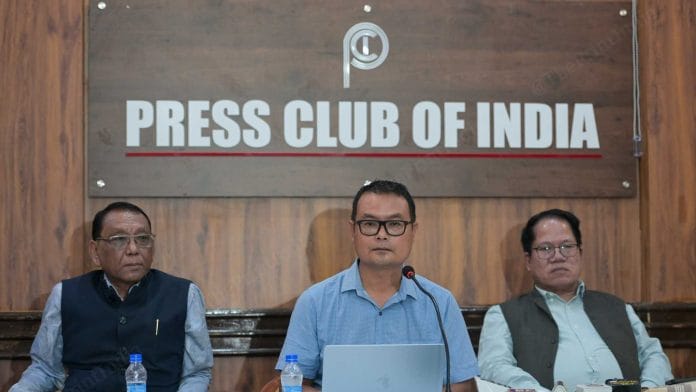


New Delhi: Amidst the ongoing armed conflict in Manipur, the Kuki-Zo Council met officials from the Ministry of Home Affairs (MHA) and Intelligence Bureau (IB) and submitted a memorandum to call for a political solution.
Demands made last week to Director, IB, Monday and the home ministry Saturday include urgent intervention, and the “need for a political solution for the Kuki-Zo people,” Henlianthang Thanglet, chairman of the Kuki-Zo Council, told ThePrint.
Thanglet was speaking at a press conference at the Press Club of India, organised by the Kuki-Zo Council—a conglomerate of Kuki-Zo bodies.
The discussion with the IB Director covered the atrocities, the killings, and the subsequent violence, said Thanglet. “We spoke about how we can end it, how we can solve the problem of food supply and essential goods,” added Ginza Vualzong, spokesperson of the Kuki-Zo Council. He said the IB Director noted their concerns.
The Kuki-Zo Council said the conflict in Manipur has shifted from Meiteis and Kukis on opposite sides, to Nagas now being party to it.
At least 15 Kuki-Zo civilians have been killed and approximately 55 houses in 14 Kuki-Zo villages burned since March 2026, it said.
Before this, the Nagas, who constitute approximately 24 percent of Manipur’s population and are concentrated mostly in the hill districts of Ukhrul, Senapati, Chandel, Tengnoupal and Tamenglong, had largely stayed away from the conflict.
Also Read: 2 months after 6 Naga civilians were abducted & killed in Manipur, couple held in NIA-led operation
Focus on key demands
The Kuki-Zo Council said 250 of their people have been killed, more than 300 villages burned, more than 350 places of worship destroyed and more than 3,000 people displaced since the violence began in May 2023.
Thanglet told ThePrint that over the past three years, the Kuki-Zo people have faced “repeated attacks from both the Meitei and Naga communities of Manipur”.
“Our people have been killed, our homes looted and burned, our places of worship desecrated, and tens of thousands displaced from their ancestral lands. Despite repeated appeals and the change in the Manipur government, these acts of violence, intimidation, and deprivation continue to this day,” he said.
He added that despite these challenges, the Kuki-Zo community remains committed to peace, dialogue, and democratic solutions.
On demands made before the MHA, Ajang Khongsai, coordinator for the Kuki-Zo Council, said they requested the government to ensure a fair, impartial, and time-bound investigation into all incidents of violence, including the killing of 14 Kuki-Zo civilians, and the burning of Kuki-Zo villages.
“To ensure immediate protection of lives and properties, and ancestral land of the KZC. To direct a thorough and impartial investigation into the killings, the villages burnt, and to bring justice to. To ensure restoration of humanitarian access of uninterrupted food and essential supplies, and to take constitutional measures to provide durable solutions that guarantee security,” Khongsai said.
He also said the delegation urged the government to strengthen security arrangements in vulnerable areas to protect civilians and Kuki-Zo villages, and to take effective measures to prevent further attacks and call for a political solution.
“The demand for a separate administration in the form of a Union Territory with legislature is therefore not merely a political aspiration, but a necessity born out of lived experience and continued suffering,” Ginza added.
Inflation, no access to healthcare
For Kukis in Manipur, a bag of rice costs Rs 3,500, a litre of petrol costs Rs 250, while an LPG gas cylinder costs around Rs 5,000, said Ginza, a resident of Churachandpur. He told ThePrint that displaced Kuki-Zo families are being made to live in halls separated by plastic. “The toilets have no roof. It has been extremely difficult for women and children.”
The Kuki-Zo people, particularly those residing in Kangpokpi, Ukhrul, and Kamjong districts, continue to face severe problems due to disruptions in transportation and supply routes, Ginza said.
Citing reports, indicating that Kuki-Zo residents of various villages including Chassad and Aishi in Kamjong are facing restrictions in procuring essential commodities from nearby markets, he said similar issues are being faced by Kuki-Zos in villages in the Kotlen and Leilon areas of Kangpokpi.
The transportation of essential commodities destined for Kangpokpi town has reportedly been blocked at Namdilong and Senapati by Manipur-Naga villagers, Ginza said. “These actions have created significant humanitarian hardships for the Kuki-Zo population, disrupting access to food, medicines, fuel, and other necessities required for daily life.”
Alongside essential items like food supply, another key issue mentioned during the press conference was denial of healthcare services.
On 15 June, 2026, three Kuki-Zo boys between the ages of 18 and 20 sustained serious injuries during an attack allegedly carried out by suspected NSCN (I-M) and ZUF-K militants at Leilon Munlai village in Kangpokpi, Ginza alleged.
One of them required advanced medical treatment due to the severity of his injuries. The injured men were initially admitted to the Regional Institute of Medical Sciences (RIMS), Imphal. However, reports indicate that protests arose within the hospital premises opposing their treatment. Consequently, they were compelled to leave the facility and were transferred to Churachandpur District Hospital in the early hours of the following day, said Ginza. Adding, “This deeply disturbing incident raises serious concerns about the ability of Kuki-Zo citizens to safely access medical care in public institutions. Healthcare is a fundamental right and must never be denied, obstructed, or compromised on the basis of ethnicity.”
(Edited by Amrtansh Arora)
Also Read: There is only one path to peace in Manipur—weapons must be surrendered