



Bengaluru: The Karnataka government on Monday suspended the licences of some local suppliers of global pharmaceutical major Pfizer, as investigators uncover more details in the counterfeit medicine racket in the state.
Health Minister UT Khader said several batches of counterfeit medicines have been found, but most people and agencies believed to be involved have been uncooperative with the investigation so far.
“License of M/s Pfizer C & F Depot, Survey No. 66/3 B2, Kempalinganahalli, Nelamangala Taluk, Bengaluru Rural District, Bengaluru-562123 is also suspended,” Khader said Monday.
Our Health & Family Welfare Department @DHFWKA has taken strict action against a large scale counterfeit medicine racket in Karnataka.
The Karnataka FDA has cancelled the licences of 16 pharmaceutical distributors and retailers and suspended the licences of 8 others for their… pic.twitter.com/g3EDQSIcDE
— UT Khader (@utkhader) September 21, 2026
In a statement, Pfizer India told ThePrint they have been working with the authorities through the past one month when the matter of counterfeit medicines was brought to their attention.
“Since then, we have taken several actions to support the investigation, including removing, from the market, Pfizer batches (where batch numbers were copied by counterfeit) to avoid confusion, supporting to differentiate between original and counterfeit product, and providing technical and other relevant information related to the affected batches. We continue working closely with the authorities to resolve the open queries. Our focus remains on protecting patients, safeguarding public health and maintaining confidence in the healthcare system.”
“Patient safety and product quality are of the highest priority for us at Pfizer,” it said.
So far, the licenses of 17 pharmaceutical distributors have been cancelled and eight others suspended for their alleged role in distributing fake medicines.
“On the surface, it appears that most of them are hand-in-glove with the producers (of fake medicines). When we asked them to recall medicines already distributed, they (distributors) showed no interest nor were they cooperative,” Khader said Monday in Bengaluru.
Khader, however, alluded to a “kingpin” of this well-oiled nexus but refrained from sharing any more details of what the government-constituted Special Investigation Team (SIT) has found so far.
“This Kingpin, whoever is connected with him and the agencies that they operate…wherever these medicines have been sent to..the 24 agencies so far, of which we have shut down 17 of them,” Khader said.
According to people aware of the developments, one person named Prashanth has been allegedly operating this network from Azerbaijan.
However, jurisdictional constraints have forced the Karnataka government to reach out to the Centre for assistance in extraditing Prashant for further probe.
The rampant discoveries of fake medicines have fuelled a wave of distrust among consumers since these distributors supplied life-saving drugs, including those for cancer treatment, to several reputed hospitals.
Also read: How an iCloud ID set off a 3-yr hunt for transnational drug operative Prabhdeep—an ex-BSF constable
What is known so far
Several persons have been arrested in connection with the fake medicine racket which started to unravel after Karnataka’s Food Safety and Drug Administration (FDA) raided a small counterfeit medicine distributor in Bidadi on 18 August.
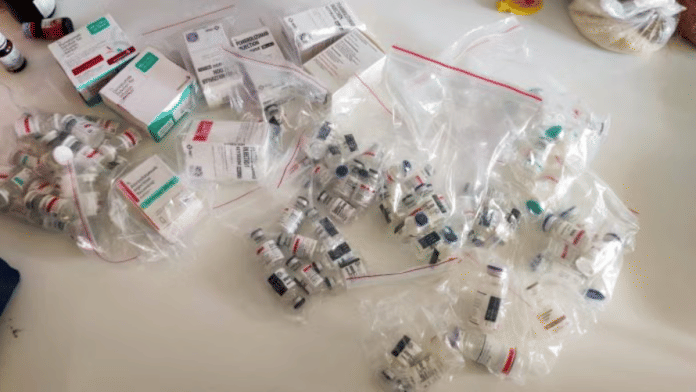
The operation led to the unravelling of a large-scale, unlicensed pharmaceutical repackaging and re-labelling racket out of a farm house in Bidadi, about 30 kms from Bengaluru. Spurious drugs and industrial machinery worth an estimated Rs 5.05 crore were seized during the raid.
“Preliminary investigations revealed that the premises were being used to procure low-cost medications from neighbouring states. These cheaper drugs were allegedly refilled into new vials and relabelled to counterfeit expensive life-saving brands of multinational corporations (MNCs), specifically imitating imported products under the brand name ‘Pfizer’,” according to a statement by the Karnataka health department.
Most of the counterfeit medicines were labelled under global brands like Pfizer, according to health department officials.
The counterfeit drug racket revealed that this was a deeply entrenched network operating across several states, including Himachal Pradesh, Telangana, Tamil Nadu and others.
In a statement Sunday night, The government said that these counterfeiters would deceive buyers and maximize profits with fake labels featuring QR/scanning codes, which were found to be completely nonfunctional upon verification.
“These spurious drugs contain no active medicinal components, the wrong ingredients, or toxic substances, posing a fatal threat to public health,” according to the statement.
Khader said that these fake drugs were sent for further examination and their reference standards were not on par with original medicines.
The report has been updated to include Pfizer India’s statement
(Edited by Ajeet Tiwari)