


Bengaluru: A new report by the state-run Fiscal Policy Institute (FPI) highlights that one in three children in Karnataka suffer from malnutrition and stunting, and nearly one in five women are forced into child marriage, putting the spotlight on the gap between the expenditure for education, nutrition and other child health indicators.
The report titled, ‘Child Development and Child Budget Outlays in Karnataka: An Analysis through an SDG-Aligned Framework’, published on Sunday, emphasises that the performance gap in Karnataka remains at alarming levels and below the Sustainable Development Goals (SDG) 2030 agenda.
“Nutrition is the state’s most challenging sector, with a sub-index score of only 0.49. At 35.4%, the stunting rate is nearly identical to the national average and six times higher than the SDG target of 6%,” the report states.
Authored by Aboobacker Thachaparamban, Research Fellow at the FPI, the report also states that “nutrition is the weakest domain across almost all districts”.
The report further mentions the issue of child marriage and crime in the state, underscoring that 21.3 percent of women are married as children while the crime rate against children (45.4 per lakh) is higher than the national average of 39.9, though child labour remains low at 1.1 percent.
These alarming indicators exist despite Karnataka being among the top spenders in education.
Between 2020-21 and 2025-26, the state government spent a total of Rs 63,135 crore, or a per-capita investment of Rs 34,186 per child, which is far higher than its counterparts like Bihar and Kerala. The health indicators also expose the fault lines in budget allocations and effective utilisation that have exacerbated the nutrition gap, experts say.
The nourishment gap
Malnutrition and other child health concerns have significantly stunted the overall growth of children across India, as experts argue the need to increase the provision of high-protein and nourishing foods like eggs and other supplements to bridge the nourishment gap.
In August, the Cockroach Janta Party (CJP) travelled to various states, highlighting the deplorable conditions under which children are forced to study. But the issue gained political colour with respective state governments attacking the agenda rather than the findings.
“It’s not a question of either/or. Both physical infrastructure and food require equal care and concern. No one is against spending money on infrastructure, painting up the walls and having adequate teachers. However, there should be a separate budget for food,” Veena Shatrugna, the former Deputy Director at the National Institute of Nutrition (NIN), told ThePrint.
The report asks whether the child budget allocations match the child development priorities in the state.
Also Read: States want millets, kheer in mid-day meals at Rs 6 per day. Teachers say math doesn’t add up
‘Watery dal, digitisation and exclusion’
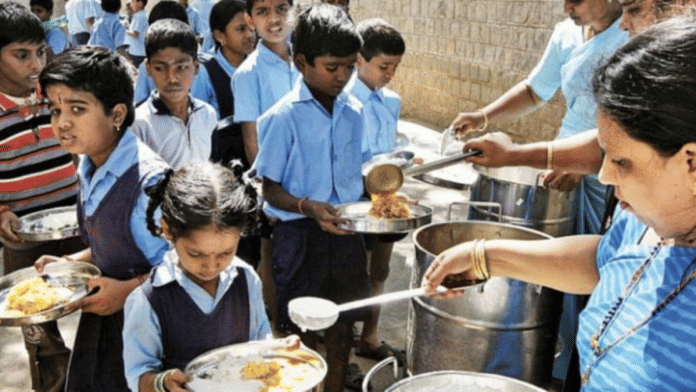
Karnataka, like its peers, has a robust mid-day meal programme under which millions of school-going children receive hot food delivered to their respective schools every day.
Organisations like the Akshaya Patra Foundation implement the Centre’s PM POSHAN initiative, serving hot food every school day to over 2.35 million children across 76 locations in 16 states & 3 UTs.
However, experts say that certain organisations entrusted with mid-day meal programmes push a caste-specific agenda, including the notion of vegetarian superiority to exclude eggs from school lunches.
Shatrugna says that for a child to grow tall, they needs milk and eggs to develop muscle and bone.
“And both require protein, which will not be fulfilled with watery Dal and rice. Children need to put on maximum height in the first two to three years, because this can’t be compensated later. If a child does not get milk and later eggs, this will not be possible. There are organisations and agendas that push the notion of moral superiority of being vegetarian. With the same money spent on watery Dal, if we give children various preparations of eggs and breads, we will get much better results,” she said.
In West Bengal, the newly elected Bharatiya Janata Party (BJP) government decided to hand over the mid-day meal to the International Society for Krishna Consciousness (ISKCON), which would have effectively ended the provision of eggs with lunch. However, after facing backlash, West Bengal CM Suvendu Adhikari said the government will separately provide eggs to students in mid-day meal.
According to the PM Poshan guidelines, every child aged 6-14 studying in classes I to VIII who enrols and attends school shall receive a free hot cooked meal every day except on school holidays, meeting nutritional standards of 450 calories and 12 gm of protein for primary and 700 calories and 20 gm of protein for upper primary, free of charge every day except on school holidays.
In Karnataka’s Anganwadis, the guidelines dictate about 500 calories of energy and 12-15 gms of protein for 0-6-year-old children, 600 calories of energy and 18-20 gms of protein for pregnant women/lactating mothers/adolescent girls, and 800 calories of energy and 20-25 gms of protein for severely malnourished children as a supplement to their normal intake.
For 300 days in a year, it costs between Rs. 8 per beneficiary per day for normal children, Rs. 9.50 per beneficiary per day for pregnant/lactating/adolescent girls, and Rs. 12 per severely malnourished child.
In Karnataka, instances have come to light where organisations entrusted with providing mid-day meal schemes refused to provide eggs, garlic and onions.
Widening regional imbalance
In Karnataka, the glaring regional imbalance is evident in the nutrition of children from different districts.
Udupi, in coastal Karnataka, is the most developed district for children, securing the 1st rank in the Composite CDI with a score of 0.87. Yadgir ranks last with a CDI score of 0.20. This highlights significant regional disparities. Udupi and Dakshina Kannada have achieved near-perfect scores (1.00) in the Health SubIndex. Yadgir (0.23) and Raichur (0.29) struggle with high neonatal and under-five mortality rates. While Kodagu leads with 94.7% full vaccination, Kalaburagi lags significantly at 63.4%.
Even the top-ranked district (Udupi) scores only 0.69; Koppal (0.24) and Yadgir (0.27) face severe challenges of malnutrition. “The stunting rates in some northern districts exceeded 45%. Adolescent Anaemia remains a universal hurdle even in economically advanced districts,” the report adds.
The districts of the Kalyana Karnataka region, specifically Koppal, Raichur, and Yadgir, are observed to be recording the worst indicators for child malnutrition.
“Our children can reach International Standards (in child health and growth). It is not a genetic problem. We (in India) have thin, lanky people growing tall with no muscle. But once you do not have muscle, this leads to chronic illnesses like diabetes, high blood pressure and others, which have become far too common,” Shatrugna says.
(Edited by Anupama Yadav)
Also Read: Students’ performance in govt schools suffer if they are hungry: Study