


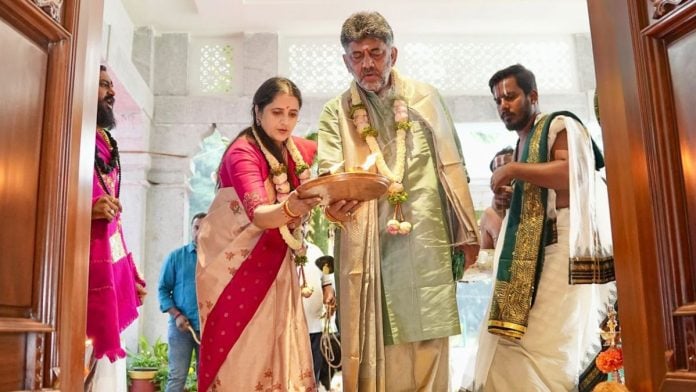
Bengaluru: Karnataka Chief Minister D.K. Shivakumar moved into his new residence, ‘Ganga’, which he also declared the “official residence” of the head of the state government. He said he will start residing in the house from Thursday and begin using it for all official and other engagements.
Having operated out of his home in Sadashivanagar, an upscale locality in northern Bengaluru, since he took office in June, Shivakumar will now move a significant portion of his administrative apparatus to ‘Ganga’, part of the heritage-linked property in the city centre. Shivkumar is to hear public grievances, process software and documents, and hold meetings and programs, among other duties in the building.
“Today, I left my private home and took Kumar Krupa (Ganga). The earlier portion was not useful. I have modified it about 10 percent but retained the heritage portions,” Shivakumar told reporters Monday.
Previously, there wasn’t an officially notified residence for the Chief Minister. Successive heads of government have chosen homes based on convenience, beliefs and political equations.
Shivakumar’s immediate predecessor, Siddaramaiah, continues to occupy ‘Cauvery ’- a palatial bungalow—despite having stepped down from power earlier this year.
The adjoining building, Krishna, was made into the Chief Minister’s home office during the term of S.M. Krishna in 1999.
Kumar Krupa, Krishna and Cauvery are a few hundred metres apart and serve as the corridor of power along with Vidhana Soudha, the state’s secretariat, about a kilometre away.
Shivakumar was earlier criticised for trying to modify the heritage structure and spend precious resources to revamp the place.
“Nearly 80 percent of the furniture being used here is from the old house. There is other furniture that is from the old Kumara Krupa guest house,” the Chief Minister said.
Different CMs, different choices
Kumar Krupa was originally the residence of K. Sheshadri Iyer, the former Dewan of Mysore between 1883 and 1901. It was also home to Mohandas Karamchand Gandhi in 1927 during his visit to Bengaluru.
Shivakumar’s decision to declare ‘Ganga’ the official residence of the Chief Minister, however, is unlikely to end the practice where heads of government are restricted from choosing their own residence.
Siddaramaiah’s predecessor, Basavaraj Bommai, operated from his personal home between July 2021 and May 2023 because B.S. Yediyurappa lived in Cauvery despite stepping down as Chief Minister.
Similarly, H.D. Kumaraswamy, known for his superstitious beliefs, refused to occupy Cauvery when he became Chief Minister in the Congress-Janata Dal (Secular) coalition government between 2018 and 2019. Kumaraswamy firmly believed that living at his palatial home in J.P. Nagar, was luckier for him while serving as Chief Minister.
Meanwhile, Siddaramaiah lost power in 2018 but continued to reside in Cauvery until the coalition broke down, as the government chose not to dislodge him.
Over the decades, Chief Ministers have chosen differently regarding their residences.
Following the reorganisation of the erstwhile Mysore state, Chief Ministers have resided in colonial-era bungalows like Carlton House, Balabroohi and Crescent House, among others.
Gundu Rao was the first to occupy Cauvery when he became Chief Minister in 1980. Several others like Jagadish Shettar, J.H. Patel, Veerendra Patil, and S. Bangarappa stayed in Cauvery during their respective tenures in office.
But in Karnataka, it’s not just about ‘Cauvery’ being a symbol of power, but ironically what it is believed to take away.
Superstitious beliefs around ‘Cauvery’
Karnataka’s political volatility has often been linked to local superstitions.
Leaders such as H.D. Deve Gowda, D.V. Sadanada Gowda and even Yediyurappa, during his first term, refused to occupy Cauvery to avoid its perceived bad luck, specifically the belief that residents would fail to complete their term in office.
Yediyurappa and some before him chose ‘Anugraha’ – another palatial bungalow but political instability was associated with these residential choices.
A significant number of political leaders in Karnataka and across India are known to consult astrologers and observe religious customs. For instance, D.K. Shivakumar regularly consults astrologers and visits temples, while Siddaramaiah has shifted over time from atheism to agnosticism, and ultimately to belief.
Other leaders follow similar practices; during the initial weeks of the Congress-JD(S) coalition government, H.D. Revanna commuted roughly 250 kilometres daily between Holenarsipura and Bengaluru because his astrologer had not yet approved his allotted residence.
(Edited by Anupama Yadav)
Also Read: K’taka CM Shivakumar seeks equitable Centre-State funding mechanism for Metro projects