





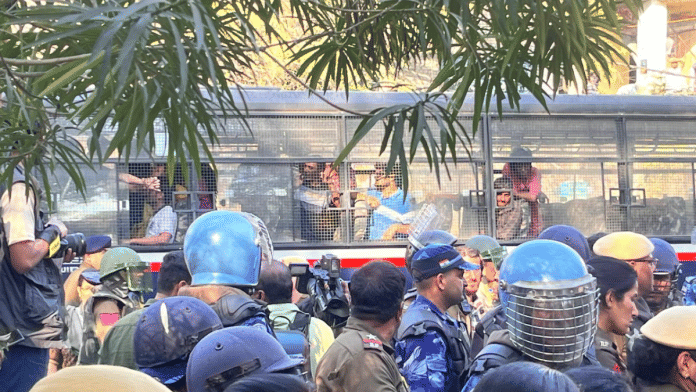



New Delhi: Delhi Police arrested 14 students of Jawaharlal Nehru University, including the JNU Students’ Union president, following a confrontation that stretched across 24 hours after a protest march was halted Thursday afternoon.
Police said 51 other students were detained. Those arrested were granted bail by a Delhi court on personal bonds Friday morning, but the order was yet to be released.
The arrested students include JNUSU president Aditi Mishra, vice-president Gopika Babu, joint secretary Danish Ali and former JNUSU president Nitish Kumar.
The episode was the latest clash at JNU, with both the sides accusing the other of violence and brutality against each other.
The standoff originated Thursday when the union called for a long march from Sabarmati Dhaba on the JNU campus to Shastri Bhawan, where the Union Ministry of Education is based, in central Delhi. The students were demanding the resignation of JNU Vice-Chancellor Santishree Dhulipudi Pandit over allegedly discriminatory remarks she made on a podcast while commenting on the new University Grants Commission (UGC) norms.
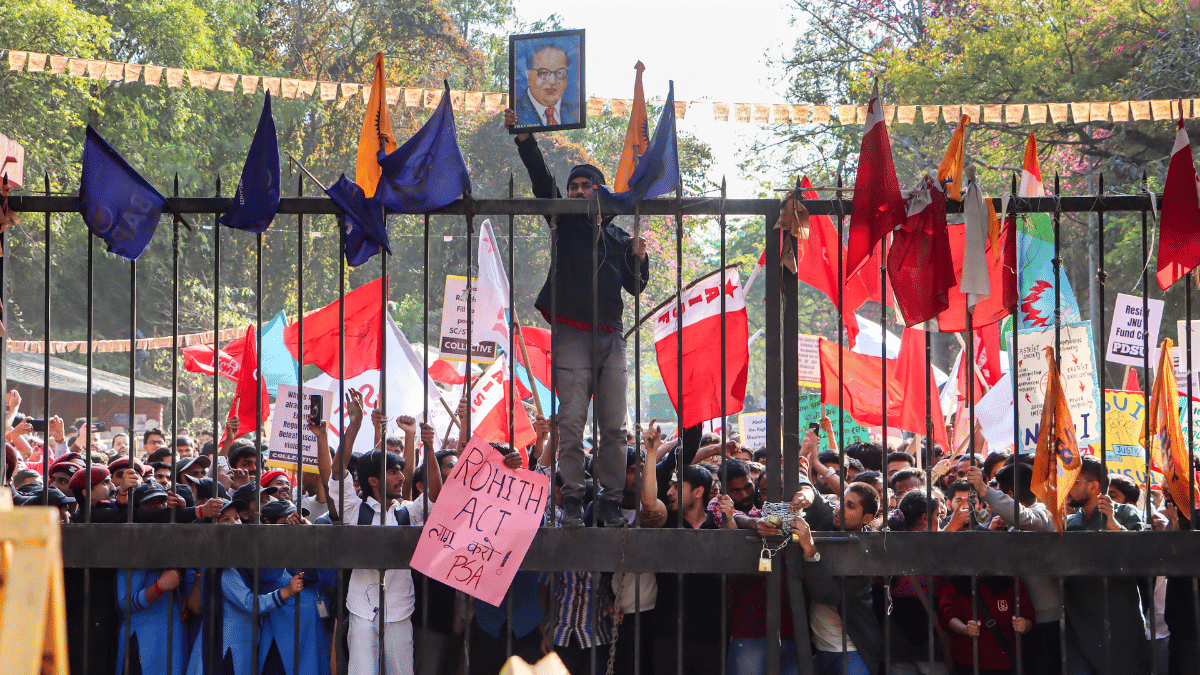
Students also pressed for implementation of “Rohith Act” and the reversal of the rustication of JNUSU office bearers.
The Rohith Act, named after PhD student Rohith Vemula who died by suicide after alleging caste discrimination at his college, refers to the 2026 UGC Equity Regulations. The norms, meant to curb caste discrimination in higher education institutes, were notified this year but were put on hold by the Supreme Court soon after. The court was hearing petitions against the norms amid protests by upper caste groups against their implementation.
The ‘rustication’ order was related to the suspension of JNU students for two semesters for alleged vandalism during a protest they had held last year against installation of a biometric system for entry into a campus library. The students who were suspended include Aditi Mishra and Nitish Kumar.
On Friday morning, the JNU campus gates were still barricaded and the students continued protesting. While police were deployed, there was no restriction on movement in and out of the campus.
Also Read: The story of JNU’s first woman VC Santishree Dhulipudi Pandit and why students turned against her
The FIR
The march set off from Sabarmati Dhaba at around 2.30 pm Thursday and reached the North Gate of the JNU campus at 3 pm. Delhi Police had sealed the gate with barricades and deployed personnel there from 10 am.
Yogesh Singh, a police officer at Vasant Kunj North Police Station who registered the FIR, said in the complaint that the march was led by Aditi Mishra, Gopika Babu, Nitesh, Sunil Yadav and others.
“After this, the students broke the lock of the JNU North gate. Meanwhile, senior officers instructed them through the PA system not to do so and to follow police instructions, but they did not listen and forcibly uprooted the barricades put up by the police, cut the ropes used to stop the barricades and forcibly started moving forward…” the officer said.
Singh alleged that when stopped, students began pushing and hitting officers with sticks, shoes, and slippers. “Meanwhile, a group of about 40-50 boys and girls caught hold of me and threw me down. They started beating me with shoes and sticks. They even tore my uniform. Due to which I and other staff members suffered severe injuries,” he said.
“The above students, despite repeated instructions, having a determined mind, broke the barricades on the road outside JNU North Gate, disobeyed the police orders, assaulted me and other police staff and obstructed our official duty,” Singh added.
The FIR was registered under BNS sections 221 (obstructing public servant in discharge of duty), 121(1) (voluntarily causing hurt to public servant), 132 (assaulting a public servant), and 3(5) (common intention) at the Vasant Kunj North Police Station.
‘Protesters violent’
Deputy Commissioner of Police (South West) Amit Goel said Thursday that the protest, involving 400 to 500 students, turned violent.
“They pelted banners, sticks, were throwing shoes, and physically assaulted the police. They bit the cops as well, which resulted in the injuries to several police officers. A total of 14 students were arrested so far,” Goel said.
According to police, 20 to 25 personnel were injured in the scuffle, among them ACP Vasant Kunj Ved Prakash, ACP (Crimes Against Women) Sanghamitra, SHO (Sarojini Nagar) Atul Tyagi, and SHO (Kishangarh) Ajai Yadav.
Goel said police had approached JNUSU a day before the march and urged students to confine the protest to the campus, as no permission had been obtained for a procession outside.
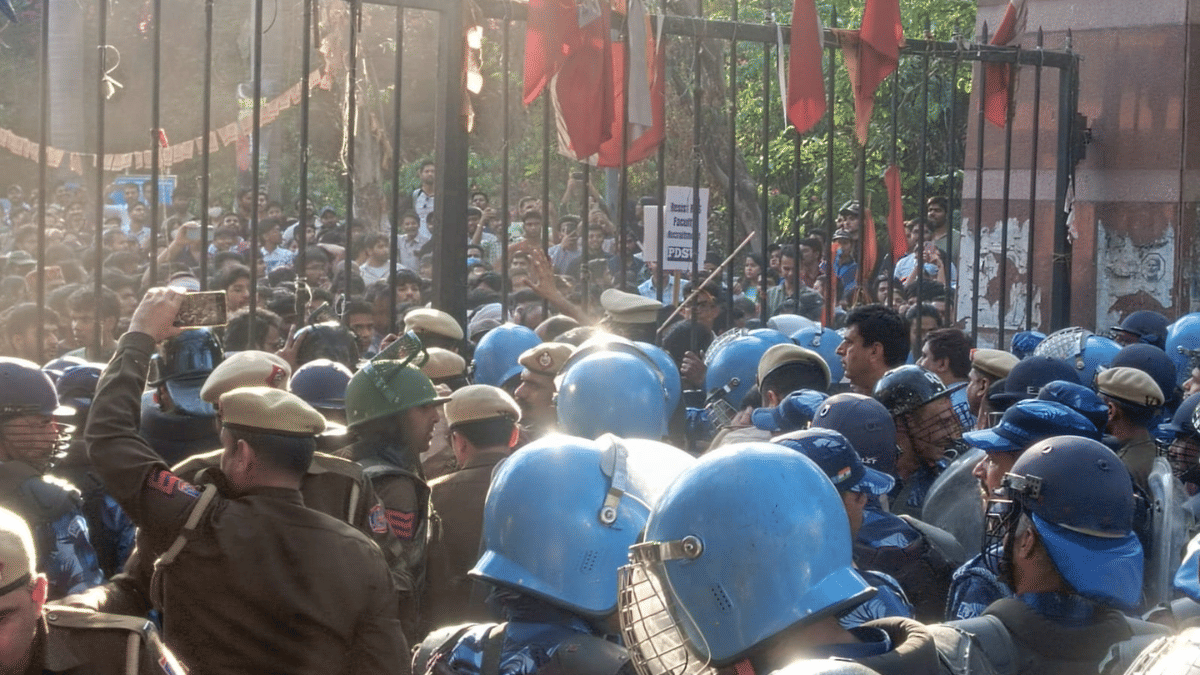
On Thursday, he said, officers offered to facilitate a delegation to the education ministry instead. “During that time, in self-defence and to stop them from moving forward, our staff detained some of their protesters, in which around 51 protesters were detained,” the DCP said.
‘Can students not protest peacefully?’
JNUSU gave a sharply different account.
In a statement Thursday, the union said police and paramilitary forces had locked the main gate with chains and multiple layers of barricades before the protesters arrived. More than 50 students were subsequently detained and taken to undisclosed locations, it said.
The union alleged that men in plain clothes kicked and beat protesters, that women were dragged and assaulted, and that police denied medical assistance to the injured.
Danish Ali, the JNUSU joint secretary, said, “On Thursday, the students were taking out a march from JNUSU, towards the Ministry of Education. We had raised several demands… implement the Rohith Act, remove JNU’s vice-chancellor Santishree Dhulipudi Pandit.”
Ali said the march was peaceful, but at least 700 police officers were deployed around the university.
“We still managed to break the locks, however, the police lathi-charged us. Students were dragged, brutally beaten up. All we want to ask is–can the students of Delhi not have peaceful protests in the national capital?”
JNUSU president Aditi Mishra said in video statement while she was being arrested: “The casteist government used their police and Rapid Action Force, more than 400 officers barricaded the protest site, and locked the gates of our university. Men in civil dress came and assaulted us, women were getting dragged and beaten up. We will reclaim our streets and we will return. Delhi belongs to us, and we will be heard.”
University & teachers’ union respond
The JNU administration said the students’ demand to implement the new UGC norms was itself in conflict with a Supreme Court order that had put those regulations in abeyance till a ruling was made on the petitions.
It said that neither the vice chancellor nor the registrar had authority over implementation of the norms.
It maintained that the rustication of student leaders had followed a duly conducted proctorial inquiry into vandalism and violence on campus, and accused the protesting students of raising the V-C issue to deflect attention from that finding.
“JNU is a public university, hence accountable to the Government, the Parliament and the Indian taxpayers. It is deplorable that a woman OBC Vice-Chancellor is instead attacked on false allegations, only to divert from the issue of violence and vandalism of public property,” the statement issued Thursday read.
JNU Teachers Association president Surajit Mazumdar condemned the episode, directing criticism at both the administration and the Ministry of Education. “The JNUTA knows that the bankrupt JNU Administration led by the V-C cannot be expected to discharge its duty as guardian of the students’ interests. After all, it is its own actions that have led to the current situation,” he said.
Mazumdar questioned whether the ministry had, in effect, endorsed the Vice-Chancellor’s conduct. “Is it that her infamous casteist remarks, that too while criticising Regulations notified with the approval of the Ministry of Education, and her other illegal actions, in fact have the endorsement of the Ministry? Was the march prevented because the Ministry wants to avoid answering the uncomfortable questions it would have had to face from JNU students,” he questioned.
The JNUTA strict action against police officials “responsible for transgressing the laws they are themselves bound by while enforcing them”.
The V-C had said in the podcast, “You cannot progress by being permanently a victim or playing the victim card. This was done for the Blacks; the same thing was brought for Dalits here.”
(Edited by Prerna Madan)
Also Read: From ‘azadi’ to biometrics—a new wave of protest takes shape at JNU