





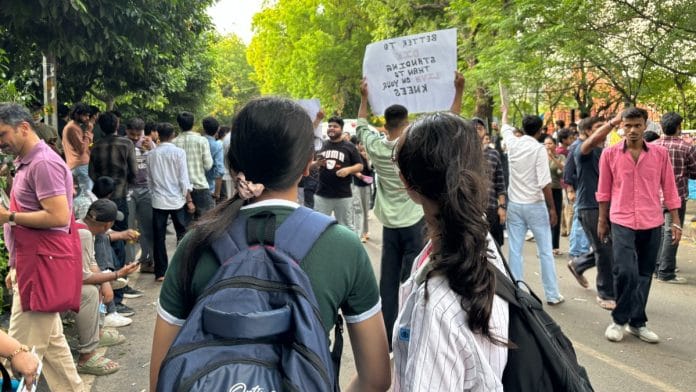

New Delhi: Some lied to their parents, others simply showed up straight from school in their uniforms. At Jantar Mantar, a growing crowd of student protesters have made one thing clear: their concerns go beyond the NEET-UG 2026 paper leak. They want a discussion on flaws in the CBSE evaluation process, delays in CUET and other university entrance exams, and the overall Indian education system.
Students ThePrint spoke to had either come alone, with a friend, or a parent—some from different parts of India, camping at the protest site.
Amit Kumar, 30, who works at a dental clinic in Bihar’s Chhapra, sat down at the verandah of Bangla Sahib gurdwara after a long day. With him, two nephews—Priyanshu and Suraj, both 16—also straightened their legs. Heeding the call given by Sonam Wangchuk and the Cockroach Janta Party (CJP), they had been at Jantar Mantar since morning.
Students of Class 8 and Class 9, Priyanshu and Suraj have decided not to go back to school, unless the government takes accountability. They sit in the verandah, recalling the clashes during the march on Parliament when security forces used batons and tear gas against them. “What a day it was, bhai,” Suraj tells Priyanshu.
He then pulls up the hem of his trousers and checks the wounds he says he sustained in the lathi-charge. His cuts have dried up. But the anger persists.
“So many paper leaks in Bihar. The children are angry. Our future is unsafe now. Many like us are protesting in Bihar,” says Priyanshu.
The two talk about the multiple paper leaks reported in Bihar in recent years, be it the NEET-UG paper leak in 2024 and 2026, or the BPSC Teacher Recruitment Exam (TRE-3.0) in 2024, even the Bihar Police Constable Recruitment in 2023.
“It has just become a money-making business. There are people selling the papers, and there are buyers. Students of Bihar are caught in the middle of all this,” says Priyanshu.
Adding, “We are not going back home. We are here to get “insaf”.
Also Read: Student protests find ally in veteran BJP leader Murli Manohar Joshi
Confusion over CUET, CBSE
Students at Jantar Mantar—like Lavisha, 17, and her friend Angel, 17, from Delhi’s Rohini—expressed concerns about poor grievance redressal, like the CBSE evaluation fiasco.
“For us students, the CBSE issue was difficult to grasp. People had to post on X, tag multiple accounts, to seek reply. The grievance redressal system is so broken. How do students from smaller towns manage when they have such problems,” asks Lavisha, a NEET aspirant.
“I want accountability for students like me, but they have been lathi-charged,” she adds. Having told her parents that she was going for her coaching classes, she came to Jantar Mantar instead to extend support to the protesters.
Angel, on the other hand, is planning to go for BCom. She says CUET is a genuine concern. She tells ThePrint: “Test centres are allotted far away, and it requires additional cost. Admit card comes a few days before the exam. There are a lot of delays and cancellations. And, everything is on the internet, and it is difficult to request any change…”
Government vs private schools
Sagar Yadav, 17, left home in Uttar Pradesh’s Jhansi a few weeks ago, and found a spot for himself at the Jantar Mantar protest site. A NEET aspirant, he studied at a government school, and is very concerned about the disparity between private and public education.
“There are so many differences between government and private schools. There exists such a high level of fee parity, the kind of education, and even school infrastructure,” he says.
The government, he adds, must focus on education, especially in rural India.
“The NEET issue was the tip of the iceberg, but there are multiple other issues with the education sector. We have to cater to what the students have to say…but, rather than hearing out our concerns, we were beaten up. We were lathi-charged, students lost their belongings, money, mobile phones,” says Sagar.
Since the last week of June, students, teachers, activists, and families have been camping at Jantar Mantar to demand the resignation of Union Education Minister Dharmendra Pradhan. On Monday, they organised a march to Parliament during which Delhi Police and the Rapid Action Force (RAF) used tear gas and lathi-charge to disperse the thousands who had gathered in central Delhi.
Hours later, the protesters regrouped at Jantar Mantar, with a renewed demand—justice for protesters who were at the receiving end of force used by security personnel.
(Edited by Amrtansh Arora)
Also Read: TV news showed the CJP protest live. Then it rewrote the story on primetime
Students are students. Such protests are not the right way to get redressal. But they don’t have enough maturity. They are easily brainwashed in their youth frenzy n many protesting are not even aware of people n facts. N global media is not unbiased or impartial in presenting facts
The coaching centre business must be banned and these coaching centre superstars put behind bars.
As long as the coaching mafia exists, paper leaks will keep happening.