





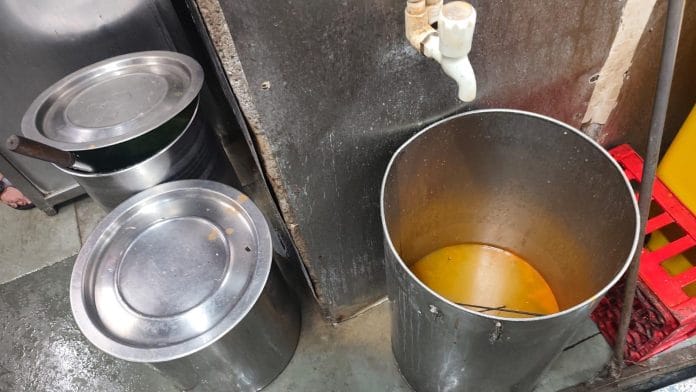

India’s widening crackdown on food hygiene has created an unofficial alliance between regulators and social media vigilantes, with both calling out unsanitary conditions at commercial kitchens across the country.
Central government and state-level regulators are stepping up policing of food preparation after years of complaints by consumers and online content creators about the $56 billion Indian food services market’s poor reputation for food safety.
Violations discovered during recent raids include infestations of flies, rats and cockroaches, expired or adulterated raw ingredients and improper storage. Some of the probes stemmed directly from complaints lodged via online portals set up by the government to receive complaints.
The increased scrutiny follows scathing viral posts about unsanitary conditions on platforms like Instagram and X, which have proliferated in recent years amid a growing awareness of food safety.
Governmental efforts have been applauded by foodies and casual eaters alike after accusations of lax enforcement on social media attracted widespread attention. That upswing in viral posts about nightmarish kitchens echoes a broader sense of consumer empowerment, especially among young Indians who are using online networks to challenge institutions and businesses.
“There was a lot of pressure from people on social media around this,” said Ankur Bisen, senior partner at consumer consultancy The Knowledge Company, due to “massive awareness” about unhygienic food handling and storage practices.
The same instinct helped propel recent mass movements in India such as the Cockroach Janta Party, a civic reform initiative targeting education that spearheaded protests in July. Long-simmering frustrations about other aspects of life are increasingly being aired publicly and going viral. It reflects rising disaffection with the status quo from India’s middle class, which is impatient with living standard improvements that haven’t kept pace with the rapid growth in the country’s overall economy.
“What’s really common among a lot of these movements that are looking at seeking accountability is that there’s this sense of data-oriented public communication that’s happening,” said Jitendra Chouksey, health activist and founder of fitness platform FITTR.
Reformist at FDA
The heightened inspections campaign was sparked a few months ago after the appointment of a reformist bureaucrat at the Food and Drug Administration in Maharashtra, India’s richest state. Since then, it has spread nationwide from the northern hilly state of Jammu and Kashmir to Karnataka in the southern part of the country.
The Maharashtra FDA has already conducted over 3,000 spot checks since May, with its no-nonsense commissioner, Tukaram Mundhe, suspending operations everywhere from exclusive clubs to fast-food chains.
“We eat out so many times more than what our parents used to eat,” said Aditi Thakur, a 24-year-old finance professional in Bengaluru who posts on Instagram about food safety concerns at restaurants and elsewhere.
Since April, Indian regulators have conducted more than 24,000 raids — or nearly two-thirds of the total number of inspections they did as recently as the full year through March 2023, according to the Food Safety and Standards Authority of India’s online database.
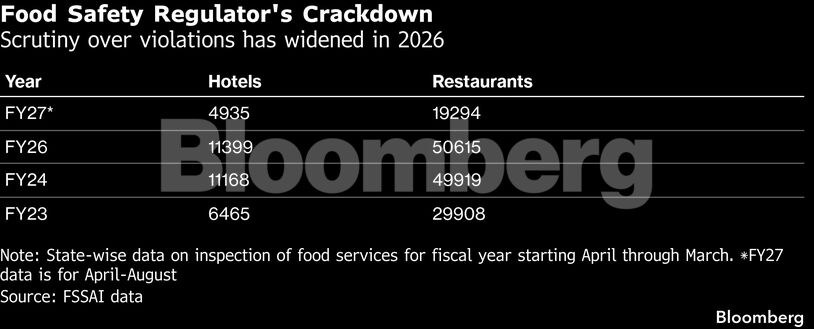
Five-star establishments, including New Delhi’s JW Marriott and Mumbai’s historic Cricket Club of India, were among those flagged this year for failing to meet hygiene standards. Local management for the JW Marriott said last week that they are fully cooperating with authorities and will address any issues identified. The Cricket Club did not respond to a request for comment.
The stricter countrywide inspections follow global concerns over India’s food safety standards. Japan banned imports from India of items such as mangoes this year due to alleged pest-control lapses. In 2024, countries including Singapore banned products from some Indian spice brands due to concerns around possible contamination with carcinogenic pesticides.
While the campaign has raised the profile of the head of Maharashtra FDA, his efforts to bring food safety to the masses since taking on the role have triggered pushback from some restaurant owners. Even the High Court in Mumbai has chided him for taking a “pedantic instead of pragmatic view,” according to local media reports.
But Mundhe, who himself has more than a million Instagram followers, sees his work as part of a broader mission to modernize India. Counterfeit and adulterated products hurt not just consumers, but India’s image abroad, he told Bloomberg News in July.
Quick Commerce
The Food Safety and Standards Authority of India and the Maharashtra FDA, in separate actions, have cracked down on rapidly growing quick-commerce operators such as Eternal Ltd.’s Blinkit and Swiggy Ltd.’s Instamart for alleged hygiene violations at a warehouse. The central government regulator also has targeted large packaged-food companies like Dabur India Ltd. for claims of misleading labels.
Representatives for Blinkit did not immediately respond to a request for comment. Dabur said last month that it was phasing out the problematic labeling.
Regional governments across India are bolstering enforcement of food safety rules in the run-up to India’s festive season, which kicks off this month and continues until Diwali in November, when Indians typically splurge on dining out, sweets, packaged foods and gifts.
The regulator in Jammu and Kashmir, for example, this week banned the sale, storage and distribution of some batches of ghee, an Indian clarified butter used for cooking. The capital city of Gujarat state has asked more than 11,000 food establishments to install cameras inside their kitchens, according to local media reports. Karnataka FDA has been seizing and destroying food products unfit for consumption.
Naming, Shaming
Enforcement efforts should focus on education and giving businesses a chance to address gaps without “unnecessary loss of reputation, public naming and shaming, or repeated reassessments that may amount to harassment,” the National Restaurants Association of India said in a statement.
The industry body is conducting an awareness program on best practices but has also urged a “collaborative” and balanced regulatory environment.
Some wonder how much of the crackdown is just for theatrics, and not in the service of realistic food safety goals.
Prakash Shetty, owner of a casual restaurant in southern Mumbai, said regulators’ tactics are excessive and their penalties too harsh. “Rats are here. Cockroaches are here,” Shetty said in Hindi, referring to how those pests are a ubiquitous presence in the city. “No one is making such errors on purpose. As restaurant owners, it’s our duty that no one falls sick after visiting us.”
Disclaimer: This report is auto generated from the Bloomberg news service. ThePrint holds no responsibility for its content.