





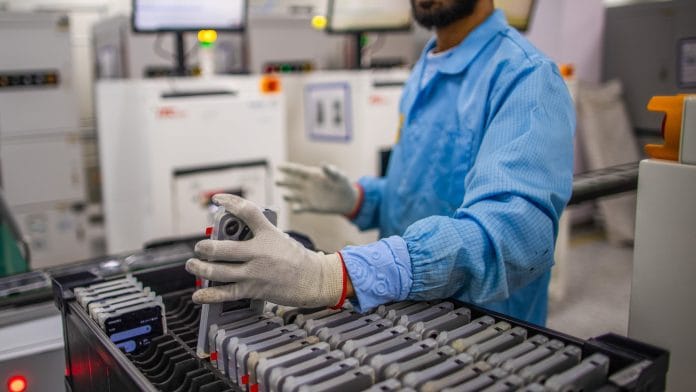



New Delhi: India’s electronics trade has grown at a striking 17.2 percent compounded annual growth rate (CAGR) between 2015 and 2024, far outpacing the global growth rate of 4.4 percent. However, its share in global electronics exports remains around 1 percent in 2024, federal think tank NITI Aayog said in a report released Friday.
“The electronics segment represents a $4.6 trillion global market. India’s share in this market stands at around 1 percent for 2024,” said the sixth edition of Quarterly Trade Watch Report.
In absolute terms, India’s electronics exports have surged from $8.6 billion in 2015—when they made up just 3.01 percent of total exports—to $42 billion in 2024. Electronics now account for 10 percent of the country’s export basket, making them India’s second-largest export sector.
Despite this explosive rise, India’s share in global electronics exports remains around 1 percent, underscoring the scale of the gap India still faces in becoming a true global electronics powerhouse.
NITI Aayog credits India’s recent rise in electronics exports largely to a single product category—mobile phones. “India’s electronics exports are concentrated in mobile phones, which make up 52.5 percent of the basket, while power equipment and wires contribute smaller shares,” the report states.
Although mobile phones have become India’s flagship electronics export, the country is yet to develop meaningful strength in upstream products such as integrated circuits, semiconductors, and other high-value intermediate goods.
“India remains heavily import-dependent for components such as semiconductors, integrated circuits, batteries, and displays, which dominate global electronics demand,” the report states.
It adds, “Comparative analysis shows that while India is competitive in mobile phones and telecom equipment and power-electronics segments, it remains marginal in high-value, technology-intensive components that anchor global value chains.”
Also Read: Inside India’s only dark factory in Tamil Nadu. Robots work all night, engineers stay out
India lags behind other Asian countries
The report flags that while electronics has emerged as one of India’s most promising export sectors, the country is still far from being a major global player.
NITI Aayog underscores that countries like China, South Korea, and Japan continue to dominate global electronics trade, reflecting their deep manufacturing ecosystems and control over high-value segments such as semiconductors and components.
“China’s entrenched dominance, together with mature players like South Korea and Japan specialising in high-value components (such as semiconductors and displays), highlights the intensity of the competitive landscape India faces,” the report states.
Global electronics trade is highly concentrated in East Asia, with China, Taiwan, South Korea, and Vietnam deeply embedded in component-intensive production networks, according to NITI Aayog.
India, however, is not strongly linked to these Asian supply networks. Instead, it mainly exports finished electronic products to consumer markets like the US and UAE, rather than being part of the region’s component-based manufacturing ecosystem.
“As a result, India lacks scale, value addition, technological learning, and spillovers associated with integration,” the report said.
Also Read: India approves $4.6 billion to boost electronics supply chain & challenge China
High tariff structure
NITI Aayog’s report flags that India’s electronics tariff regime is far more protective than key Asian competitors.
“India’s tariff structure is more protective than peers like China and Vietnam, supporting domestic assembly, but it raises costs for component-intensive production and weakens India’s integration into global supply chains,” the report states.
India’s average import tariff on mobile phones and telecom equipment is 7.6 percent, compared to 1.7 percent in China and 1.6 percent in Vietnam, even though India imports $17.6 billion worth of these products.
Power equipment tariffs are even higher at 13.3 percent, versus 4.4 percent in China and 3.8 percent in Vietnam. India also imposes steeper duties on component-heavy categories such as semiconductors and LEDs (8.3 percent), compared to China (2.4 percent) and Vietnam (1.4 percent), limiting supply chain integration.
Also Read: Electronics manufacturing shares rise after Budget 2026 sets aside $4.3 billion to boost sector
NITI Aayog’s recommendation
In its recommendations, NITI Aayog argues that India must focus on building a stronger domestic manufacturing ecosystem rather than relying on final-stage assembly.
It suggests that India must incentivize production of critical components, sustained R&D investment, and end-to-end supply-chain integration.
NITI Aayog also recommends streamlining the input tariff regime by correcting inverted duty structures and tackling logistics bottlenecks to reduce the cost disadvantage by 10–18 percent compared to global competitors.
The government think tank also calls for simplifying compliance by easing regulatory approvals, certifications, and customs procedures, while using public procurement to create steady demand for domestic manufacturers.
Finally, it stresses attracting more foreign investments. “Attract anchor investments from global firms for components in the ecosystem to enable technology transfer, improve quality and standards, and generate sustained demand for domestic suppliers,” the report states.
Also Read: Road-dependence, poor EV charging infra key hurdles to India’s net-zero transport push—NITI Aayog