








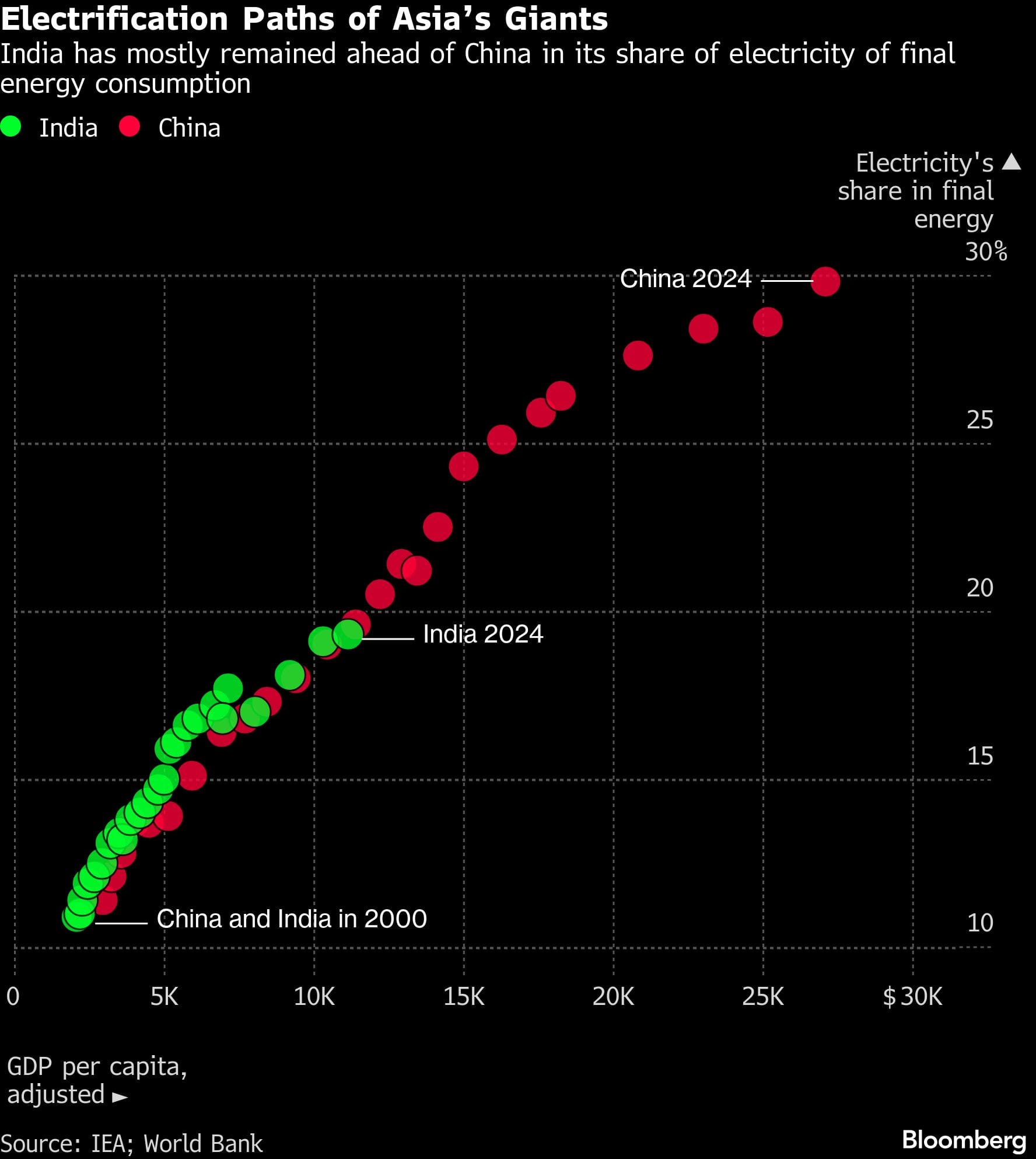
China’s rapid electrification has been hailed as a miracle. By some measures, India is even further ahead.
The nation is electrifying faster and using fewer fossil fuels per capita than China did when it was at similar levels of economic development, according to a new report from the think tank Ember. It’s a sign that clean electricity could be the most direct way to boost growth for other developing economies, too.
That flies against “the orthodox narrative that emerging markets must follow the same path the West and China took: go from biomass to fossil fuels,” said Kingsmill Bond, a strategist at Ember and one of the authors of the report.
Ember’s analysis adjusted China’s and India’s gross domestic product for the cost of living, putting India’s income per person of about $11,000 today at the same level as China’s in 2012. That allowed the report’s authors to compare the two economies’ energy systems at a similar level of development.
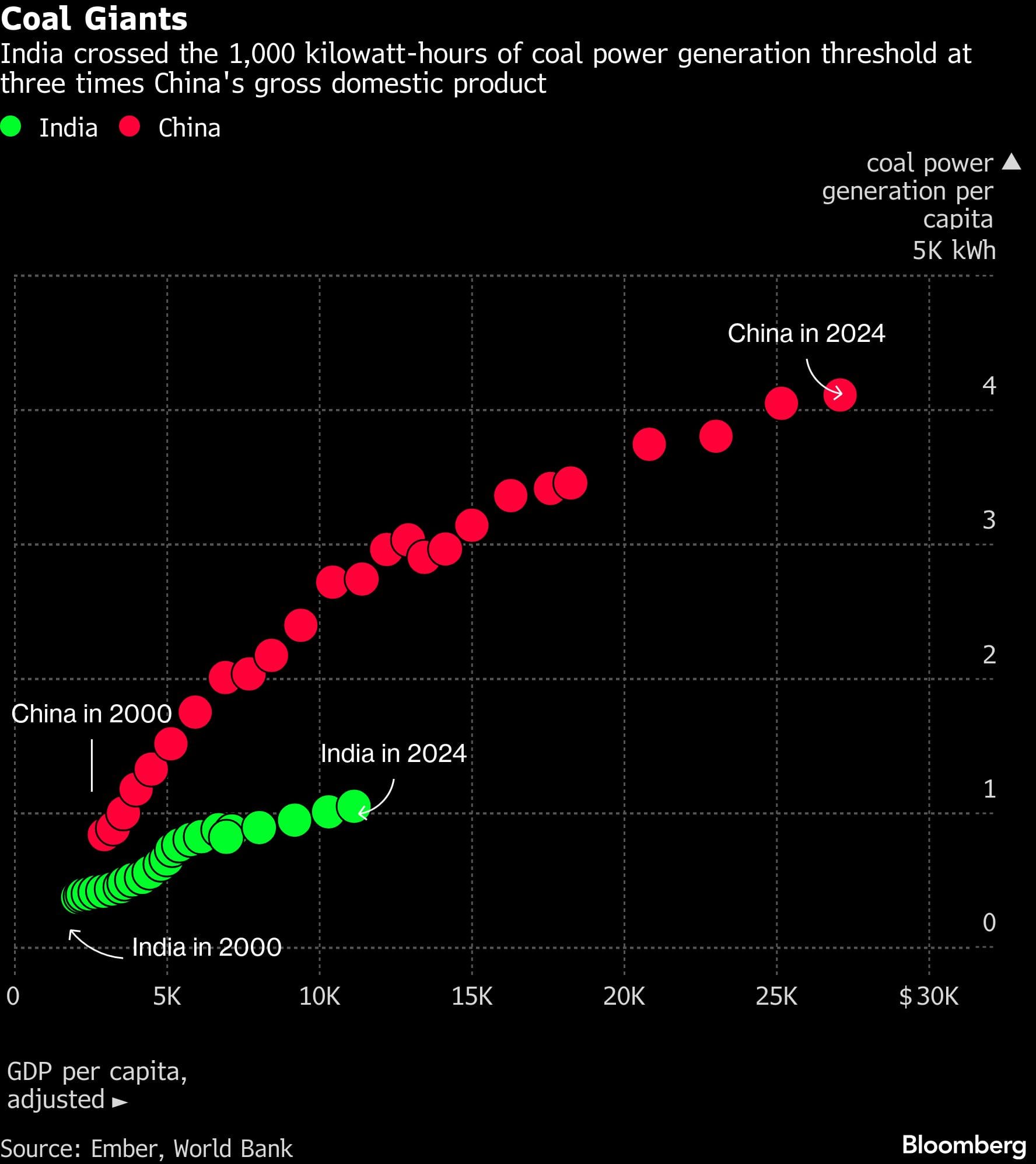
Even as it boosts green electricity, India continues to rely heavily on fossil fuels. The government is considering new plans that would double India’s coal power capacity by 2047, and the country’s oil consumption growth was set to outpace China’s last year.
But the South Asian economy’s coal and oil consumption per capita is a fraction of what China’s was at similar income levels. In absolute terms, India’s fossil fuel consumption is growing at slower rates than China’s today.
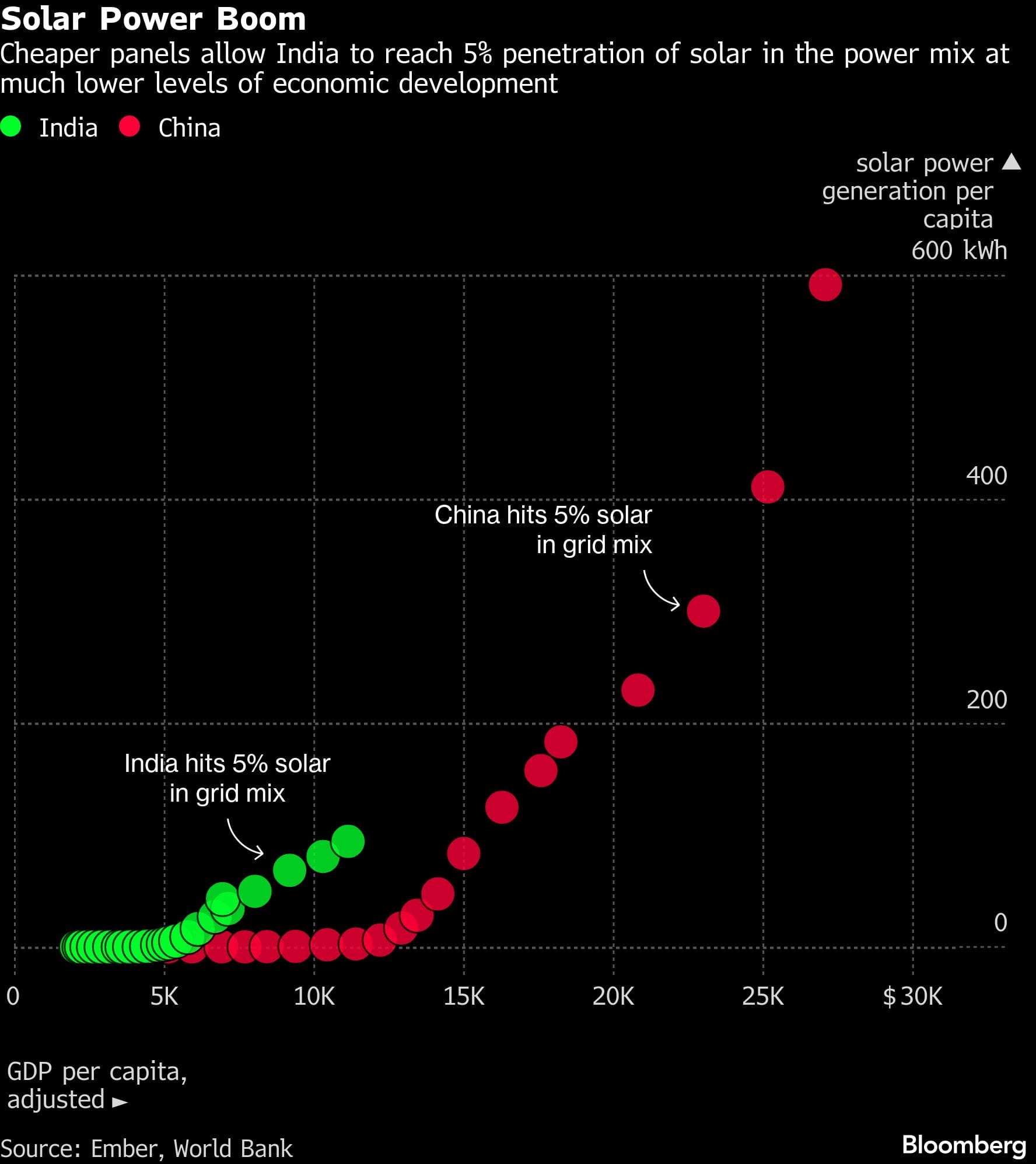
That’s mainly because India has access to solar panels and electric cars at a much lower price than China did about a decade ago. Chinese investments lowered the costs of what experts call “modular technologies” — the production of each solar panel, battery cell and electric car enables engineers to learn how to make it more efficiently.
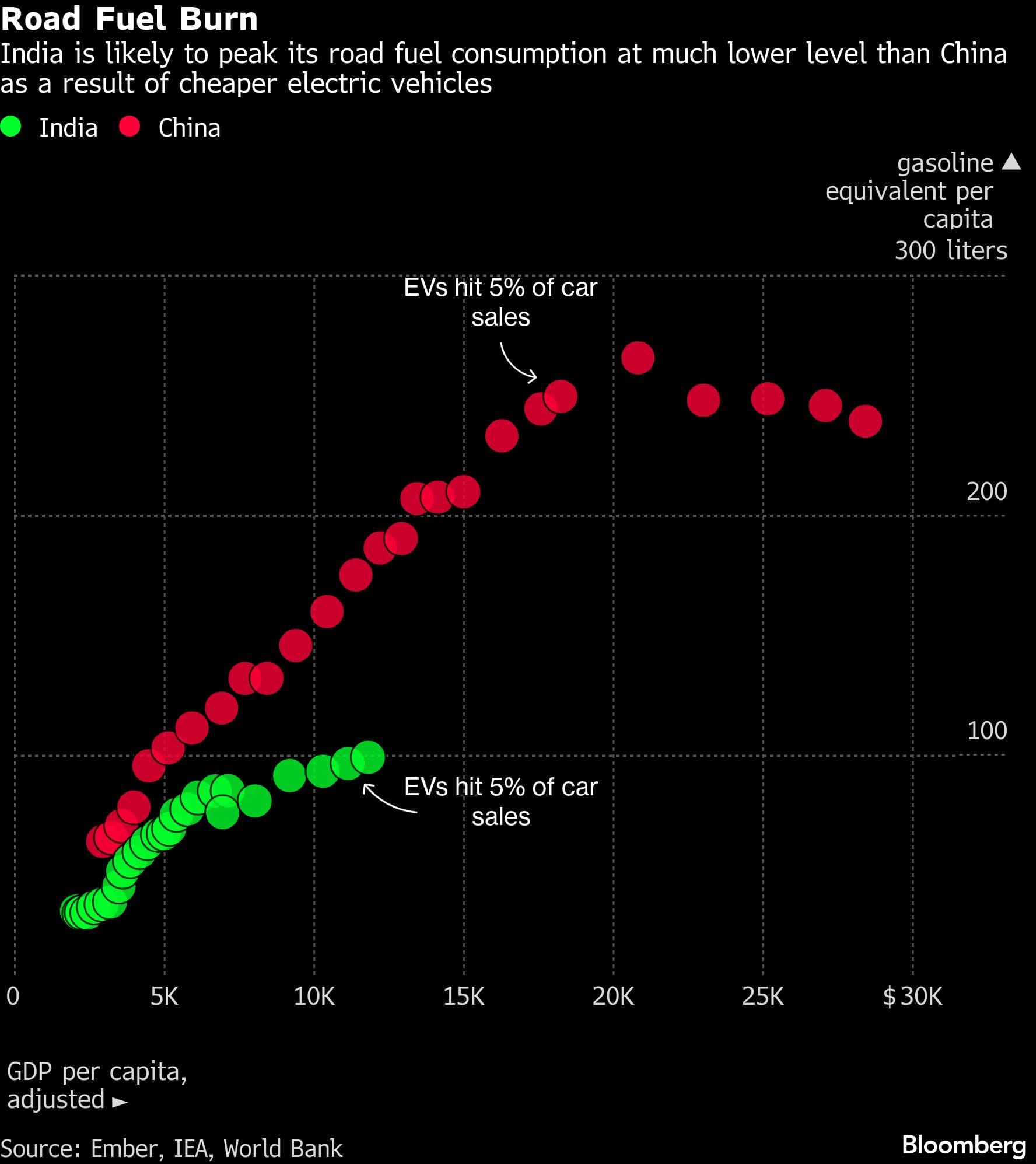
In India, 5% of all new car sales in 2024 were electric. The country’s per-capita consumption of oil for road transport is 60% lower than when China hit that milestone. As a result, Bond says that India’s peak road-oil consumption per person will likely never reach Chinese levels.
Bond and his team at Ember argue that countries such as India, who don’t have significant domestic fossil-fuel reserves, will become “electrostates” that meet most of their energy needs through electricity generated from clean sources.
No country is an electrostate yet, Bond says, but countries are increasingly turning to green electricity to power their economies. Nations that are less developed than India will see even more advantages as the cost of electricity technologies, from solar panels and electric vehicles to battery components and minerals, continue to fall.
Neither India nor China is going electric purely to cut emissions or meet climate targets, says Bond. They’re doing so because it makes economic sense, particularly for India, which imports more than 40% of its primary energy in the form of coal, oil and gas, according to the International Energy Agency.
“To grow and have energy independence, India needs to reduce the terrible burden of fossil-fuel imports worth $150 billion each year,” said Bond. “India needs to find other solutions.”
The difficulty is that today China is the world’s biggest manufacturer of all kinds of electricity technologies, which could create a bottleneck in other parts of the world.
China has leveraged that dominance, for example to extract tariff concessions from the US in return for rare earths. Chinese companies also control the equipment other countries need to kickstart domestic manufacturing, creating another potential roadblock for would-be electrostates. This month, Indian giant Reliance Industries Ltd. paused plans to make lithium-ion battery cells at home after it failed to secure necessary equipment from China.
Bond acknowledged that these risks could grow as trade becomes more contentious and slow down electrification. Conversely, if countries like India find ways to grow electrotech manufacturing without absolute dependence on Chinese equipment, electrification could speed up further.
With the US and Europe continuing to add exclusions for Chinese-linked electrotech, countries like India will have an incentive to invest in their own manufacturing capacity. “We are probably at a moment of peak Chinese dominance in the electrotech system, as the rest of the world starts to wake up and realize that this is the energy future,” he said.
–With assistance from Jeremy Diamond.
Disclaimer: This report is auto generated from the Bloomberg news service. ThePrint holds no responsibility for its content.