





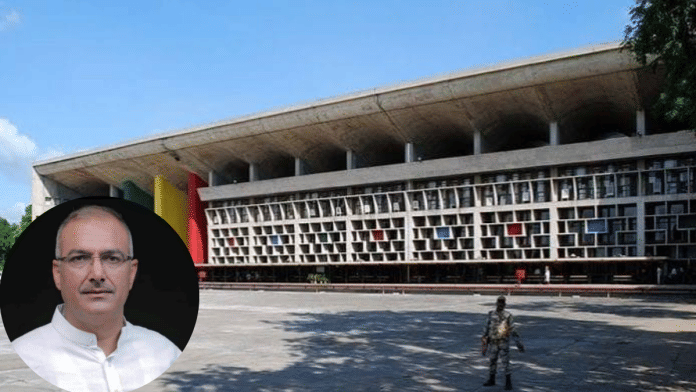


Gurugram: BJP Rajya Sabha MP Sanjay Bhatia on Thursday used Zero Hour in Parliament to press the Union government to set up a circuit bench of the Punjab and Haryana High Court in Gurugram, a demand that has floated through Haryana’s legal and political circles for nearly three decades.
Bhatia told the House that litigants, advocates, MSMEs and corporate establishments from Gurugram, Faridabad, Nuh, Palwal, Rewari and Mahendragarh are forced to travel to Chandigarh for every High Court matter, since the court functions only from its Chandigarh seat.
He said this adds to litigation costs, travel time, and delays access to justice for a region that has grown into one of India’s largest corporate and financial hubs.
The MP linked the demand to Gurugram’s economic weight, citing the volume of commercial disputes, labour matters, land acquisition cases, arbitration proceedings, tax litigation and insolvency matters originating from the region.
He also pointed to the recently inaugurated Tower of Justice in Gurugram, a modern judicial complex with digital courtrooms and e-court facilities, as ready-made infrastructure that could house a circuit bench.
Bhatia invoked Article 39A of the Constitution, which places a duty on the State to secure equal access to justice, and the right to speedy trial read into Article 21, to argue that decentralising the High Court’s reach to Gurugram is a constitutional imperative rather than an administrative convenience.
He asked the Centre to initiate a feasibility study in consultation with the Haryana government, the Punjab and Haryana High Court and other stakeholders.
Also Read: Don’t rely on AI, Google mid-argument—Punjab & Haryana HC warning divides legal practitioners
What is a circuit bench
A circuit bench is a temporary or periodic sitting of a High Court set up away from its principal seat, usually in a city far from the main court, to hear cases without litigants having to travel to the primary location.
Unlike a permanent bench, a circuit bench typically sits at fixed intervals, weekly, fortnightly or monthly, with judges from the principal seat travelling to hear matters, though some circuit benches have over time been upgraded into permanent ones as caseloads grew.
India has several precedents: the Bombay High Court has benches at Nagpur, Aurangabad and Panaji; the Madhya Pradesh High Court sits at Gwalior and Indore in addition to its principal Jabalpur seat; and the Rajasthan High Court has a bench at Jaipur alongside its principal seat in Jodhpur.
Setting one up requires consultation among the Chief Justice of India, the Chief Justice of the concerned High Court, and the state government(s) involved, since it is essentially an extension of the High Court’s own sittings rather than a separate judicial body.
A decade-old demand
The circuit bench proposal is not new. It was first raised by lawyers in Gurugram in the late 1990s and early 2000s, as the district industrialised rapidly and the Gurugram District Bar Association began passing resolutions seeking a High Court bench.
The demand gathered pace between 2008 and 2012, as Gurgaon (as it was then called) grew into India’s BPO and IT hub, with lawyers’ bodies submitting memoranda to the Haryana government, the Union law ministry and the Chief Justice of the Punjab and Haryana High Court — none of which progressed into a formal proposal.
Then Haryana BJP president Manohar Lal Khattar also backed the demand in 2015, citing the roughly 300-km round trip litigants from south Haryana have to make for every hearing.
Between 2014 and 2019, with the BJP in power both in Haryana and at the Centre, the Gurugram and Faridabad bar associations, along with south Haryana lawyers’ organisations and several MLAs, kept the issue alive, though without a formal proposal advancing.
The Covid-19 pandemic added a new argument: proponents said the shift to virtual hearings showed that court work no longer had to be concentrated only in Chandigarh. The Gurugram Bar renewed its demand during this period.
After the 2024 Haryana Assembly elections, public representatives again raised the issue, arguing that south Haryana contributes a disproportionate share of the state’s economy without matching judicial infrastructure.
Bhatia’s Rajya Sabha intervention on Thursday is being described by lawyers as the strongest parliamentary push the demand has received so far.
What lawyers say
Santokh Singh, a former president of the Gurugram District Bar Association, told ThePrint that the demand for a circuit bench is far from new and that advocates have been pursuing it for years. He said the case has only strengthened as Gurugram’s economic footprint has grown, even as the formal process for setting up a bench has never actually begun.
Senior advocate Ritu Bhariok, who practises at the Gurugram district courts, was more emphatic. She told ThePrint that the demand for a circuit bench “is no longer just a demand—it is a necessity,” arguing that timely justice is not merely a constitutional obligation under Article 39A but an integral part of the Right to Life and personal liberty under Article 21, and that justice delayed or made inaccessible amounts to justice denied.
Bhariok said litigants should no longer have to travel hundreds of kilometres to Chandigarh for hearings that are often adjourned within minutes, calling this an avoidable financial, emotional and professional burden on families. With Gurugram now a major economic hub with judicial infrastructure already in place, she said, a circuit bench would make justice more accessible and affordable while strengthening investor confidence and the rule of law in south Haryana.
“Our responsibility is to deliver justice to the people—not to make their pursuit of justice more difficult,” she said. “A Circuit Bench in Gurugram is the need of the hour.”
Why nothing has moved so far
Because the Punjab and Haryana High Court serves two states and a Union Territory, any decision on a circuit bench requires consultation among the Chief Justice of India, the Chief Justice of the High Court, the state governments concerned, and the Union government — a process distinct from, and more layered than, setting up a new district court.
Lawyers and officials cite the shared nature of the High Court, the absence of consensus among stakeholders, and the judiciary’s traditional preference for strengthening the principal seat over creating multiple benches as reasons the demand has not moved forward despite decades of advocacy.
Supporters argue a Gurugram bench would cut litigation costs and travel time, and strengthen investor confidence in south Haryana.
However, critics caution that additional benches could fragment the High Court’s institutional coherence, stretch already-thin judicial resources, and add administrative costs — arguments that have, so far, kept the proposal in the realm of political statements rather than government action.
(Edited by Ajeet Tiwari)