



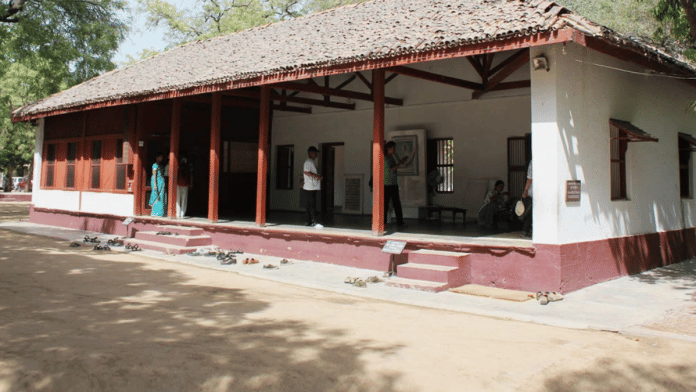
New Delhi: In India’s latest pitch to the United Nations Educational, Scientific and Cultural Organization (UNESCO) for World Heritage status, Mahatma Gandhi’s Satyagraha begins at a railway platform in South Africa’s Pietermaritzburg and ends on the lawn of Birla House.
India’s dossier, filed with UNESCO on 3 September under the title ‘The Sites of Satyagraha: The Emergence and Institutionalization of the Non Violent Movement’, names nine sites—seven in India and two in South Africa—considerably pruning the 2014 list.
The 2014 proposal had 22 entries, and it still sits on the UNESCO website’s Tentative List. A site has to be on the Tentative List for at least a year before it can be formally nominated. India never took the 2014 proposal forward to a formal nomination.
Only four from the 2014 list have been retained—Sabarmati, Sevagram and Mani Bhavan and Champaran—while 18 have been dropped.
The other five components in the 2026 proposals are new: Pietermaritzburg Railway Station and Phoenix Settlement in South Africa, Harijan Sevak Sangh and Gandhi Smriti in Delhi, and Aga Khan Palace in Pune.
But the Dandi March route did not make the cut in 2026. Neither did the Vaikom temple-entry agitation, the Bardoli satyagraha, Jamia Millia Islamia or Banaras Hindu University, all of which were on the list India sent to the UNESCO in 2014.
A Tentative List entry is only a statement of intent, and UNESCO does not assess it. To go further, India must file a full nomination dossier at least a year after listing. Nominations are due on 1 February each year and are evaluated by the advisory body ICOMOS International Council on Monuments and Sites.
The World Heritage Committee then decides at its annual session, usually about 18 months after the filing. That puts any decision on the Satyagraha sites at least two to three years away.
Vishal V Sharma, India’s Permanent Representative to UNESCO, said the 2026 nomination was a “message of peace” at a time when the world was caught in conflicts—from the US-Iran to Russia-Ukraine.
India, he said, had always been a messenger of peace and had always banked on soft power, and this was the kind of soft power it wanted to use.
Sharma also had a message for young Indians. He said the country was seeing violence by youth, from protests in Delhi to student-led agitations elsewhere, and that they needed to be shown that throwing stones was not the answer. Gandhi and the young people who stood with him faced far worse colonialism and racism among them, but they did not throw stones, Sharma said.
A significant milestone for India’s heritage!
5 remarkable properties and serial and transnational proposals have been added to India’s UNESCO Tentative List, taking India’s total to 78.
From the Buddhist murals of Bagh and the Gupta era Udaigiri to the temple heritage of the…
— Gajendra Singh Shekhawat (@gssjodhpur) September 29, 2026
Gandhi was young, and so was the Buddha, and neither of them took to violence. Gen Z needs to be told that violence is not the answer, he said, and the nomination does that.
The Delhi protests he referred to were led this summer by the Cockroach Janta Party (CJP). The group was started online in May by Abhijeet Dipke after Chief Justice of India Surya Kant compared unemployed youth to “cockroaches”.
On 20 July, a march to Parliament by the protesters ended in baton charges and tear gas. More than 100 protesters were injured and taken to the RML hospital. The Delhi Police said 118 personnel were hurt, and accused a section of protesters of pelting stones.
Also read: UNESCO panel raises red flags over Manas grasslands, Hampi & Ahmedabad; green flag for Ramappa
A transnational list
India’s 2026 dossier filed with UNESCO names nine sites. Seven are in India and two are in South Africa: the Pietermaritzburg station, where Gandhi was thrown off a first-class compartment on 7 June 1893, and the Phoenix Settlement near Durban, which he set up in 1904.
The seven Indian sites are the Mahatma Gandhi Satyagraha Smarak in East Champaran, Bihar; Sabarmati Ashram in Ahmedabad, Gujarat; the Harijan Sevak Sangh and Gandhi Smriti in Delhi; and Sevagram Ashram in Wardha, the Aga Khan Palace in Pune and Mani Bhavan in Mumbai, all three in Maharashtra.
Sharma said South Africa had been on board. India had been pursuing the nomination through diplomatic channels for a while, he said, and last month it was discussed at length at a Project Mausam workshop that South Africa attended, after which the nomination was made.
Project Mausam, the Culture Ministry’s Indian Ocean heritage project run by the Archaeological Survey of India (ASI), was launched in June 2014 at the World Heritage Committee meeting in Doha. One of its stated goals is to get transnational sites on the World Heritage List.
India’s first Satyagraha dossier was filed a few months before that, on 15 April 2014, in the middle of the Lok Sabha polls, when the Congress-led UPA was still in office.
Titled “Sites of Saytagrah, India’s non-violent freedom movement”, it listed 22 sites spread across Gujarat, Maharashtra, West Bengal, Tamil Nadu, Bihar, Madhya Pradesh, Karnataka, Kerala, Uttar Pradesh and Delhi.
The new one has sites in only four of these—Bihar, Gujarat, Maharashtra, and Delhi.
On the sites left out, Sharma said the new nomination was more transnational in nature and not just India-focused. He said the ASI prepares the dossier and the choice of sites was its call. The new dossier was drawn up under different criteria, he added, and these criteria could be added later.
Each of the 18 dropped sites is in India. They include Ahmedabad’s Kochrab Ashram, Gandhi’s first ashram after he returned from South Africa in 1915.
Prime Minister Narendra Modi inaugurated the refurbished Kochrab Ashram on 12 March 2024, the same day he launched the master plan for Sabarmati. Also gone are the Khadi Pratishthan at Sodepur, the Dandi and Vedaranyam salt march routes, and the Kheda, Bardoli and Dharasana satyagraha sites.
The Flag Satyagraha sites in Nagpur, Jabalpur, Mysore and Mumbai are out, as are the Quit India sites at Gowalia Tank and Wardha, Chauri Chaura, Gandhi Bhawan at Beliaghata in Kolkata, where Gandhi fasted during the 1947 riots, and Tilak Ghat in Chennai.
Santiniketan, also on the 2014 list, was inscribed separately as a World Heritage Site in 2023.
The 2014 proposal grouped three Champaran Satyagraha sites into one component—Patna’s Sadaqat Ashram, now the Bihar Congress office, the Champaran Ashram and the Motihari courtroom. The new list replaces all three with a single memorial, the Mahatma Gandhi Satyagraha Smarak in Motihari. The memorial, which has a 48-ft Chunar-stone pillar and a museum, marks the spot where Gandhi was summoned before the magistrate in April 1917.
In 2014, India had described Jamia, BHU and Gujarat Vidyapith as centres of the national movement, noting that Madan Mohan Malaviya founded BHU in 1916 and that Jamia was set up in 1920 in response to Gandhi’s call. The three universities do not figure in the new text.
The fight against untouchability
One of the biggest changes from 2014 to 2026 lists is about the sites that represent India’s fight against untouchability.
The 2014 list included Vaikom and Guruvayur, two temple-entry satyagrahas in Kerala. Both have been dropped. In their place comes the Harijan Sevak Sangh, which Gandhi founded in 1932 after the Poona Pact with BR Ambedkar. The dossier calls the Sangh “the symbol of Gandhi’s lifelong Satyagraha against untouchability”.
It leaves out that Ambedkar went on to reject the pact. In his 1945 book “What Congress and Gandhi Have Done to the Untouchables”, he wrote that the pact left Dalit legislators beholden to caste-Hindu voters and that the Sangh was run by caste-Hindus.
Vaikom has been a rallying point for two opposition-ruled states. In April 2023, then Kerala and Tamil Nadu chief ministers—Pinarayi Vijayan and M K Stalin, respectively—launched the centenary celebrations of the Satyagraha together. Stalin gave credit for the agitation to Periyar.
When the celebrations wound up in December 2024, Stalin opened a renovated Periyar memorial in Vaikom.
The Aga Khan Palace where Mahatma Gandhi, Kasturba Gandhi and Mahadev Desai were held from 1942 to 1944, was kept out on purpose in 2014. That dossier had said the palace, like Jallianwala Bagh, was not directly linked to non-violent resistance.
The new dossier still says this about Jallianwala Bagh, but the palace is now on the list, described as the “carceral and sacrificial dimension of non-violence”.
The Gandhi Smriti entry says Mahatma Gandhi was shot on its lawns at 5.17 pm on 30 January 1948, “while restoring communal harmony”. Nathuram Godse is not named.
The title has changed too, from ‘Sites of Satyagrah, India’s non-violent freedom movement’ to ‘The Sites of Satyagraha: The Emergence and Institutionalization of the Non Violent Movement’.
Lines from 2014 saying that India’s freedom was won “solely by Indians”, that people across caste, creed, religion and gender took part, and that over 60 governments had changed through non-violent protest since 1966, have been dropped.
In 2014, India had cited point (iv) of UNESCO’s World Heritage selection criteria, which covers buildings and architectural ensembles that illustrate significant stages in human history, arguing that the ashrams were training centres for Satyagrahis.
The new dossier replaces it with criterion (iii), which covers exceptional testimony to a cultural tradition; and criterion (vi), covering sites associated with ideas or beliefs of outstanding universal significance.
Large chunks of the old dossier have been carried over as they were. The passage on authenticity is nearly identical, down to the claim that changes to the original buildings “are not drastic in nature” and the promise that the Culture Ministry has set up a Gandhi Heritage Sites Mission to protect them.
The 2014 dossier also contained a mistake: it said the Dandi March started from Sevagram, which was set up in 1936, six years after Mahatma Gandhi set out from Sabarmati.
The new dossier says Mahatma Gandhi’s quarters at Sabarmati, Hriday Kunj, are “preserved exactly as he left them”. The ashram is in the middle of a Rs 1,200-crore makeover designed by Bimal Patel’s firm, the architects of Central Vista, which will expand it from five acres to 55.
Tushar Gandhi, Gandhi’s great-grandson, challenged the project, but the Supreme Court threw out his plea in April 2025 on grounds of delay. It noted the Gujarat government’s promise that the core five acres would be left alone.
The South African sites
The two South African sites named in the new list have their own problems. Only goods trains now run through Pietermaritzburg station. South Africa had looked at putting the Phoenix Settlement on its own tentative list, but decided against it.
Tolstoy Farm and Satyagraha House in Johannesburg were left out of the joint bid because they had changed too much, and Satyagraha House is now a museum and guest house owned by a French travel company, Voyageurs du Monde.
The list linked to Mahatma Gandhi’s Satyagraha is one of several UNESCO heritage proposals India has submitted this year.
Madhya Pradesh has added four sites to the Tentative List: Ginnorgarh Fort, the Bateshwar, Padavali and Kakarmath temples in Morena, the Udaigiri Caves near Vidisha, and the Bagh cave paintings in Dhar. That takes the state to 19 of the 78 sites on India’s Tentative List.
The Ginnorgarh dossier presents the fort as a Gond capital and puts later additions down to “Mughal interventions”. There is no mention of Rani Kamlapati, the Gond queen after whom the Shivraj Singh Chouhan government renamed Bhopal’s Habibganj station in 2021. Nor does it mention Dost Muhammad Khan, the founder of Bhopal state, who took the fort after her.
The Morena dossier says more than 60 temples at Bateshwar were put back together “like a jigsaw puzzle”. It skips how that came about.
The ASI began the work in 2004 after archaeologist K K Muhammed persuaded the dacoit Nirbhay Singh Gujjar to let it go ahead, and the work later stopped for six years because of illegal mining nearby.
Earlier this month, India also added the Ahom capital of Rangpur-Sivasagar in Assam, the painted haveli towns of Shekhawati in Rajasthan, the Nicobarese cultural sites, and the British penal settlement in the Andamans, including the Cellular Jail.
India now has 45 World Heritage Sites, the latest being Sarnath, added in July at the committee’s meeting in Busan. A site has to be on the tentative list for at least a year before it can be formally nominated.
(Edited by Ajeet Tiwari)
Also read: UNESCO flags cracks in India’s reservation system as legal challenges mount; cites 30% vacant posts