



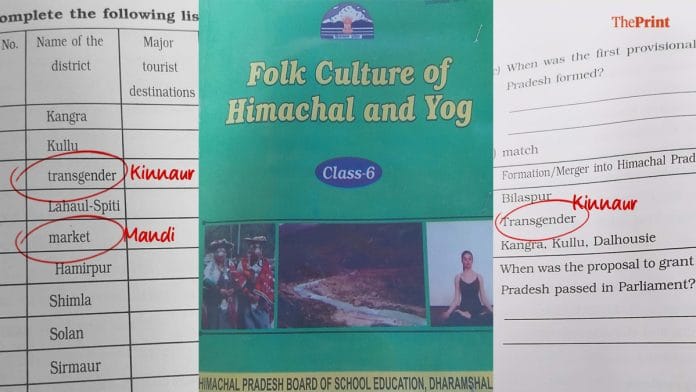
Shimla: Kinnaur has been rendered as ‘transgender’ and Mandi as ‘market’ in Himachal Pradesh government textbooks for Class 6, after district names were absurdly translated instead of being retained as proper nouns, prompting the recall of thousands of copies.
This comes at a time when Himachal Pradesh is claiming improved educational standards and showcasing the introduction of English-medium education in government schools as a major reform.
The controversy centres around the English-medium version of the Himachal Pradesh Board of School Education (HPBOSE) textbook “Himachal ki Lok Sanskriti aur Yog”, introduced in schools during the current academic session.
The Himachal Pradesh Board of School Education (HPBOSE) has sought a report into the matter. HPBOSE secretary Vishal Sharma said in a statement that books already distributed have been taken back, and a decision has been taken to reprint the books.
As per the board’s records, 65,000 books have been printed for Class 6.
According to officials, the textbook was originally prepared in Hindi several years ago and was now translated into English after the state government began expanding English-medium education in government schools phase-wise.
The book appears to have been translated mechanically from Hindi to English, leading to embarrassing and contextually absurd errors.
In one of the most glaring mistakes, Kinnaur district has been translated as “transgender” on pages 16 and 37 of the textbook. The error appears to stem from the Hindi word “Kinnar”, which in another context refers to the transgender community, but in the textbook clearly denotes the tribal district of Kinnaur in Himachal Pradesh.
Similarly, Mandi district has been translated literally as “Market”.
In a multiple-choice question related to the formation or merger of districts in Himachal Pradesh, the English version lists Bilaspur, Kangra, Kullu, Dalhousie, and “transgender”, instead of Kinnaur.
The Hindi-medium version correctly mentions Kinnaur, indicating that the error surfaced during the translation process.
Also Read: Amid revenue crisis, Himachal cuts budget by Rs 3,586 cr, defers salaries of CM, MLAs, top officials
Risk around AI translation
The controversy has emerged at a time when conversations around the risks and limitations of artificial intelligence and unchecked machine dependency are growing globally. The use of apparent machine translation in textbooks meant for Class 6 students has now triggered concern among teachers, parents, and education experts in Himachal Pradesh.
The controversy has also exposed deeper questions about quality control, editorial scrutiny, and accountability within the education system.
Social activist Rajesh Sharma said the issue could not be brushed aside as a simple oversight.
“Typing errors can still be tolerated, but this is not an error. This is a deliberate mistake. Those who were supposed to prepare the study material did not perform their duty properly,” Sharma said.
He further said the government must revise its academic review and publication mechanism to ensure such incidents are not repeated.
“The government should revise the mechanism so that such things do not happen in the future. School textbooks are not ordinary documents. Children treat them as authentic sources of knowledge,” he added.
The mistakes in the textbook were circulated widely on social media and in academic circles, drawing criticism and ridicule in equal measure.
Educationists warned that the matter should not be reduced merely to humour.
“This reflects a serious institutional failure,” said a school principal from Shimla. “District names should never have been translated in the first place. If such basic errors can pass through proofreading, editing and approval, then questions naturally arise about the rest of the content as well.”
Many teachers also expressed concern privately over the larger implications of rapidly introducing English-medium instruction without sufficient academic preparation, trained translators, or language experts.
The controversy has now intensified scrutiny over whether the translation work was outsourced or carried out without adequate human verification.
“While the government may now replace the flawed books, the controversy has left behind an uncomfortable question: if errors as basic as district names escaped the system, how reliable is the rest of the learning material being placed before students?” said Dr Ashok Thakur, a retired school principal, told ThePrint.
(Edited by Ajeet Tiwari)
Something tells me a human didn’t translate these books from Hindi or whatever language they were drafted in.