






This is an updated version of the report, published originally on 19 February, 2025.
Thiruvananthapuram: In 2020, when the nation was grappling with the economic stress induced by COVID-19, Kerala’s then finance minister, Thomas Isaac, said that the Kerala Infrastructure Investment Fund Board (KIIFB) was the state’s strength. He emphasised that KIIFB’s projects would help transform the state into a strong economy, despite reduced income from various sources, including agriculture.
Once lauded as a landmark initiative in infrastructure development and a pet project of the Pinarayi Vijayan-led LDF government, KIIFB has since faced multiple controversies over its debt burden, Enforcement Directorate (ED) probes and, most recently, scrutiny by the newly elected United Democratic Front government.
On Monday, the V.D. Satheesan government constituted a high-level expert committee, led by retired IAS officer Sudha Pillai, to undertake a comprehensive review of the board and recommend a restructuring roadmap to strengthen its long-term sustainability.
“The government has decided to undertake a comprehensive review of the institutional, financial, governance and operational framework of the Kerala Infrastructure Investment Fund Board (KIIFB) with a view to strengthening its long-term sustainability, improving governance standards and enhancing its capacity to support the State’s infrastructure development,” the government order said.
Besides the chairperson, the panel comprises former Federal Bank MD and CEO Shyam Srinivasan, chartered accountant Nilesh Vikamsey, retired IA&AS officer H. Shubhalakshmi Narayanan and former Union Revenue Secretary Tarun Bajaj. The additional chief secretary (finance) will serve as the convenor, while the committee can also seek assistance from the State Planning Board, the Centre for Development Studies (CDS), the Gulati Institute of Finance and Taxation (GIFT) and other institutions.
The latest move follows the Congress’s long-standing criticism of KIIFB. While in opposition, the party had accused the previous Left Democratic Front government of using the board as a vehicle for off-budget borrowing to finance infrastructure projects, effectively bypassing the state’s borrowing limits under the Fiscal Responsibility and Budget Management (FRBM) framework and masking Kerala’s actual debt burden.
The criticism had drawn support from successive Comptroller and Auditor General (CAG) audit reports beginning 2020, which described KIIFB’s borrowings as off-budget borrowings backed by state guarantees and dedicated tax revenues.
The CAG had observed that these borrowings were effectively liabilities of the state and should be considered while assessing Kerala’s fiscal position. The Union government had later included KIIFB’s borrowings, while determining Kerala’s borrowing ceiling under the FRBM framework—a move that is now under challenge before the Supreme Court.
“If we don’t do anything about it (KIIFB), the financially stressed state will fall deep into a debt trap,” Satheesan had said in the Kerala assembly in February last year, when he was the Leader of the Opposition.
Also Read: Kerala budget brings hikes in taxes & levies amid fiscal deficit crisis
The KIIFB model
The KIIFB was established under the Kerala Infrastructure Investment Fund Act 1999 by the government of the Communist Party of India (Marxist)’s E.K. Nayanar.
In 2016, during the first Pinarayi Vijayan government, it underwent a structural overhaul. Under the change, made through an amendment, the chief minister replaced the chief secretary as its chairperson. It also became a powerful body functioning as the Kerala government’s key arm for large-scale infrastructure investment.
KIIFB is the state’s key funding arm for large-scale social and physical infrastructure projects. It mobilises funds primarily through debt instruments, such as General Obligation Bonds, Alternative Investment Funds (AIFs), Infrastructure Debt Funds (IDFs), revenue bonds, land bonds and borrowings from banks and other financial institutions, in accordance with frameworks approved by the Securities and Exchange Board of India (SEBI) and the Reserve Bank of India (RBI).
The state government also provides budgetary allocations to meet repayment obligations and operational costs, with 50 percent of the Motor Vehicle (MV) Tax and a portion of the petrol cess earmarked for this purpose. If KIIFB fails to meet its repayment obligations, the state government, as guarantor, is liable to cover the shortfall.
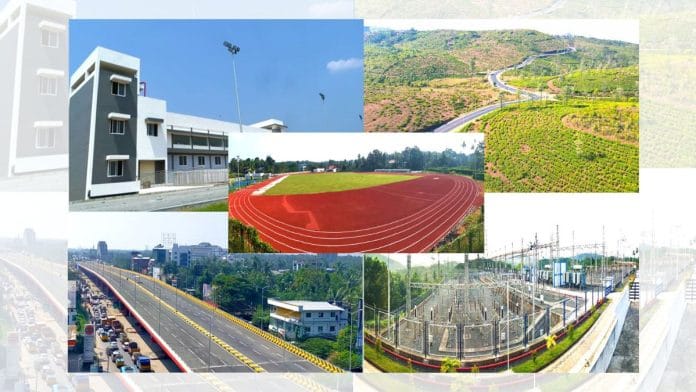
As per the State Economic Review, published in January this year, KIIFB had approved 1,149 infrastructure projects and seven land acquisition projects worth Rs 88,070.26 crore across sectors, including healthcare, education, roads and transport, irrigation and water supply, power, ports, inland navigation, drainage and solid waste management as of March 2025. Of these, 513 projects worth Rs 33,460.74 crore are linked to the Public Works Department (PWD), including the State Hill Highway project and the Wayanad-Kozhikode tunnel road.
This had also drawn criticism from the Congress, which had questioned the concentration of KIIFB-funded projects under the PWD when it was headed by P.A. Mohamed Riyas, then chief minister Pinarayi Vijayan’s son-in-law.
In 2024-25 alone, the board approved 46 infrastructure projects worth Rs 1,079.10 crore.
Though KIIFB became a household name after undertaking projects ranging from roads to school buildings, the Board remains dependent on the state because it lacks independent revenue sources.
According to KIIFB’s latest annual report for 2024-25, the board reported total revenue of Rs 5,37,004.58 lakh against an expenditure of Rs 6,69,337.05 lakh. During the year, the Kerala government contributed Rs 1,32,837.21 lakh to offset the net loss. In 2023-24, KIIFB had reported revenue of Rs 5,62,930.23 lakh against expenditure of Rs 6,60,070.11 lakh, with the state contributing Rs 96,771.09 lakh.
From the Motor Vehicle Tax alone, the Kerala government transferred Rs 2,469.69 crore to KIIFB in 2023-24, Rs 2,068.08 crore in 2022-23 and Rs 2,172 crore in 2021-22.
K.M. Abraham, the former CEO of KIIFB, had told ThePrint last year, “If the Government of India hadn’t targeted KIIFB, it would have been able to make repayments through the MV cess alone.” He had said that revenue from the MV Tax had been steadily growing, and that KIIFB would not have had to look for other revenue-generation sources.
A former Kerala chief secretary and a close associate of Pinarayi Vijayan, Abraham was appointed CEO of KIIFB in January 2018, a position he held until 5 May this year, resigning a day after LDF’s defeat in the assembly elections. Additional CEO Mini Antony was subsequently given interim charge. Abraham had also served as Chief Principal Secretary to Vijayan and was accorded Cabinet rank in 2024.
Abraham had described KIIFB as a “very bold experiment”, adding that it ensures “the quality and timeliness of projects”.
“The state government is doing many projects without the help of the World Bank because of KIIFB,” he had said, adding that 20 percent of the KIIFB projects were generating revenue.
Nirmal Roy V.P., an assistant professor at the Gulati Institute of Finance and Taxation, said the KIIFB model was an innovative approach and a crucial moment for sub-national financing, which could have been projected as the “Kerala model” to the world.
“In most parts of the world, a board like this will undertake only one project or one city. Here, the entire state is benefitting,” Nirmal told ThePrint.
Another economist in the state, Shaijumon C.S., explained that a body like the KIIFB is important for infrastructure development to ensure timely completion.
However, both economists suggested that the model could have been more sustainable if the KIIFB had its own revenue sources. Shaijumon said many of the projects undertaken by KIIFB are in social infrastructure, where there is no revenue.
“The government can invest in projects without revenue. But bodies that want to stay independent can’t go without revenue, it’s not sustainable,” Shaijumon said.
Nirmal said that the KIIFB, among its social sector infrastructure projects, should also explore those that generate revenue, such as solar power generation.
The KIIFB should have a “master plan” for its projects and revenue sources and the government should also announce the revenue sources in advance, he said, adding that KIIFB can continue working with available resources, but it will be limited as there is a cap on borrowing without Supreme Court interference.
In 2024, the Kerala government approached the Supreme Court challenging the Union government’s decision to include KIIFB and certain other off-budget borrowings, while determining the state’s borrowing ceiling. The apex court referred the matter to a five-judge Constitution Bench to interpret the scope of Article 293 of the Constitution. The case remains pending.
Abraham had said that generating revenue in social infrastructure was against the public policy of the state.
“Every government has its policies. Suppose if we have charged for the social sector, Kerala would not have reached where it is now,” he had said. “Even in the social sector, we are spending on developing infrastructure that will make more students benefit from it. That will increase the human resources of the state.”
Masala bonds controversy & ED probe
The 2020 Comptroller and Auditor General (CAG) of India report said the KIIFB “borrowed/raised funds amounting to Rs 3,106.57 crore” from financial institutions till 2018-2019. This included Rs 2,150 crore through masala bonds in foreign countries, which were to be repaid from the fund set apart by the state.
The report said such off-budget borrowings are not in accordance with Article 293 (1) of the Constitution of India. The article says that the state governments have an “executive power” to borrow from the Consolidated Fund of the state—that is, the government account—from time to time.
In 2019, KIIFB became the first Indian sub-sovereign entity to debut a ‘masala bond’ of Rs 2,150 crore on the London Stock Exchange. A ‘masala bond’ is a debt instrument issued by Indian companies in overseas markets, though denominated in Indian rupees.
In November 2020, months before the Kerala Assembly elections, the Enforcement Directorate (ED) began an investigation into the overseas borrowing of KIIFB for the alleged violation of the Foreign Exchange Management Act (FEMA). The ED had also sought clarifications from the Reserve Bank of India for issuing the No Objection Certificate (NOC) to KIIFB in this regard.
The ED had summoned Abraham and then Finance Minister Thomas Isaac in this regard against which the finance minister approached the Kerala High Court. The KIIFB alleged that the state was “selectively targeted” by the ED for the inquiry.
Jayaprakash said the ED case fizzled out in 2024 as KIIFB repaid the Rs 2,150 crore it borrowed through a masala bond in time.
“It was borrowed for five years. We paid back the amount with interest even before the time limit,” he said, adding that RBI had also given clarifications to the ED.
However, in December last year, the ED had issued fresh show-cause notices to Vijayan, Abraham and Isaac, alleging that Rs 466.91 crore from the bond proceeds had been used for land acquisition, which it claimed was prohibited under RBI rules and violated FEMA guidelines.
Isaac had rejected the allegation, maintaining that the money had not been used to purchase land and describing ED’s action as an election stunt.
KIIFB again approached the Kerala High Court. In an interim order passed the same month, the court stayed the proceedings, observing that there was prima facie merit in KIIFB’s contention that, under the RBI’s External Commercial Borrowing (ECB) framework, the infrastructure activities undertaken by the Board could not be classified as “real estate activity” and that the adjudicating authority may not have jurisdiction to initiate proceedings. The court, however, did not rule on the merits of the case.
(Edited by Sanya Mathur)
Also Read: From Davos pavilion to ‘masala bonds’, LDF pulls out all stops to separate ideology from investments