





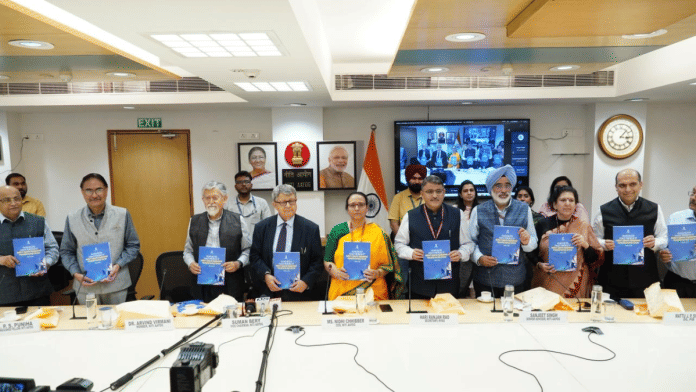



New Delhi: India’s sports equipment manufacturing sector is struggling with structural problems–high costs, fragmented production, and weak global linkages that have limited its growth in global markets, according to a NITI Aayog report released Thursday.
The report, ‘Realising the Export Potential of India’s Sports Equipment Manufacturing Sector,’ points out that India’s manufacturing base is largely driven by small units and legacy clusters, which have not scaled up or adopted modern technology.
“The sector has largely remained fragmented and has not fully transitioned to the scale-driven, technology-enabled manufacturing that defines today’s global sports equipment industry,” it noted.
While the global sports equipment market is valued at $140 billion and growing rapidly, India’s global export share remains at just 0.5 percent, despite a sizable domestic manufacturing base.
In 2024, the country exported $275 million worth of sports equipment which was concentrated in a narrow set of products like cricket equipment, inflatable balls, boxing gear and athletic/weightlifting equipment.
The report identifies a combination of supply and demand side challenges behind this under-performance.
On the supply side, cost disadvantages are stark. Indian manufacturers face a “10-20 percent cost disadvantage relative to China/Pakistan,” driven by high raw material costs, expensive land, and logistics inefficiencies.
Raw materials remain a major bottleneck. “Indian manufacturers pay high customs duties (10-20 percent) on raw materials that are not available in India,” the report noted, adding that even domestically available metals are costlier due to regulatory constraints like quality control orders.
Further, certification and testing costs act as barriers to global participation. “Manufacturers need internationally accredited certifications…These usually carry high upfront costs thereby causing an additional burden to manufacturers already facing significant cost disabilities,” the report noted.
On the demand side, it points out that Indian manufacturers lack strong brand presence and global linkages. “Indian manufacturers lack strong forward linkages with global anchor brands and a cohesive Brand India narrative, resulting in low global visibility despite adequate manufacturing capability.”
Trade barriers and limited integration of sports into free trade agreements also restrict market access, the report said. “India currently does not have sports focus in its existing FTAs (except the recent EU and UK FTAs). This limits brand building, distribution reach, and the ability to capture demand at scale.”
It must be noted that report covers only sports equipment (balls, sticks, bats, rackets, goals, nets), whereas sports apparels (team kits, outerwear, sports shoes etc) and sports accessories (bags/carry gear, headwear, socks, wearables etc.) is not part of the analysis.
States positioned to lead
Despite these challenges, the report identifies strong regional bases that can anchor future growth in manufacturing of sports equipment.
Traditional manufacturing hubs such as Jalandhar in Punjab and Meerut in Uttar Pradesh continue to form the backbone of the industry, with thousands of micro-small and medium enterprises (MSMEs) and household units engaged in production. These clusters already possess skilled labour and established supply chains which makes them critical for immediate scale-up.
However, the next phase of growth is likely to be driven by new and strategically located clusters.
The report identifies Gujarat, Andhra Pradesh, and Tamil Nadu as key states with strong potential due to favourable policy environments, port proximity, and infrastructure readiness.
“Readiness assessment of key states on parameters such as strong plug and play infrastructure, policy favourability, logistics infrastructure, and event-led tailwinds reveal that Gujarat, Andhra Pradesh and Tamil Nadu can serve as initial prospects,” the report states.
Gujarat’s policy push and port access (Mundra, Kandla), Andhra Pradesh’s plans for Sports Economic Zones, and Tamil Nadu’s industrial ecosystem position them as future export hubs.
At the same time, the NITI Aayog calls for upgrading legacy manufacturing hubs. The report suggests that modernising existing hubs like Meerut and Jalandhar can deliver “quick wins” by improving productivity and scale within already established ecosystems.
The recommendations
To unlock an estimated$ 8.1 billion export opportunity by 2036, the report outlines a comprehensive reform focused on cost competitiveness, need for fiscal support and global integration.
First, it calls for addressing structural cost disadvantages. Key measures include rationalising import duties on critical raw materials, easing quality control restrictions on carbon fibre and PU/TPU, and improving logistics efficiency. These steps are essential to close the estimated 15 percent cost gap with competitors.
The federal think tank also calls for targeted fiscal support. The report proposes a Rs. 2,000 crore outlay for export-enabling investments such as capex support for MSMEs, bulk procurement of machinery, and assistance for certification and testing.
The report also proposes a cluster-led development. It recommends setting up four new greenfield clusters with an investment of Rs 4,000 crore, alongside Rs 1,000 crore for upgrading legacy clusters like Meerut and Jalandhar.
The NITI Aayog also recommends building a robust domestic testing and certification ecosystem to eliminate double-testing and delays. The absence of accredited facilities increases costs and delays, limiting India’s ability to compete globally.
On the demand side, the report proposes a unified ‘Brand India’ strategy with an outlay of Rs 500 crore. This would involve partnerships with global brands, stronger engagement with international sports federations, and promotion through trade fairs.
“Targeted market-access and branding reforms would improve global competitiveness and demand visibility,” it stated, highlighting the need for coordinated action across government, industry, and sports institutions.
Implementing the above measures effectively, the report said, could transform the sector into a major export driver, generating up to 54 lakh jobs and positioning India as a credible global supplier of sports equipment.
(Edited by Tony Rai)
Also Read: Floundering PM Internship Scheme used less than 1% of Rs 10,831 crore set aside for it in FY25-26