


New Delhi: Health economists have raised questions about claims of affordable healthcare in India, even as government spending on healthcare has more than tripled over the past decade and the share of healthcare costs paid directly by households has fallen.
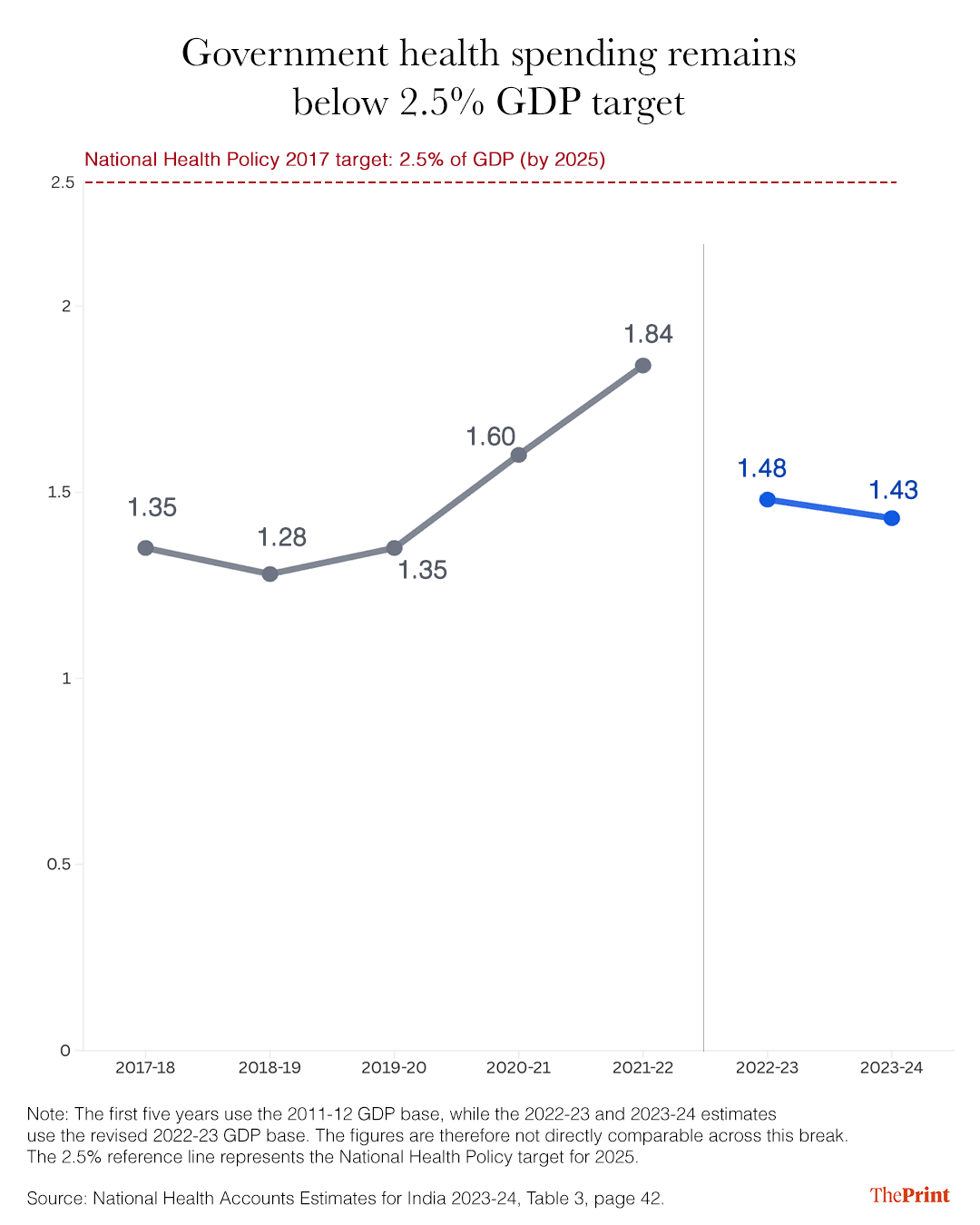
They pointed out that government health expenditure as percentage of GDP has in fact gone down from 1.48 percent a year earlier to 1.43 percent of GDP in 2023-24, well below the 2.5 percent target set for 2025 under the National Health Policy, 2017, as per the National Health Accounts (NHA) estimates for India 2023-24, released by the Union health ministry on Sunday.
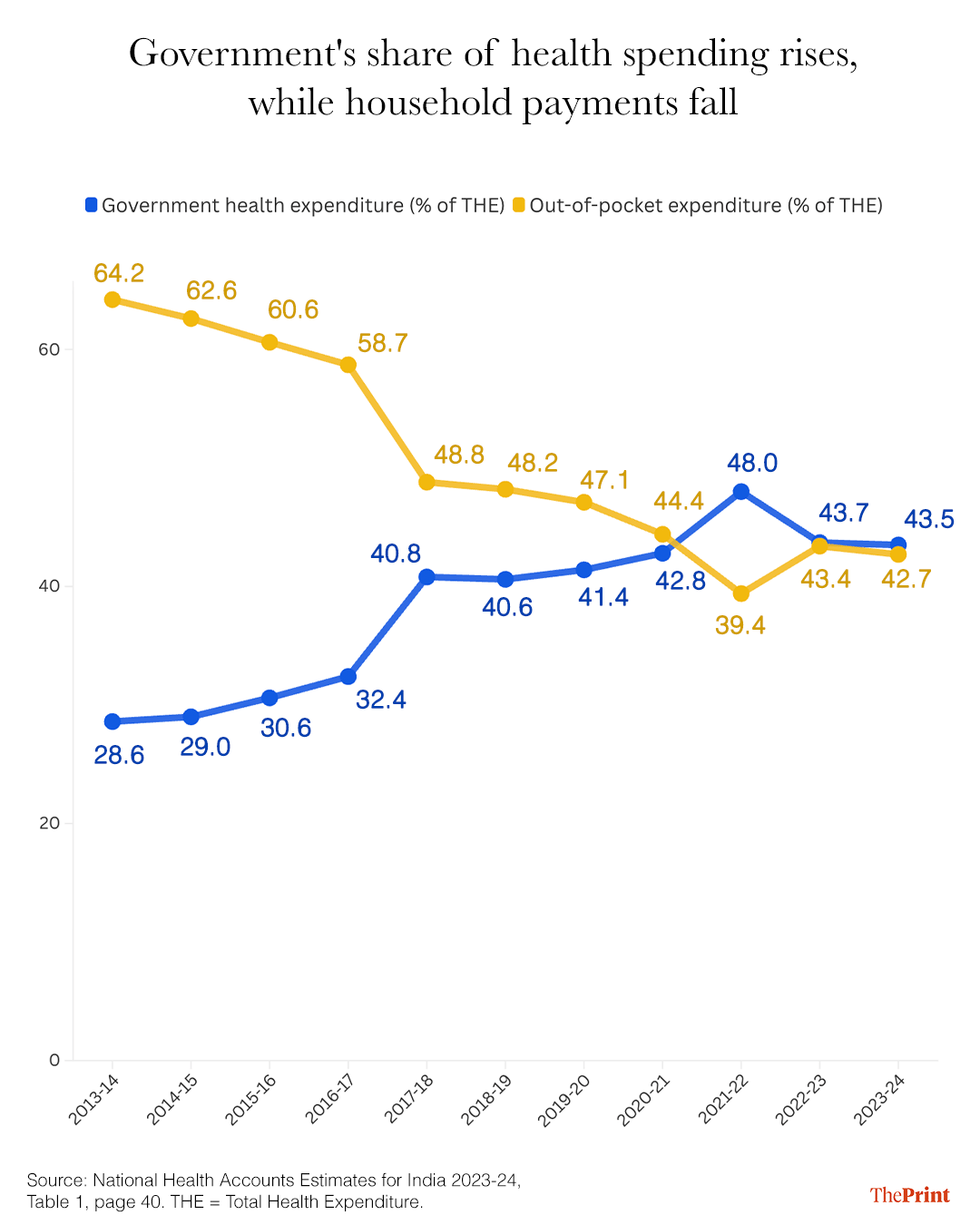
The report showed that the government spending on healthcare more than tripled from Rs 1.3 lakh crore in 2013-14 to Rs 4.14 lakh crore in 2023-24. Over the same period, out-of-pocket expenditure (OOPE), or the share of healthcare costs paid directly by households also fell from 64.2 percent to 42.7 percent of total health expenditure.
In a press release accompanying the report, the Union Health Ministry cited these figures as evidence of what it called “India’s progress towards a more accessible, affordable and financially protective healthcare system”.
Health economists, however, cautioned that these figures do not establish that healthcare has become more affordable.
Indranil Mukhopadhyay, a health economist and professor at OP Jindal Global University’s School of Government and Public Policy in Haryana, said the ministry’s claim of a threefold increase in government health spending since 2013-14 was based on nominal figures that did not account for inflation.
“The actual increase in real per capita spending is much less than what is being projected,” he told ThePrint.
Real per capita spending refers to government health expenditure per person after adjusting for inflation. This gives a more accurate picture of how much healthcare spending has increased in real terms, rather than simply comparing the rupee amounts across years.
The eleventh round of NHA estimates has been prepared by the National Health Accounts Technical Secretariat (NHATS) at the National Health Systems Resource Centre (NHSRC), under the Union health ministry. The report tracks how much India spends on healthcare, who pays for it and where the money goes.
Govt’s overall spending rises, but states bear most of it
Government health expenditure (GHE), which includes spending by the Union and state governments, has risen by nearly 15 percentage points from 28.6 percent in 2013-14 to 43.5 percent in 2023-24.
“This remarkable shift highlights the growing role of public financing in the health system,” the NHA report stated.
However, Dipa Sinha, a public health economist and Assistant Professor of Economics at Ambedkar University, New Delhi, said even though the figures show a rise in GHE, the decline in government health expenditure as a share of GDP is concerning.
“The worrying thing is that the government health expenditure has declined (to 1.4 percent) as a proportion of GDP. The National Health Policy goal is 2.5 percent. We should have reached that by now,” she said
“India is not spending enough on health, which reflects on poor access to public health facilities, quality and so on,” she told ThePrint.
The report also shows that states continue to bear the larger share of government health spending. The Union government contributed 32.1 percent of government health expenditure in 2023-24, while states accounted for the remaining 67.9 percent.
Mukhopadhyay said the Centre’s spending decisions also influenced how much states allocated to healthcare, adding that the Centre’s health expenditure had remained largely flat as a share of its total budget and declined as a percentage of GDP.
“With states having limited funds to expand their health budgets, the Finance Commission should allocate more funds to states for healthcare,” he said.
Fall in household spending rests on pre-pandemic survey data
One of the most significant findings of NHA 2023–24 is the substantial reduction in Out-of-Pocket Expenditure as a share of India’s total healthcare spending — from 64.2 percent in 2013-14 to 42.7 percent in 2023–24, marking a reduction of 21.5 percentage points.
“The sustained downward trend reflects the expanding role of government-supported healthcare services and financial protection mechanisms. Initiatives aimed at improving access to free and affordable treatment, medicines, diagnostics and hospital services are supporting efforts to reduce dependence on direct household spending,” the ministry said in a statement.
But the latest estimate of OOPE does not come from a fresh survey of household spending in 2023-24. It continues to draw on the National Sample Survey’s 75th round on health, conducted between July 2017 and June 2018, experts told ThePrint.
Mukhopadhyay said the use of older survey data meant the estimate could not capture changes in household spending during and after the Covid pandemic.
“All other data sources, even government, other NSS household consumption expenditure survey data shows that out-of-pocket is increasing as a percentage of household budget,” he said.
Sinha also questioned why the estimates continued to rely on the 2017-18 survey when newer household expenditure data were available.
She also flagged that the survey was conducted after demonetisation and recorded a decline in hospitalisation rates, raising questions about whether it captured actual healthcare use during that period.
The health ministry, however, has informed that the more recent NSS 80th round health survey was conducted in 2025, and its findings would be used in the NHA 2024-25, following the practice adopted for previous NSS health surveys.
It said OOPE in a given year depends on several factors, including healthcare use and government interventions. Therefore, it was preferable to calculate OOPE alongside government health spending for the same period.
The ministry added that it had compared the OOPE estimates based on the older survey data with those from the Comprehensive Annual Modular Survey (2022-23), which also collected information on household health spending, and found that the two estimates were close.
Insurance cover has grown, but direct payments persist
The government has also pointed to the expansion of insurance and other financial protection schemes. Social security expenditure on health, which includes government-funded insurance schemes such as Ayushman Bharat-Pradhan Mantri Jan Arogya Yojana (PM-JAY), state health insurance schemes and medical benefits for government employees, rose from 6 percent of total health expenditure in 2013-14 to 11 percent in 2023-24.
Private health insurance expenditure also increased, from 3.4 percent to 10.2 percent of total health expenditure over the same period.
The ministry said the rise in social security spending strengthened financial protection for households. But experts said the increase did not necessarily mean families no longer faced significant medical bills.
A peer-reviewed study published earlier this year in BMJ Open by health policy researchers Sekhar Bonu and Indu Bhushan, found that outpatient care remains poorly covered by public health insurance, with high out-of-pocket spending and catastrophic health expenditure (CHE) persisting even among insured households. CHE is spending that exceeds a set share of a household’s capacity to pay, which can force families to borrow, sell assets or cut other essential spending.
Analysing data from about 3.02 lakh households surveyed between July 2022 and June 2023, the study found that insurance was linked to lower CHE and out-of-pocket costs, but the protection was partial and far weaker for outpatient care than for hospitalisation.
Primary care share static, private hospitals and medicines dominate spending
The ministry has also highlighted its spending on primary healthcare. It said, “Government expenditure on primary healthcare reached approximately Rs 1.53 lakh crore,” describing this as evidence of investment in essential and community-level services.
The NHA estimates show that primary healthcare accounted for 46 percent of current health expenditure in each of the three years from 2021-22 to 2023-24. Current health expenditure refers to day-to-day spending on healthcare services and goods, excluding capital spending such as the construction of hospitals and purchase of equipment.
Over the same period, the share of secondary care rose from 33 percent to 35 percent, while tertiary care fell from 16 percent to 14 percent.
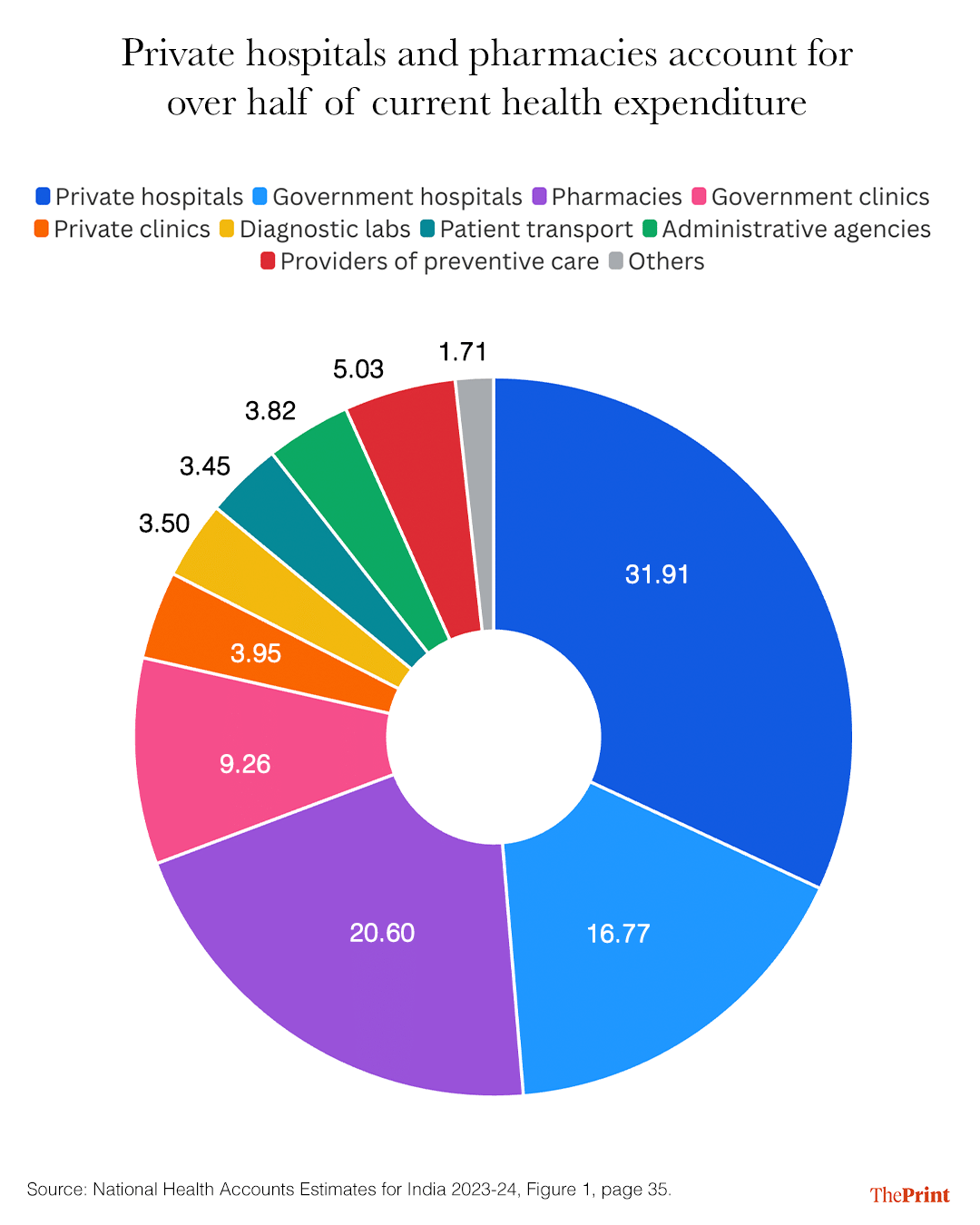
The estimates also show that private hospitals accounted for 31.91% of current health expenditure in 2023-24, almost twice the 16.77 percent spent at government hospitals.
Mukhopadhyay said the share going towards primary healthcare remained below what was needed.
“The High-Level Expert Group on Universal Health Coverage had suggested that around three-fourths of health expenditure should go towards primary care,” he said.
(Edited by Anupama Yadav)