







Gurugram: The impact of delay on a public infrastructure project is sometimes best, and most starkly, reckoned in numbers. The Gurugram Metro, conceived at Rs 5,452 crore, will now cost Rs 10,266 crore—nearly double—after years of administrative inaction, unresolved funding modalities and a prolonged wait for foreign lenders.
The Haryana Cabinet, meeting on Monday under Chief Minister Nayab Singh Saini, approved the revised project cost along with supplementary reports and a proposal to fund the entire soft loan component through the World Bank, after the European Investment Bank (EIB) failed to confirm its participation for years.
The 28.5-kilometre elevated corridor connecting the city’s Millennium City Centre to Cyber City, with all of 27 stations, has been in the making for well over a decade now. The Detailed Project Report was prepared by M/s RITES and approved by the Haryana Council of Ministers as far back as August 2020, and subsequently cleared by the Government of India.
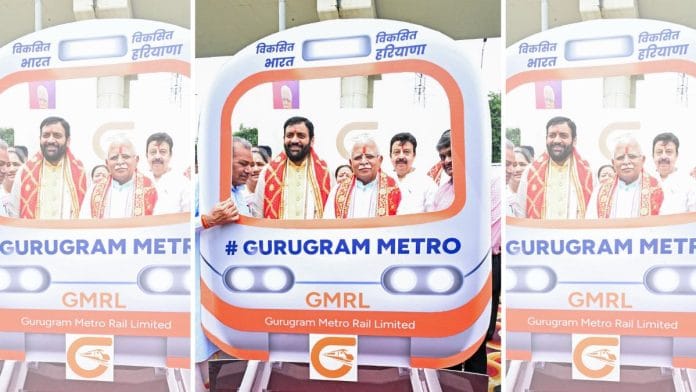
Prime Minister Narendra Modi laid the foundation stone of the project on 16 February, 2024. One-and-a-half years later, Union Minister for Power, Housing and Urban Affairs Manohar Lal Khattar and Chief Minister Nayab Singh Saini attended a bhumi poojan organised by Gurugram Metro Rail Limited at the Gurugram University Campus Auditorium in September 2025, a ceremony meant to mark the actual start of construction.
The revised estimate of Rs 10,266.54 crore against the original Rs 5,452.72 crore reflects price escalation between 2019 and 2023, revision in Goods and Services Tax (GST) rates, standalone planning requirements for the corridor after changes in its integration with Rapid Metro, the requirement of a full-fledged depot and additional rolling stock, modifications in the Regional Rapid Transit System RRTS) alignment, and the provision of a metro spur to Gurugram Railway Station.
Also Read: NCR’s biggest race — Noida Metro ahead of Gurugram by a decade
Tale of the tape
The breakup reveals that Rs 7,098.70 crore accounts for the revised project cost arising from escalation and GST changes alone. An additional Rs 947.06 crore has been added for standalone corridor requirements, and Rs 454.32 crore for the construction of a metro spur from Sector 5 to Gurugram Railway Station, a 1.8-kilometre stretch aimed at improving multimodal connectivity between metro and rail services.
The state Cabinet also approved a supplementary report on integration with Rapid Metro, which outlines the cost implications of developing the Gurugram Metro as a standalone project following changes in the integration scenario. This includes a depot and associated facilities spread over 22.86 hectares of government land in Sector 33, Gurugram.
On funding, the original sanctioned project cost had included a soft loan component of Rs 2,688.57 crore, split between the World Bank (Rs 1,075.43 crore) and the EIB (Rs 1,613.14 crore).
The Cabinet was informed that despite prolonged pursuit, the EIB never confirmed its participation. The Board of Gurugram Metro Rail Limited, meeting in October 2025, decided that if the EIB continued to delay, its share would also be routed through the World Bank. That proposal, approved by the Chief Minister in December 2025, has now received Cabinet sanction. The World Bank will accordingly fund the entire soft loan portion of the project.
Speaking to ThePrint on Monday, a senior officer of the Haryana government said the delay was attributable to multiple factors. “The biggest was the debate over whether the Sector 9 to Cyber City stretch should remain elevated or go underground. An underground alignment would have nearly doubled the per-kilometre construction cost and required a completely fresh DPR, new approvals, tender revisions and redesign work, which alone could have pushed the project back by two to three years. Then there were coordination issues with National Capital Region Transport Corporation (NCRTC) over the Regional Rapid Transit System (RRTS) corridor near Cyber City. On top of that, the European Investment Bank simply did not confirm its funding commitment for years, which kept the financial closure in limbo,” the officer said on condition of anonymity.
The officer said ground-level work had also been slowed by the sheer complexity of the corridor. “The route passes through some of the most congested stretches of old Gurugram — narrow roads, dense commercial zones, developed residential areas. Underground utilities have to be shifted before a single pillar can come up. Also, even after Central approval in 2023, the project kept seeing design changes: the railway station spur was added, RRTS integration required alignment modifications, double-decker structures were reconsidered, station layouts were revised. Each change meant fresh technical evaluation and another round of approvals,” he added.
NCRTC is a joint venture company of the Government of India and the NCR states, Delhi, Haryana, Uttar Pradesh and Rajasthan, with the main job to plan and implement the high-speed regional rail network called RRTS across the National Capital Region (NCR).RRT S is a semi-high-speed regional rail system designed for travel between cities in the NCR, unlike a normal metro, like the upcoming Gurugram Metro, which mainly serves intra-city travel.
The route of the Gurugram Metro, when complete, will link old Gurugram with the new city for the first time via the metro, passing through Sector 45, Cyber Park, Sector 47, Subhash Chowk, Hero Honda Chowk, Udyog Vihar Phase VI, Sector 10, Sector 37, Basai Village, Sector 9, Sector 7, Sector 4, Sector 5, Ashok Vihar, Palam Vihar, Sector 23A, Sector 22, Udyog Vihar Phases IV & V and Cyber Hub, among others. In the first phase, the metro is to be extended up to Sector 9, covering 15.5 km.
The Cabinet that met on Monday also nominated the Administrative Secretary, Town and Country Planning Department, as the Nodal Officer for signing project agreements, and authorised the Chief Minister to approve any modifications needed during consultations with the Government of India or for the removal of bottlenecks during implementation. The project is targeted for completion by December 2028, a deadline the state government will be under pressure to meet, given the delays so far.
(Edited by Nardeep Singh Dahiya)
Also Read: What happens to Haryana real estate agents now? Govt agency HSVP to act as broker, take commissions