







New Delhi: A parliamentary committee has asked the Education Ministry to prepare a single nationwide list of blacklisted firms involved in paper setting and examination work, after finding that companies barred by one state or organisation continue to get contracts from others.
The Rajya Sabha’s standing committee on education, women, children, and youth affairs, then chaired by senior Congress leader Digvijaya Singh, made these recommendations in an action taken report on the higher education department’s Demands for Grants for 2025-26. The committee is now chaired by Congress MP Mukul Balkrishna Wasnik.
Interestingly, the report, uploaded on 16 June during a parliamentary recess, comes at a time the Education Ministry is at the centre of multiple controversies and faced with a demand for the resignation of Union education minister Dharmendra Pradhan.
The committee said firms blacklisted by one body were still securing work elsewhere and recommended that the department “compile a nationwide list of blacklisted firms so as to bring clarity in this regard”.
The National Testing Agency (NTA), in charge of conducting medical entrance test NEET, said its core work was not outsourced. Paper setting and correction “are not outsourced, as they are crucial to maintain integrity of examination process,” it said. It added that it does “not engage vendors it has blacklisted, and that its tenders require bidders to disclose any blacklisting by a government agency”.
The parliamentary committee also questioned the agency’s finances and said the NTA collected around Rs 3,512.98 crore and spent Rs 3,064.77 crore on conducting examinations over six years, leaving a surplus of Rs 448 crore. It recommended that the surplus be used “to build the agency’s capabilities to conduct tests itself, or to strengthen regulatory and monitoring capabilities for its vendors”.
The NTA said it received no government funding and needed money before fees were collected, for booking centres, paying experts, software and security. It said an average of Rs 74.5 crore was left each year after expenses, and that this was used for the next year’s preparations. Any surplus after that, it said, “can be appropriately utilised”.
On accountability, the committee said the NTA had audited accounts but had not submitted annual reports to Parliament, even after being asked. The committee “strongly recommends that the NTA issue and present Annual Reports every year to Parliament”. The agency said its accounts were audited by the Comptroller and Auditor General and that its work was subject to parliamentary oversight.
The committee further attacked the NTA and said examination irregularities had continued despite reform measures. The government has set up a steering committee under former ISRO chairman K. Radhakrishnan to act on recommendations made by an expert panel. “Despite these measures, the paper irregularities are still happening leading to the cancellation of the examinations thereby causing a lot of anxiety among students,” the committee said. It asked the department to publish “a time-bound implementation roadmap” for the reforms.
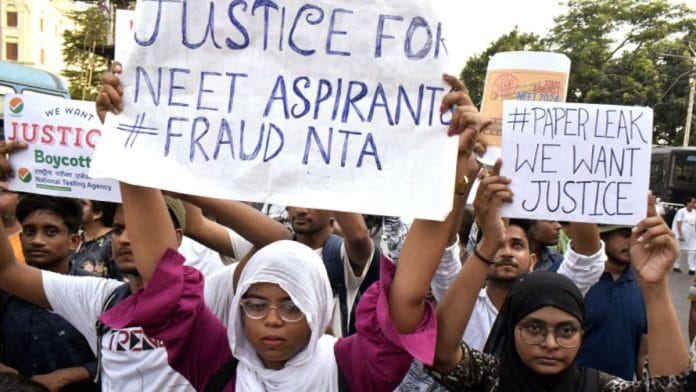
The report follows a difficult year for the NTA. The agency, set up in 2018 by the Bharatiya Janata Party-led NDA government, came under fire as the NEET-UG examination held this year was cancelled after a paper leak following which a re-test was ordered, the latest in a series of disruptions that drew protests from students and parents.
The National Assessment and Accreditation Council (NAAC), in charge of grading higher education institutions, has faced a separate controversy over a bribery case involving members of an inspection team.
On NAAC, the committee called the bribery scandal “deeply concerning” and sought “a full investigation into the scandal, the background of the members of the accused NAAC team, the process by which these members were chosen.” The government said the matter was under investigation by the CBI. It said “NAAC had tightened its assessment process, including finalising inspection teams closer to the visit date, moving college assessments online, and recording proceedings of meetings.”
(Edited by Viny Mishra)
Also read: Telegram architecture conducive to amplification of content—why HC upheld ban for NEET retest