





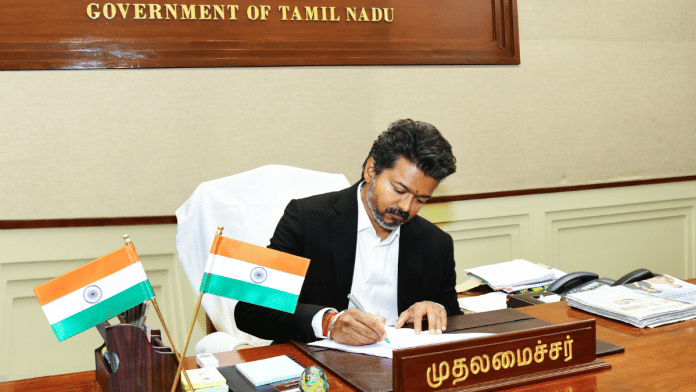


Chennai: Tamil Nadu Chief Minister C. Joseph Vijay’s first official visit to Delhi to meet Prime Minister Narendra Modi and Union Finance Minister Nirmala Sitharaman within a fortnight of taking office was more than a routine courtesy call.
The meeting highlighted that despite the change in governance, Tamil Nadu’s stance on several of the state’s long-standing issues with the Centre has not changed.
Vijay’s visit, less than a month after taking oath, however, highlighted his willingness to engage assertively with the Centre even as he prioritises Tamil Nadu’s cultural and regional interests, said analysts and commentators who spoke to ThePrint.
The issues raised by Vijay were in line with what the previous Dravida Munnetra Kazhagam (DMK) or All India Anna Dravida Munnetra Kazhagam (AIADMK) governments had already taken up with the Centre, maintaining the federal stance taken by the state, they said.
They added that the message from Vijay’s visit is that Tamil Nadu’s core position on state issues do not change with the government, and that he is not softening on these key issues.
From the Mekedatu Dam dispute on the Cauvery to the arrest of Tamil fishermen by the Sri Lankan Navy, pending metro rail approvals and Institutes of National Importance, every issue on Vijay’s agenda has been carried forward from the DMK and AIADMK governments before him.
On the Mekedatu project, Vijay opposed Karnataka’s recent Bhoomi Pooja announcement as a violation of the Supreme Court’s judgment and the Cauvery Water Disputes Tribunal award, urging the Prime Minister to direct the Ministry of Jal Shakti and the Central Water Commission against approving the project without the consent of Tamil Nadu, Kerala, and Puducherry.
“The DMK and AIADMK repeatedly approached the Centre and Supreme Court, and held all-party meetings urging the Union government not to approve the project without Tamil Nadu’s consent. Vijay’s intervention continues this established state position,” political analyst Sunil Kumar told ThePrint.
Political analyst Ramu Manivannan set a definitive benchmark for the visit’s success. “He (Vijay) should be ensuring that the Karnataka government does not proceed with the Mekedatu Dam project. If this visit can secure even a basic assurance, or at least convey a sense of shared concern from the Centre on that issue, then the visit can be considered successful. Otherwise, it remains merely posturing,” he said.
On fishermen, 12 incidents of arrest by the Sri Lankan Navy have been recorded in 2026 alone, with 58 fishermen and 266 boats in custody. Vijay’s appeal to Prime Minister Modi for diplomatic intervention mirrors the letters his predecessor M.K. Stalin had written on the same issue. “These appeals reflect that the new government still holds on to state issues and that regional issues remain his priority. This is also a reminder of Vijay’s poll promises of giving priority to vulnerable communities like farmers and fishermen,” added Sunil Kumar.
Regionalism and state interests
From the Day 1 of the TVK government, the issue of Tamizh Thaai Vaazhthu, the traditional Tamil invocation song, became a controversy after it was played third at the swearing-in ceremony after the National Song and Anthem. The issue invited criticism of the new government and Tamil Nadu minister Aadhav Arjuna had to clarify that the government would ensure Tamizh Thaai Vaazhthu gets priority.
The issue being raised by Vijay with the Union government reflects his government’s stance on protecting regional cultural identity. This stance comes amid confusion created by a recent Ministry of Home Affairs circular emphasising the National Song, positioning Vijay as the one trying to defend Tamil pride and culture. Vijay has sought clarity to ensure the Tamil Thaai Vaazhthu continues to be rendered first at official functions in Tamil Nadu.
Previous governments have also defended the primacy of the state song as a matter of cultural pride and federal tradition; the issue resonates deeply with the public. By placing cultural identity alongside economic demands in his opening conversation with the Centre, Vijay is signalling that Tamil pride will remain a priority of the government.
Infrastructure push and familiar delays
Vijay maintains continuity in seeking Central funds for the state’s infrastructure development projects. On economic development, he has pushed for central funding for Metro Rail projects in Chennai, Coimbatore, Madurai, and Hosur, defence infrastructure, including facilities for the Centre for Airborne Systems and the Advanced Medium Combat Aircraft, and Institutes of National Importance for Tamil Nadu during his meeting with the finance minister.
The previous DMK government had flagged delays in approvals and central funding for Chennai Metro Phase II, and sought expansion to other urban centres. Vijay’s advocacy of the same reflects his developmental priorities while underlining delay by the Union Government, all sans confrontation.
Political commentator Mukund Padmanabhan echoed that it is significant is that Vijay wants a non-confrontational approach with the Centre and is making moves to maintain his stability. “The issues he has flagged are not new and they are kept in consideration of state interests and have been raised earlier. However, on these issues, the Centre might be wary of his alliance with the Congress.”
While Vijay’s early visit to Delhi shows that he is interested in a dialogue with the Center, there are other complications ahead. Political analyst Ramu Manivannan points out that the new government has been in office for barely 15 days, and Vijay is still understanding the real challenges of governance in a complex state like Tamil Nadu. “He has to tread very carefully in dealing with the Union government while maintaining a Congress alliance. The government’s biggest challenge will be maintaining a delicate balancing act with the Centre, especially on crucial fiscal relations — whether in education policy or the sharing of financial responsibilities between the Union and the state.”
(Edited by Nardeep Singh Dahiya)
Also Read: Is Vijay’s TVK ideologically bankrupt?