







New Delhi: Forty-eight cases of collapses, structural failures and major deficiencies on National Highway (NH) projects have been reported over the past five years, according to the road transport ministry, raising fresh concerns over construction quality and project supervision.
The Ministry of Road Transport and Highways informed the Rajya Sabha Wednesday that the 48 incidents reported between 2021 and 2026 were linked to poor workmanship, poor design and inadequate supervision. Of these, 19 were reported in 2025 and this year, with Kerala accounting for the highest number of recent incidents, followed by Uttar Pradesh, Maharashtra and Madhya Pradesh.
The disclosures come weeks after the newly inaugurated Lucknow-Kanpur Expressway came under scrutiny when a nearly 300-metre stretch developed surface slippage shortly after the project was opened on 13 July.
The government subsequently initiated action against concessionaire PNC Infratech Ltd, the project’s independent engineer, and officials responsible for monitoring and supervising construction.
Penalties for damages
In a written reply to questions by Rajya Sabha MPs Kapil Sibal and Imran Pratapgarhi, Road Transport and Highways Minister Nitin Gadkari said action had been taken against defaulting agencies.
“Action against defaulting agencies has been taken as per the provisions of the Contract/Concession agreement in case of collapses, failures and deficiencies, such as termination of contract agreement, levying of penalties/liquidated damages, debarment/blacklisting, declaring as non-performers including declaring failure as ‘Catastrophic’,” the reply stated.
Among the recent cases listed by the ministry, the highest financial penalty of Rs 119 crore was imposed on a contractor for premature pavement failure on the Bhopal-Biaora section of NH-46 in Madhya Pradesh.
In Gujarat, a contractor was fined Rs 2.8 crore and recommended for debarment after cracks and severe rutting were found on the Sanchore-Santalpur stretch.
Kerala recorded the highest number of quality-related failures in 2025, with seven reported cases. The government imposed cumulative penalties of Rs 31.2 crore on contractors, while some were debarred and engineers suspended over the defects.
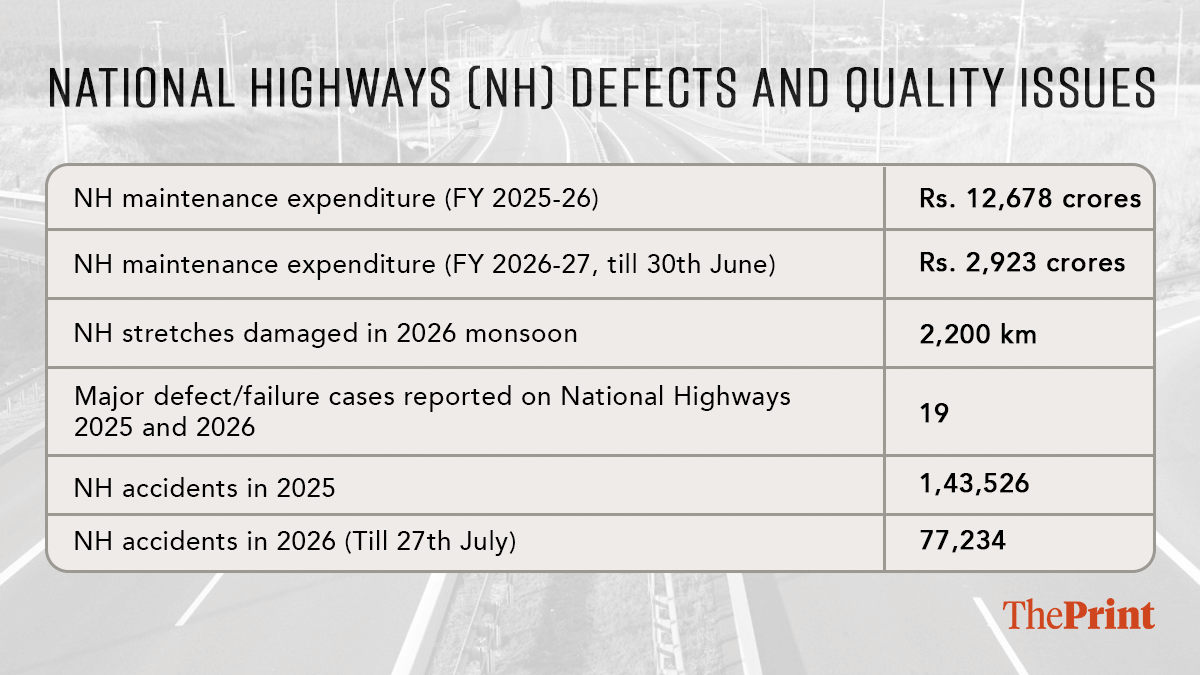
The replies also showed that the Centre spent Rs 12,678 crore on maintenance and repair of national highways in 2025-26. The government has allocated Rs 13,000 crore for the current financial year, of which Rs 2,923 crore had already been spent by June-end.
Separately, Gadkari informed Parliament that around 2,200 km of national highway stretches have been damaged this year due to monsoon rains, floods and landslides, with the expenditure in the first quarter including repairs to these stretches.
The ministry also reported 1,43,526 road accidents on national highways during 2025, while another 77,234 accidents were recorded until 27 July 27, according to provisional Electronic Detailed Accident Report (e-DAR) data.
On measures to improve construction quality, Gadkari said consultants and National Highway Authority of India (NHAI) engineers are deployed for day-to-day supervision of projects, while officials of executing agencies carry out periodic inspections to ensure compliance with Indian Roads Congress standards.
“All efforts are made to ensure that the NHs are constructed as per stipulated quality standards specified in the Indian Roads Congress (IRC) specifications and codes,” the minister stated in the reply.
He added that to ensure that highway construction adheres to stipulated quality standards, consultants, authority engineers/independent engineers are appointed by the executing agencies for day-to-day supervision of works at sites.
The Centre said it had also strengthened oversight through independent audits and technology-driven monitoring.
Gadkari said third-party quality auditors are deployed for independent quality audits of National Highway works during different stages of project implementation to ensure contractors meet prescribed standards,
The government has also rolled out machine-aided construction, mandatory road-condition assessments through Network Survey Vehicles, the NHAI One App for geo-tagging defects, AI-enabled drone monitoring and Mobile Quality Control Vans equipped with non-destructive testing equipment, currently being piloted in Gujarat, Rajasthan, Odisha and Karnataka.
(Edited by Sugita Katyal)
Also Read: Fadnavis floors the pedal, wants network of new roads and tunnels in Pune ready by 2028