








Mumbai: With service disruptions reigniting concerns over the reliability and maintenance of Mumbai’s Monorail, the Mumbai Metropolitan Region Development Authority (MMRDA) announced Friday that safety certification had been obtained for the Monorail’s new rolling stock (RST).
This new stock comes with a new signalling system—communications-based train control (CBTC)—considered more advanced than the previous one.
The CBTC system entails continuous wireless communication to track train locations in real-time, allowing trains to run closer together, but safely. The previous track-circuit-based technology used the tracks themselves as electrical conductors to detect a train’s presence.
According to the MMRDA, an independent safety assessor (ISA) issued the safety certification after the successful completion of factory-level inspections, trials, and extensive static and dynamic testing of the newly introduced trains.
The MMRDA, however, is yet to announce a clear timeline for when the monorail will be operational.
The Mumbai Monorail, which had started operating in 2014, covers nearly 20 km, stretching from Chembur in eastern Mumbai to Sant Gadge Maharaj Chowk (Jacob Circle) at Byculla. In 2025, passengers on the monorail witnessed three sudden service halts—two in August and another in September—triggered by power disruptions and technical faults.
On 16 September last year, a day after the third incident, the MMRDA announced the temporary suspension of Mumbai monorail services until further notice. It aimed to investigate the technical failures, introduce a comprehensive system upgrade, and integrate new infrastructure.
“The suspension will facilitate the commissioning of new rolling stock, implementation of advanced communications-based train control (CBTC) signalling, and refurbishment of the existing fleet of monorail trains,” the MMRDA’s statement read at the time.
The installation and testing of the CBTC signalling system, which has been tested across multiple sections of the monorail corridor over the past two months to validate system integration and operational readiness, is similar to what’s deployed on the Egypt Monorail.
The Monorail in Egypt also deploys real-time, bidirectional communication between trains and the central control system, which enables automatic train supervision (ATS), centralised traffic control, and real-time monitoring, providing automatic speed regulation and faster recovery from disruptions.
Deputy Chief Minister Eknath Shinde, Chairman of MMRDA, called the safety certification “a definitive assurance of MMRDA’s commitment to providing a secure and modern travel experience for every Mumbaikar”.
Chief Minister Devendra Fadnavis called it “a reflection of Maharashtra’s uncompromising commitment to commuter security and indigenous innovation.”
Sanjay Mukherjee, Metropolitan Commissioner, MMRDA, said, “The modernisation of the Mumbai Monorail is a cornerstone of our broader ‘Mumbai in Minutes’ vision, where seamless connectivity meets cutting-edge technology. This successful safety certification of the new rakes and CBTC signalling is not merely a technical upgrade; it is a testament to our resolve in transforming legacy infrastructure into a future-ready transit asset.”
New upgrades—past disruptions
In addition to standard testing, the MMRDA has conducted several overarching testing series for advanced features to enhance passenger experience. These include spacious interiors, disability-friendly or “divyang-friendly” seating, LED lighting, charging sockets, and an advanced suspension system.
Furthermore, the upgrades include automatic fire detection systems, CCTV surveillance, real-time monitoring systems, improved couplers, and event recorders, ensuring enhanced safety and reliability.
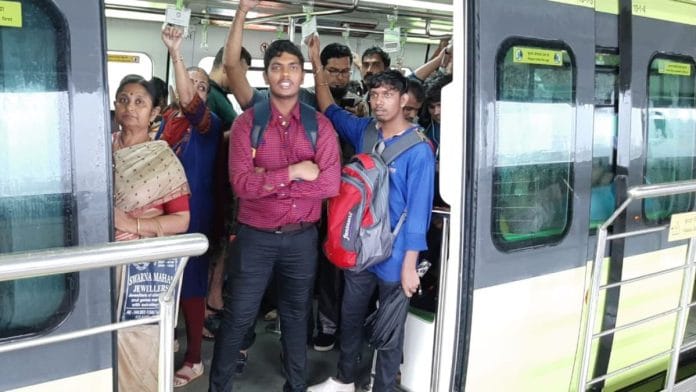
In 2025, the Mumbai monorail came to abrupt halts three times—twice in August and once in September—due to power failures and technical snags. Although the 15 September incident was managed by bringing another train on the neighbouring line to safely evacuate the 17 passengers on board, the incidents in August were rather dramatic.
On 19 August, between 6 pm and 6.30 pm, the monorail broke down for the first time at a bend in the track near Mysore Colony station, leading to the Mumbai fire brigade rushing to evacuate 582 passengers in a nearly three-and-a-half-hour operation. After the incident, several passengers complained of suffocation and were treated by doctors on site.
Nearly an hour later, at 7.30 pm, another monorail abruptly halted between Acharya Atre station and Wadala station, stranding 200 passengers. The rake was then towed down to Wadala station, where the passengers were safely evacuated.
Following the two incidents in August, the MMRDA constituted a committee to look into the failures and suspended two officials. Along with them, the authority introduced fresh guidelines to address issues related to technical glitches and overcrowding.
On 21 August, two days after the two incidents, a train stopped for at least 12 minutes at Acharya Atre Chowk station to offload passengers and avoid overcrowding.
Also Read: Rs 47,000 cr push for Mumbai infra as MMRDA tables first surplus budget in nearly a decade
Resume ‘shortly’
Currently, the urban development department of the Maharashtra government has yet to appoint an engineer to conduct a detailed inspection of the entire Mumbai Monorail corridor. The engineer’s assessment will be followed by the grant of the final statutory certification required for resuming passenger operations.
According to the MMRDA, “Monorail services with the new rolling stock (RST) are expected to resume shortly” once the final clearance is received, with a definitive date yet to be announced.
The MMRDA said it “remains fully committed to restoring safe, reliable, and efficient Monorail services at the earliest, ensuring enhanced connectivity and convenience for the citizens of Mumbai”.
MMRDA’s Mukherjee said, “By prioritising ‘Make in India’ and indigenous innovation, we are ensuring that the Monorail operates as a high-performance link within our integrated multimodal network to guarantee that every Mumbaikar experiences a commute defined by global standards of safety, reliability, and dignity.”
The question remains whether the Mumbai Monorail, often referred to as the “white elephant” due to its low ridership, high operating costs, and frequent breakdowns, will be able to sustain the city’s growing demand, with its new features and upgrades.
(Edited by Madhurita Goswami)
The author should write an article on Mumbai’s infrastructure every week. Obviously this is a request because It’s important to call out these things.
It would be great to keep this government liable for the next 5 years since it has no excuse. I don’t expect things from Congress or UBT so the only hope I see is in BJP and its important for media to give regular updates on infrastructure projects.
Thanks to the author for covering it in the past as well.