



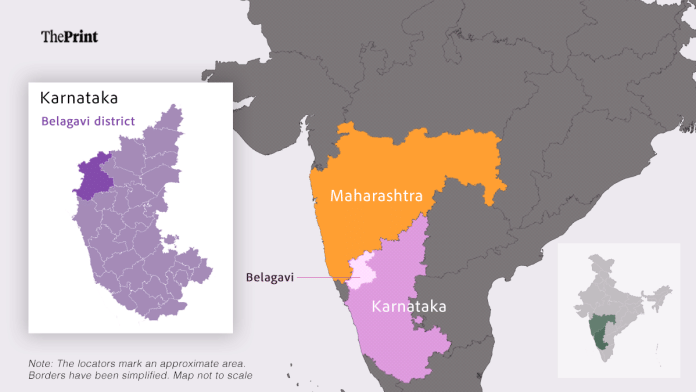
New Delhi: For decades, Belagavi—known as Belgaum before 2014—has been at the centre of a dispute between Karnataka and Maharashtra, dating back to the reorganisation of the states in 1956, when boundaries were drawn largely along linguistic lines.
Every year on 1 November, Karnataka celebrates the Kannada Rajyotsava or Karnataka Rajyostava, marking the state’s formation in 1956. And every year, the occasion brings renewed attention to the complex debate over Maharashtra and Karnataka’s territories along their shared border.
While the Maharashtra government and pro-Marathi groups have asserted over the years that Belagavi and several other dominantly Marathi-speaking areas, like Karwar and Nipani, should be included in Maharashtra’s territory, Karnataka government and pro-Kannada groups have upheld that these regions are an integral part of their state.
The matter has been a source of friction between the states for generations, one that has often resulted in incidences of violence and vandalism.
What happened in 1956?
The dispute over Belagavi, Karwar and Nipani in North Karnataka dates back to the reorganisation of states based on language.
In colonial times, several districts that are now part of Karnataka — Vijayapura, Belagavi, Dharwad and Uttara Kannada — were under the erstwhile Bombay Presidency.
The 1956 reorganisation followed the recommendations of the States Reorganisation Commission, headed by former Supreme Court judge, Justice Saiyid Fazl Ali. Appointed in 1953, the commission submitted its report in 1955. Under States Reorganisation Act 1956, Belagavi and 10 taluks of the Bombay Presidency were deemed to be part of Mysore state, which was renamed Karnataka in 1973. The decision was based on an 1881 census that identified 64.39 percent of the population of Belagavi as Kannada-speaking and 26.04 percent as Marathi-speaking.
However, the inclusion of Marathi-speaking areas in then Mysore state did not go uncontested. Maharashtra maintained that regions where Marathi was the dominant language should have been integrated within its boundaries.
In September the following year, the then Bombay government formally raised objections with the Centre, seeking a realignment of its boundary with Mysore state. The disagreement led to the appointment of a commission to examine the competing claims.
Maharashtra’s argument relied on the village as the unit of calculation, with linguistic populations assessed at village level. It pointed to the use of Marathi in revenue records in these areas, while also extending its claim to areas such as Karwar and Supa—where Konkani is spoken—arguing that Konkani is a dialect of Marathi.
Karnataka, on the other hand, maintained that the boundaries settled under the 1956 Act were final and should not be reopened. It argued that the reorganisation was neither tentative nor flexible.
Also Read: Mysuru Dasara adds to Wadiyars’ feud with ‘vindictive’ Karnataka govt. ‘Deeply disappointing’
1966 Mahajan Commission & its recommendations
Following Maharashtra’s objections, the Centre, in October 1966, appointed the one-member commission of former Chief Justice of India Mehr Chand Mahajan, tasked with examining border disputes involving Maharashtra, Karnataka and Kerala.
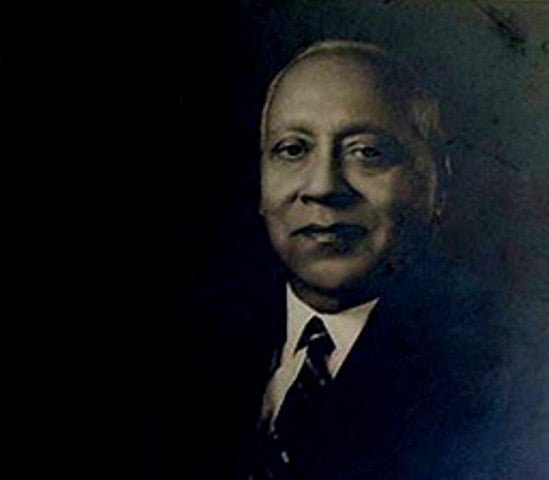
In the report submitted in August 1967, Justice Mahajan recommended that 264 villages be transferred to Maharashtra, while Belagavi and 247 other villages must remain with Karnataka.
The recommendations, however, failed to bring the two states to an agreement.
Maharashtra rejected the report, calling it biased, and demanded a fresh review. Karnataka, meanwhile, welcomed the recommendations, and has since maintained that the report should either be implemented in full, or the existing territorial arrangement be retained.
The disagreement over the report continues to be an important part of the dispute. Karnataka cites the Mahajan commission’s findings to support its position, and Maharashtra challenges them.
Four generations, one border dispute
Belagavi is the most prominent point of contention between the two states. Maharashtra has continued to assert its claim to 865 Marathi-speaking villages along its border with Karnataka, including Belagavi city. Its demands extend to several villages in districts, such as Uttara Kannada and Bidar.
The dispute has actively played out in political and cultural spheres.
The Maharashtra Ekikaran Samiti (MES), whose goal is the merger of Belagavi and other areas with Maharashtra, has had a political presence in the region since the early years after reorganisation.
Karnataka has taken steps to underline its administrative presence in the region. Since 2006, the state has held the winter session of its legislature in Belagavi, for which it constructed the Suvarna Vidhana Soudha in the district headquarters in 2012.
MES has been staging protests since September 2006, when Karnataka’s legislature session was held in Belagavi for the first time.
The issue has also found expression via cultural events. The 73rd Akhil Bharatiya Marathi Sahitya Sammelan and the 70th Akhil Bharatiya Kannada Sahitya Sammelana were held in Belagavi in 2000 and 2003, respectively.
In Belagavi, the lines between Kannada and Marathi cultures often blur in the most ordinary ways. Marathi tamasha finds an audience alongside Kannada theatre, languages & traditions intermingle in homes, local markets & the eateries selling Pav Bhaji—Belagavi style. For people, this intertwine of identities is less “adjusting” to the culture, and more a way of life.
According to Indrajit Vasantrao Sawant, president of the Sahyadri History Research Centre, there were never any major differences between Marathi- and Kannada-speaking populations before the reorganisation owing to their shared culture—language being the primary point of distinction.
“Almost four generations have witnessed this border dispute,” he told ThePrint.
The demand for a united Maharashtra, expressed through the slogan ‘Samyukta Maharashtra Pahije (we want a united Maharashtra)’, extended to areas including Balki, Bidar, Karwar and Belagavi, he added.
He further said that the economic significance of these regions is an important factor in why neither state is willing to give up its territorial claims.
The day marking Karnataka’s formation, 1 November, is observed as a Black Day by sections of the Marathi-speaking population in the disputed region.
Sawant said that various instances of protests and violence have been witnessed on the day over the years, but the intensity has subsided over time. On some occasions, shutdowns were also observed in Maharashtra’s Kolhapur, Solapur and Sangli.
Ashok Chandargi, president of Belagavi District Kannada Organisations Action Committee and member of the Karnataka Border Development Authority, told ThePrint that the hunger strike by ‘Senapati’ Pandurang Mahadev Bapat, freedom fighter and a prominent leader of the Samyukta Maharashtra movement, in Mumbai in the mid-1960s had put then Prime Minister Indira Gandhi under pressure, prompting her to call then chief ministers of Karnataka and Maharashtra, S. Nijalingappa and V.P. Naik, for talks. This had eventually led to the appointment of the Mahajan Commission.
Chandargi said the MES had its strongest political influence through its representation in the Karnataka Assembly. However, it lost all its seats in the 1999 elections, eventually weakening its hold over Belagavi.
On instances of violence in the region, Chandargi told ThePrint that the last deadly communal clash had taken place in 1986. Kannada newspaper offices, water supply boards and pumping stations were set on fire, followed by cross-firing between the two groups. The violence had claimed eight lives under the tenure of then Belagavi Superintendent of Police R. Narayan, he said.
A few years ago, in 2021, Belagavi had witnesses another flare-up between pro-Marathi and pro-Kannada groups, involving the desecration of statues of several iconic historical figures—Sangolli Rayanna, Kittur Rani Chennamma, Basavanna and Chhatrapati Shivaji—in the region, and the burning of a Kannada flag in Maharashtra.
Last year, five people were reportedly stabbed during a Kannada Rajyotsava procession in Belagavi.
Current status of the dispute
In April 2004, the State of Maharashtra had approached the Supreme Court, seeking the transfer of disputed territories on the basis of linguistic population, geographical contiguity, and the village as the unit of calculation.
Karnataka contested Maharashtra’s demand, maintaining that Belagavi’s inclusion in the state was settled through the 1956 reorganisation, and subsequently examined by the Mahajan Commission.
The dispute remains unresolved, with Maharashtra’s 2004 petition still pending before the Supreme Court. The case was last listed in the apex court on 27 October, 2025, but the hearing saw no outcome and the case was adjourned to no particular date.
In September this year, Maharashtra sought an early hearing in the case, arguing that pleadings had been completed, and that the matter should now be listed for hearing. A bench comprising Chief Justice of India Surya Kant and Justices Joymalya Bagchi and V. Mohana heard the request. The CJI said he would examine the matter, but could not assure a listing.
Attempts have also been made to resolve the disagreement through discussions between the two state governments, with the Centre acting as facilitator.
Union Home Minister Amit Shah, on 14 December, 2022, met then chief ministers of both states, Basavaraj Bommai & Eknath Shinde, and asked them to constitute a six-member team—comprising three ministers from each state—to address the boundary issues.
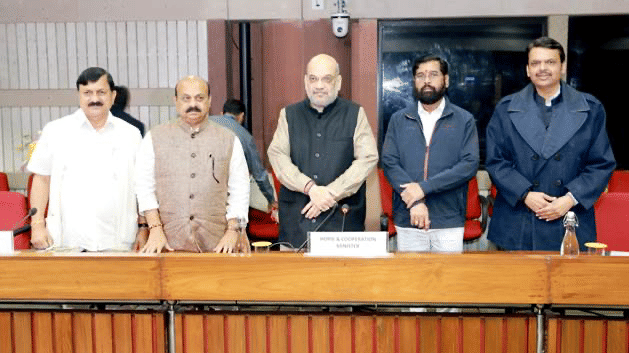
Shah later said that it was also agreed in the meeting that neither state would claim each other’s land till the Supreme Court’s judgement in the matter, which remains pending years later.
(Edited by Mannat Chugh)