





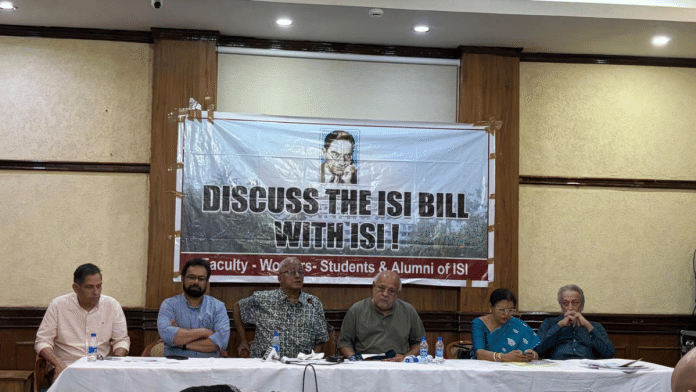


New Delhi: Faculty members of the Indian Statistical Institute (ISI) from Kolkata and Delhi, along with Opposition MPs, demanded Wednesday that the ISI Bill, 2026, introduced in the Lok Sabha Monday, be referred to a Joint Parliamentary Committee (JPC). They alleged that the proposed legislation undermines the autonomy of one of India’s premier academic institutions.
At a press briefing in New Delhi, professors from ISI argued that the Bill had been drafted without meaningful consultation with the institute’s statutory bodies and would fundamentally alter its governance structure by concentrating powers in a government-backed board of governors. They urged Parliament to undertake wider stakeholder consultations before taking up the legislation.
Professor Arijit Bishnu of ISI Kolkata said the institute, established in 1931 had played a foundational role in building India’s statistical ecosystem, including contributing to the Second Five-Year Plan and conceptualising the National Sample Survey Organisation (NSSO). Given its legacy, any structural overhaul should have come after discussions with the institute, he said.
“The three statutory bodies of ISI which are the ISI Society, the ISI Council and the academic council have all expressed reservations about this Bill,” Bishnu said.
Describing the legislation as a “top-down Bill being thrust on us”, Bishnu said its implementation would create administrative chaos by forcing the institute to rewrite its rules and regulations.
He also alleged that the proposed Bill would take away the institute’s democratic system of electing academic administrators and would also affect its long-standing policy of providing free education and stipends to students.
The faculty members received support from Opposition MPs, including Congress Rajya Sabha MP Praveen Chakravarty and CPI(M) Rajya Sabha MP John Brittas, who accused the government of attempting to centralise control over an institution that plays a critical role in India’s statistical system.
“It is not only a capture of an institution such as the IIMs and the IITs, but this plays an even more integral role in our country as ISI acts as the data watchdog,” Chakravarty said, adding that ISI serves as an adviser to the Ministry of Statistics and Programme Implementation for the country’s statistical system.
“If you tie the watchdog so that it cannot bark, then you have nobody watching,” he said.
Terming the proposal a serious matter, Chakravarty said the Congress would strongly oppose the Bill in Parliament and urged the government not to capture yet another autonomous institution without wider deliberations.
Brittas echoed the demand for parliamentary scrutiny, saying the Bill should be referred to a JPC to enable “much more scrutiny”. He alleged that the legislation reflected a broader trend of centralisation, arguing that the proposed law was “detrimental for the institution, the autonomy and also the larger ecosystem of the institution”.
Govt rejects allegations
The government, however, has rejected the allegation that the proposed law weakens ISI’s autonomy.
A senior government official, who did not want to be named, told ThePrint that the proposed legislation was intended to reform an outdated governance structure.
“The Act will ensure greater autonomy to the board of governors. What it is taking away is the autonomy of the ISI Society, which comprises around 1,800 members,” the official said.
According to the official, the existing governance structure has made reforms difficult and limited the institute’s ability to expand academic programmes and student intake.
The official said the proposed legislation replaces the existing governing council with an 11-member board of governors comprising four internal members, four external experts, a chairperson and two government nominees.
It also seeks to provide greater autonomy to the Delhi and Bengaluru centres, formally recognise the academic council under the Act, and expand academic programmes into emerging areas such as cryptology, biostatistics and data science, the official added.
Rejecting claims of excessive government control, the official argued that the Bill actually reduces the role of the ISI Society, a body of around 1,800 members. It also shifts decision-making to a smaller board of governors instead of a 33-member council.
The government also maintained that it held extensive consultations over the past year, receiving more than 600 public comments with nearly 50 percent from faculty members, before finalising the legislation.
According to the official, the reforms are intended to prepare the institute for its 100th anniversary in 2031 by making it more agile, improving governance, expanding student intake and enabling it to respond to emerging disciplines while preserving its core focus on statistics.
(Edited by Viny Mishra)