





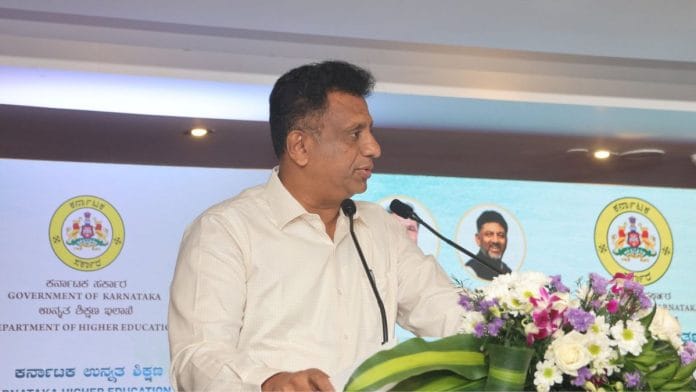


Bengaluru: The award of honorary degrees is set to be regulated by the government in Karnataka now, with the constitution of a committee to frame guidelines for the same. Set up by Governor Thawar Chand Gehlot, the all-new panel will study the issue, frame guidelines and streamline the process.
In the dock are some institutes of higher learning. “Some universities are giving honorary doctorates left, right… and it is losing its value. The committee will check how this needs to be done, with guidelines and other parameters. Depending on the suggestions, we will move forward,” Karnataka Minister for Higher Education M.C. Sudhakar told ThePrint.
The debate centres on the prefix ‘Dr’, which used to signify years of rigorous education in a specialised field, a doctoral degree, or significant contributions to a specific field. It’s common, however, for political leaders in India to sport these prefixes.
“We get so many recommendation letters and applications for honorary doctorate degrees. Even though we are restricted to giving out just three per year, there are times that we may have given more than this number due to pressure from the government or some individual,” said the vice-chancellor of a state-run university in Karnataka on condition of anonymity.
This year has been no different. Last month, the Dr Manmohan Singh Bengaluru City University (earlier known as Bengaluru University), awarded honorary degrees to six persons, including late Prime Minister Manmohan Singh.
The list included Congress Member of Legislative Council K. Govindaraj, who was removed as the Karnataka Chief Minister’s political secretary in June last year after the Chinnaswamy Stadium stampede, and Janata Dal (Secular) leader B.M. Farooq. Govindraj received the honorary doctorate for his contribution to sports administration while Farooq was recognised for his contribution to business.
The government says that it has no compiled figure of how many such honorary doctorates some public universities have handed out. The bigger problem, it adds, is that the same individual receives honorary degrees from multiple public universities.
Not only does the practice tick several boxes, but it also crosses borders as foreign dignitaries are regularly awarded such degrees. In May 2017, Jamia Milia University decided to confer an honorary doctorate to Turkey President Recep Tayyip Erdogan amid protests against the move.
Erdogan is quite the champion of this process, having collected honorary degrees from nearly 40 universities worldwide since 2004, including Istanbul University, Moscow State University, Qatar University, Addis Ababa University, and Pakistan’s Quaid-e-Azam University, as per a report in The Indian Express.
Also Read: From Sathanur to Bidadi, how Shivakumar-Deve Gowda rivalry has shaped Karnataka politics in 40 years
‘Interference of influential people’
Several former doyens of Karnataka politics have been conferred such honorary doctorates, including former Prime Minister H.D. Deve Gowda and ex-Chief Minister S.M. Krishna among others.
D.V. Parasivamurthy, the vice chancellor of state-run Kannada University in Hampi said that the Karnataka Governor has limited honorary doctorates to an annual total of three. “Some years, there are instances when the governor has rejected all recommendations and no such degree has been awarded,” Parasivamurthy said. He added that the guidelines would serve well to check the growing problem sometimes caused due to the interference of “some influential people”.
He said that the university receives several applications every year, sometimes accompanied by recommendation letters. “Once we receive them, the same applications are placed before the Governor-appointed committee.” He said that various parameters are applied for consideration, including caste, region, work and the candidate’s contribution to their area of work. Once this is done, the committee shortlists about 10 candidates.
“Then it goes to the governor with the committee’s recommendations. But no one will know who the shortlisted candidates are as it is sent in a sealed envelope,” Parasivamurthy explained, adding that the governor reads the list only when the date of the convocation approaches, and signs off on who he thinks are eligible. Only then do the universities make public the names of those who will receive the honorary degrees, he said.
(Edited by Nardeep Singh Dahiya)